Independent payments architect · Amsterdam
Every term of a Build, on one page and fixed before work starts
You can approve a Build from this note alone: the proposal names your payment flow and adds detail, never a different term.
Who you are approving
The name at the foot of this note is the only name on the work: I do all of it, with no junior, no subcontractor and no second party.
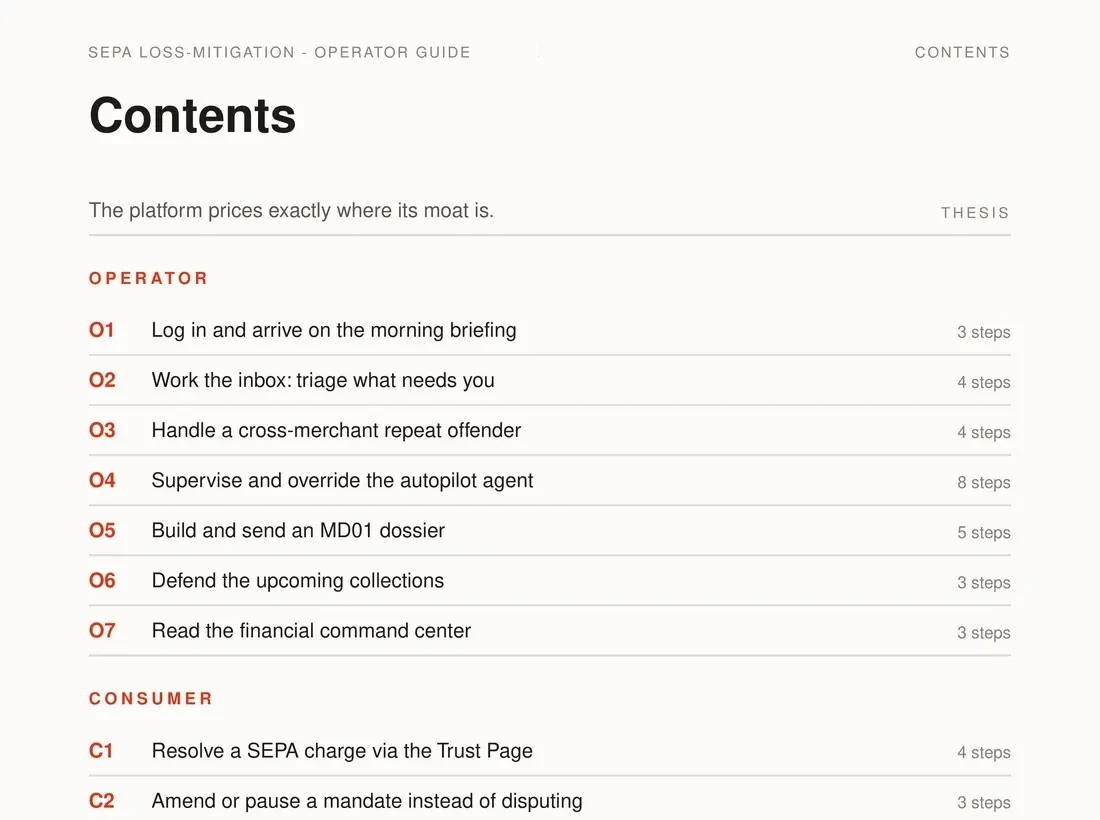
The work closest to what you are approving is my latest project for a client:
one payment flow, designed and built
for an EY-accelerated, funded startup in Amsterdam with a PostNL pilot and a Mollie partnership,
from 10 March to 26 June 2026,
ending in the flow handed over, with its manual and a written procedure for each named failure.
What you are approving
In a Build I take one payment flow of your business, such as refunds, payouts or collecting a subscription each month, from its design to a working system.
For a payout, refund or settlement flow, the Build starts from Bilanx, my own platform, set up on your own bank and processor, with no licence fee; for any other flow it starts from a specification I have read and accepted, and where there is none, the deciding is done inside the Build, or a Design comes first.
A Build ends in:
- your payment flow, working in your code repository and in your development and staging systems, where software is built and tested before it goes live;
- the acceptance criteria: pass-or-fail tests you and I sign before I start building, each worded so it can fail;
- a manual for whoever runs it, and a written procedure for each named failure;
- the procedure for moving it into your live systems and back, rehearsed before it is used;
- the record of the decisions taken and what each was chosen against;
- a handover document saying what exists and what is left;
- where your flow acts on your customers to keep money, its own measurement of what it keeps, against customers it leaves alone on purpose.
Fee, duration and access
- Fee
- From €75,000 Excluding VAT, with nothing added on top: no expenses, tools or licences, and travel within the European Economic Area included.
- How the fee is set
- The proposal sets the exact fee against what your payment flow governs, in your own numbers:
- what runs through it,
- and what a break in it would cost you. The proposal also names what moves the fee.
- Once you sign
- The fee is fixed: complexity, overrun or a defect of mine never adds to it. Anything outside the signed scope is quoted as its own engagement before it starts.
- Duration
- Eight to twelve working weeks, counted from the day the specification is accepted and the acceptance sheet signed and your development and staging systems are ready for me to build in. The proposal names the scheduled acceptance date.
- Access
- Working access to
- the code the proposal names,
- the tools that build and test it,
- and your development and staging systems.
The four payments
Me
Your side
Your code repositoryYour staging systemEvery payment after the first is released by something you can see in your own systems.
- Purchase order
- Accepted at any amount, and the Build does not wait for the money.
- Stopping
- At any time, in writing. You pay only for completed milestones and keep everything produced.
- Ownership
- Everything the Build produces becomes yours milestone by milestone as each is paid, and outright on acceptance. Bilanx, where the Build starts from it, stays mine, and you have a permanent, free right to use, copy and change it.
- Where the work lives
- In your own code repository, accounts and documents, from the first day.
How the Build is accepted
Every criterion passes, or I keep working at no further fee for thirty more business days. After that you choose a new written plan or cancel, keeping every paid milestone and the whole repository, and the final 20% is not due.
- At acceptance
- The release is built from your own repository, every criterion is run in your own staging, and the evidence is kept on your side.
- Who runs the criteria
- Whoever the proposal names: a person you name, or me with you watching. The three that prove it runs without me,
- the reproducible build,
- the operating tasks from the manual
- and the rollback,
- My recorded run
- For the end-to-end version and for acceptance, my own recorded run in your staging and its evidence reach you first, so you can run the step on your side or name a failure, and you have ten business days from my notice to do either before the step counts as done.
The scheduled acceptance date
Going live, and after
Whoever runs it can run, change and explain it without me, from its manual and its written procedures.
- Going live
- Your people move it into your live systems from the rehearsed procedure, with me on the call the day it moves live. Where you want me to, I walk each step of the procedure with them, as the proposal names.
- Questions while it runs
- For twenty business days after, whoever runs it gets my written answer to their on-call questions within four business hours.
- Your next supplier
- For twenty business days, I answer their questions in writing, at no fee.
- Later changes
- If you want each later change checked against what was decided, a Standing Review does that, a month at a time.
Unavailability, confidentiality and paperwork
- If I am unavailable
- At five working days, every delivery date, clock and calendar payment date on the Build pauses, with no date missed while they are paused, and you are told that day. Past fifteen, you may end the Build, keep everything produced and pay only for the work already done.
- Confidentiality
- I sign your NDA, and nothing of yours reaches a service you have not approved in writing. The Build includes six months of no work for one competitor you name, on the same kind of payment flow.
- Your supplier register
- The proposal comes with a one-page entry for your register of suppliers.
- Paperwork
- Whoever reviews it for you can redline it. Anybody who asks gets the whole note: I send it by email when you ask, by the end of the next Amsterdam business day.
How to start, and where to reach me
A Build starts with one short, plain paragraph about your payment flow, saying what is going wrong in it or what has to be decided. It needs no specification.
My reply comes by the end of the next Amsterdam business day. It names the first thing I would check in your flow, the engagement that fits and its published price, and the next document with the date it lands, or, where something else would serve you better, what that is.
By email to faruk@farukkurt.nl, or by WhatsApp to +31 6 18652394.
Book half an hour on my booking page, or ask for one by phone or WhatsApp on +31 6 18652394, and I phone you at the time you pick.
Build approval note October 2026 Faruk Kurt Independent payments architect Amsterdam