1
Faruk Kurt
Independent payments architect · Amsterdam
My latest project for one client, and the most representative of my work. I take on any part of how a business collects, pays out or keeps track of money. This one ran from 10 March to 26 June 2026.
I built a platform that stops businesses losing money to payments their customers take back.
I built it for an EY-accelerated, funded startup in Amsterdam with a PostNL pilot.
It works on any way of paying, and direct debit is the first it was built on.
Since I handed it over on 21 June 2026:
- On 30 September MultiSafepay, a Dutch payment provider, made the startup its preferred partner for payment disputes on cards, Klarna and direct debit.
- On 8 October the startup won the Dutch semi-final of Mastercard For Fintechs 2026, picked by the jury over four other fintechs.
What it costs the business when a customer takes back a direct debit
A business that collects by direct debit can lose any payment after it has the money. Most of Europe pays its regular bills this way: the business takes each payment from the customer’s bank account on a permission the customer signs once, through a payment processor such as Adyen, GoCardless, Mollie or Stripe. SEPA, the rules for all of it, gives the customer two ways to take the money back.
- The customer
- Their bank
- The business
Any debit, the day it is taken
Eight weeks · 56 days
Money back with no reason given, in one tap in most banking apps
A refund at once, without asking the business
Told afterwards, by its processor
Thirteen months · 396 days
A claim that they never gave permission
A refund
Told afterwards, and asked for proof of permission through its bank
A debit taken back like this is a return, and the business books it as lost. Refunding the customer does not close it: the same payment can still be taken back at their bank, and the business pays twice. Each business sees only its own customers, so it cannot know that a customer who took a debit back from it has done the same at others.
Adyen, whose word for a return is chargeback, advises against direct debit for some of what a business sells:
Due to the risk of chargebacks, we do not recommend using SEPA for one-off payments or the sale of physical goods.
Adyen, SEPA Direct Debit documentation
GoCardless tells a business that disagrees with a return:
you may have to contact the payer to handle the claim outside of the scheme.
GoCardless, SEPA guide
That leaves the business to settle each return with its own customer, directly, with no bank in between.
What the startup asked me
Several of the startup’s clients are businesses that collect from their customers by direct debit. It sent me one short, plain paragraph: those clients were losing six figures a month to returns. There was no specification, and one open question, did I have anything for this?
I did. I came back with the whole product, worked out part by part, with what each part would be worth to a business in a month and how it should charge. Three steps followed:
- Sent · 10 March 2026 A written view of the state of the startup’s business and how it should move forward.
- Designed · first The product specified in full before any of it was built, with a reference codebase of twelve thousand lines.
- Built · to 26 June The platform, handed over with its manual on 21 June.
What I built, and what it does
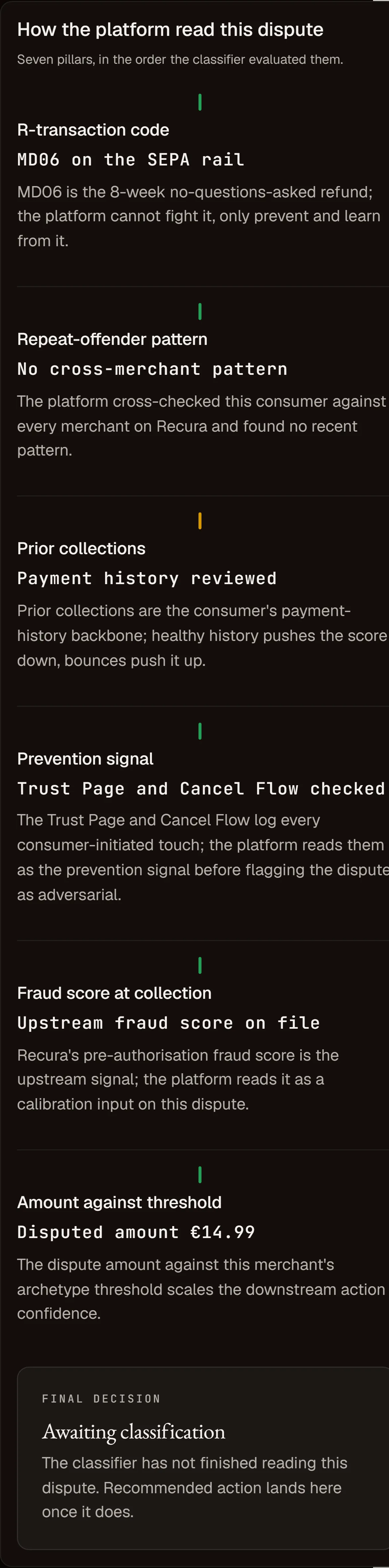




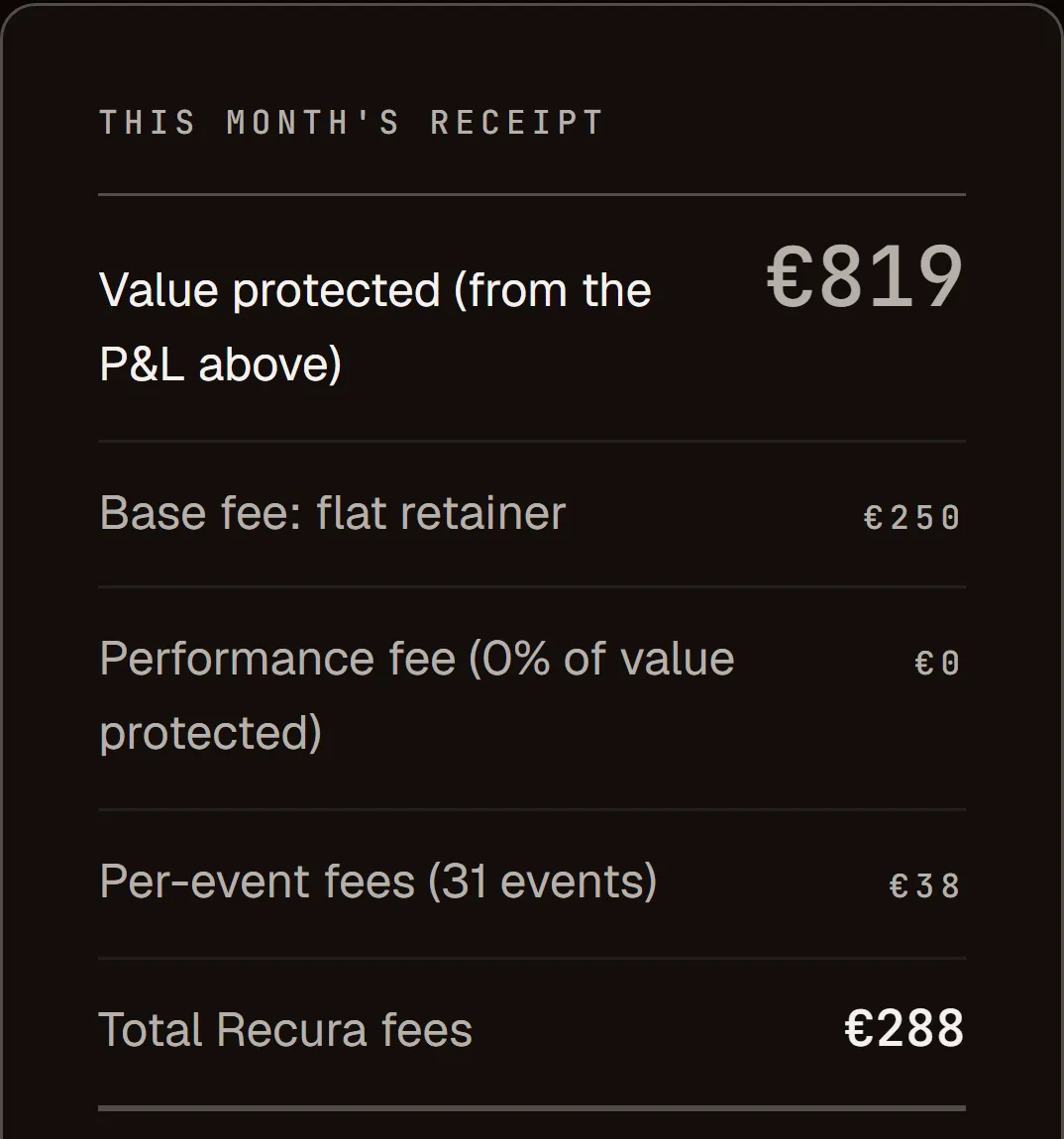
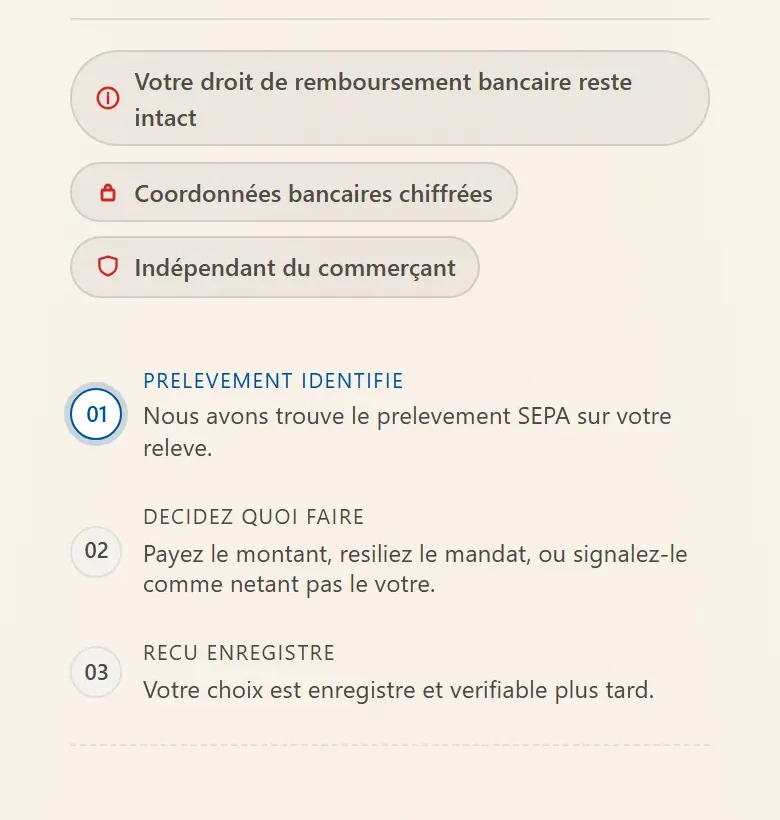
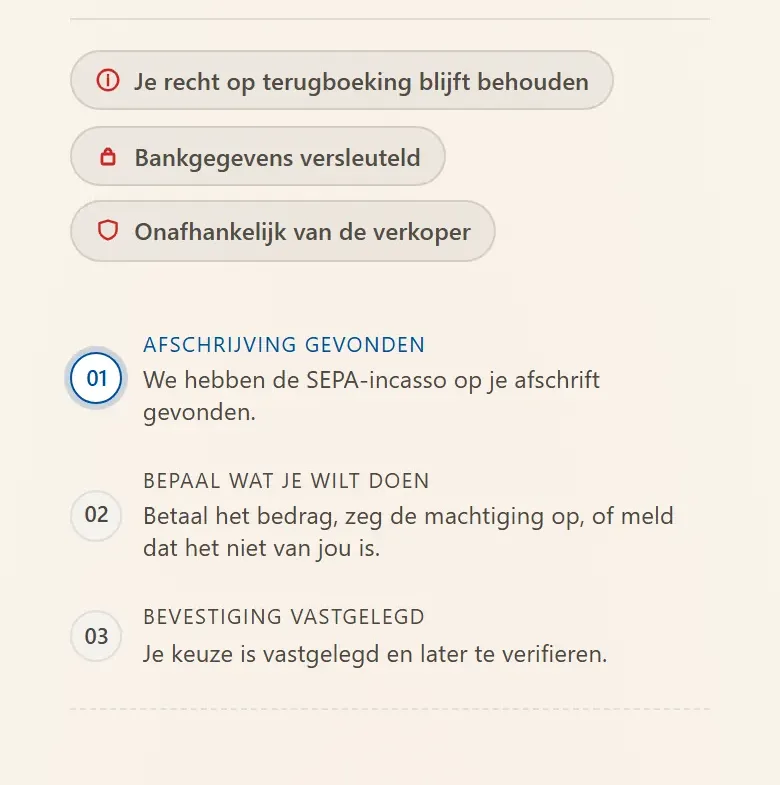
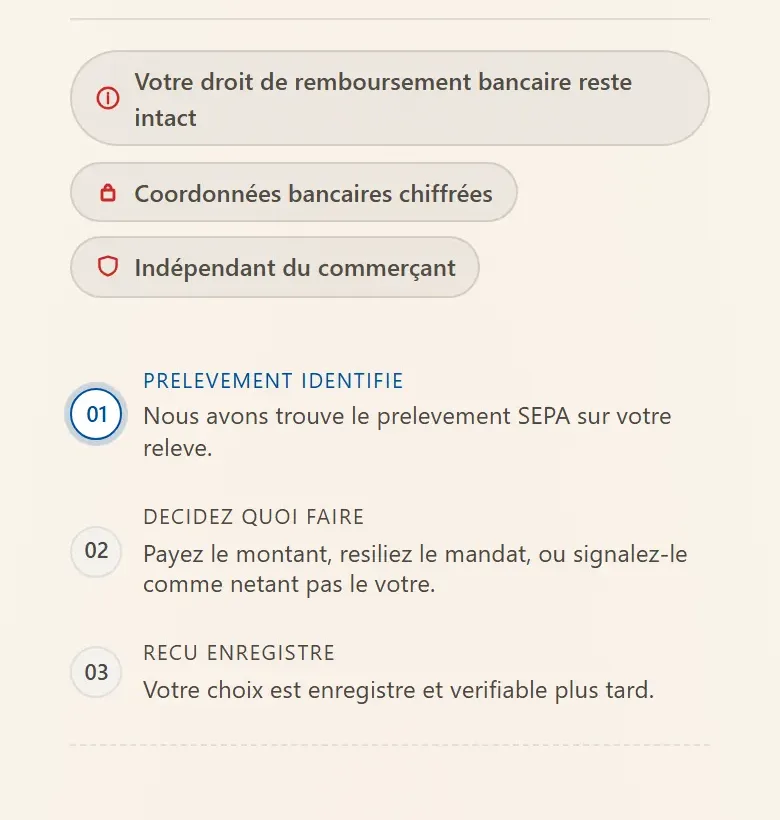
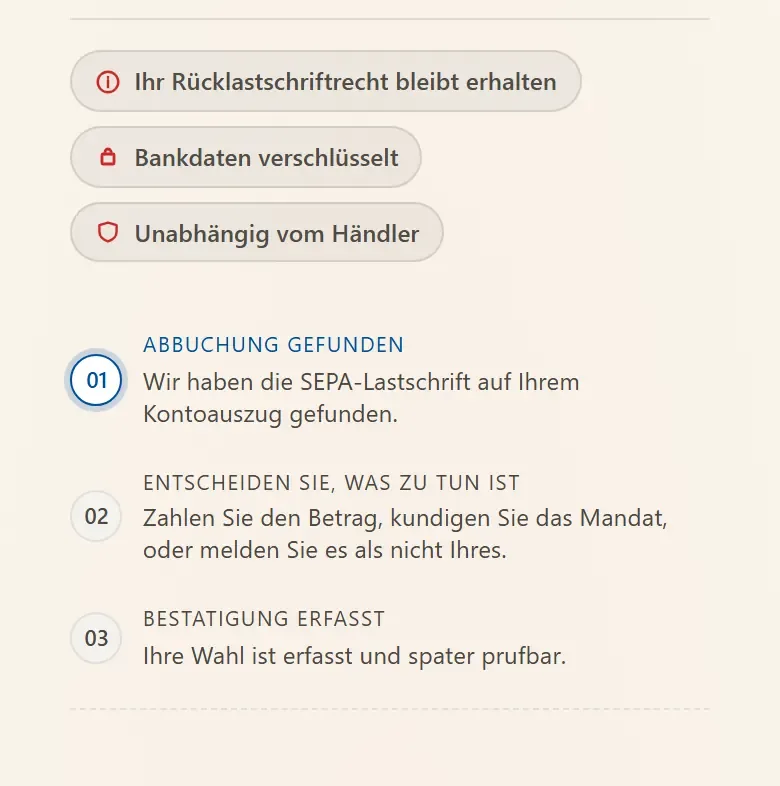
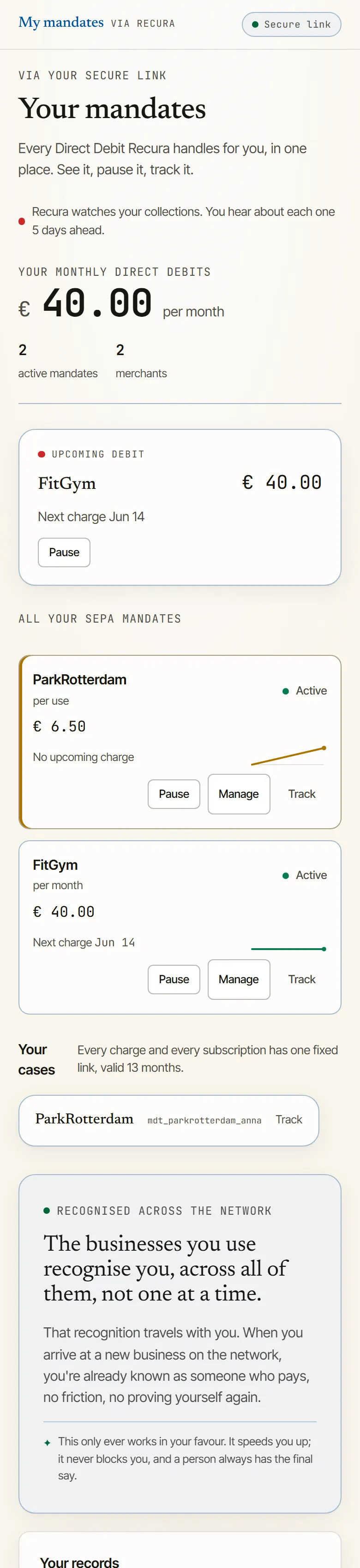
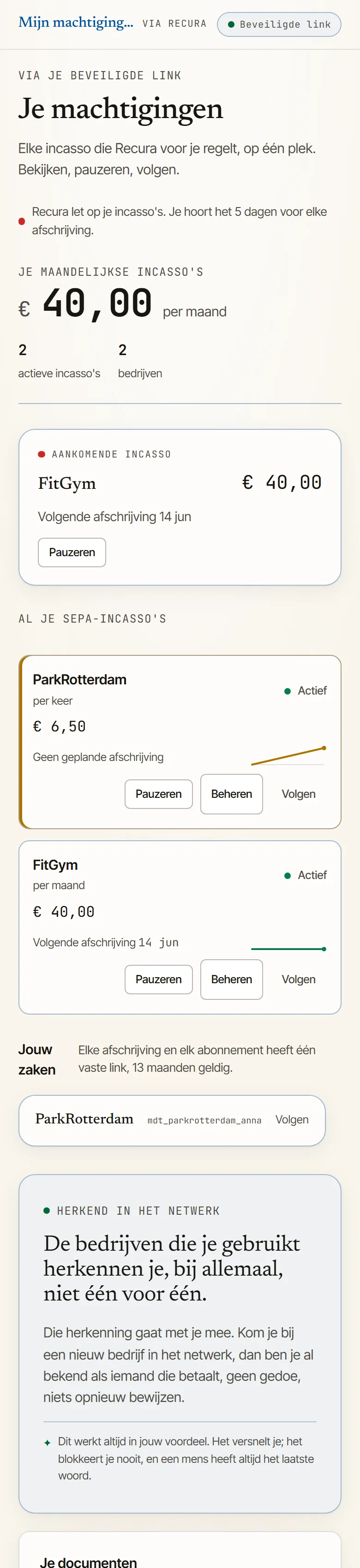
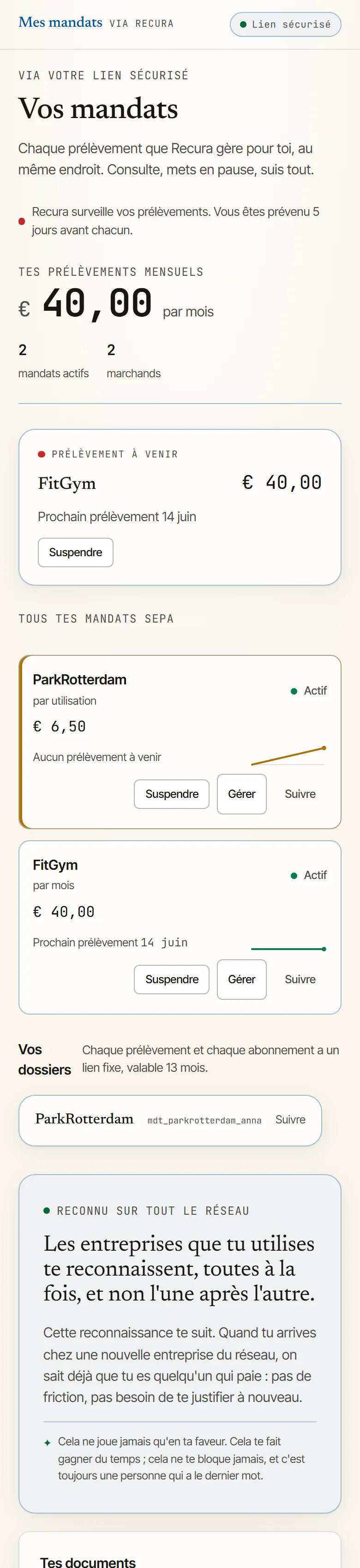
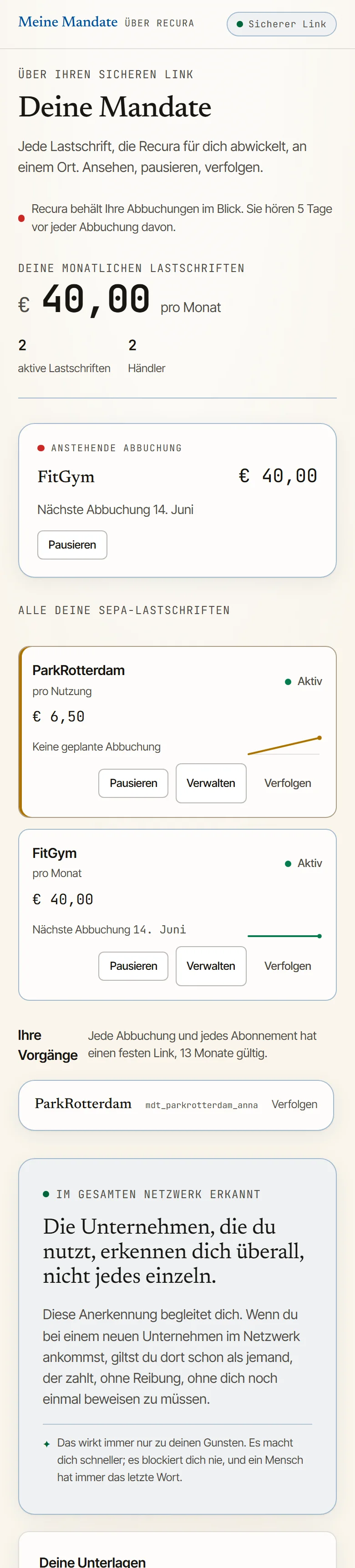



The platform I built sits behind a business’s payment processor and deals with the business’s customers in the business’s name. It reaches a customer before a payment is taken, works every return until it is closed, and recognises the customer who makes a habit of taking money back at every business it serves. I refer to it here as Recura.
I built Recura so that the way a customer paid is known in one place only: where a processor’s reports come in. There every report becomes one of four plain records that name no way of paying: a payment collected, a payment taken back, a permission signed, or the result of a case. Everything after that reads only those four. Direct debit is the first way of paying Recura was built on; a card payment, a buy-now-pay-later order or a method that does not exist yet goes in at the same point and nothing after it is rewritten.
Each case ends with its result recorded in euros: got back, prevented, let go or lost. That result then shapes how Recura decides the next case at every business on it, so each business that joins sharpens it for all the others.
Recura is made of eight parts. Six work on the money a business loses to returns:
- Preventing returns
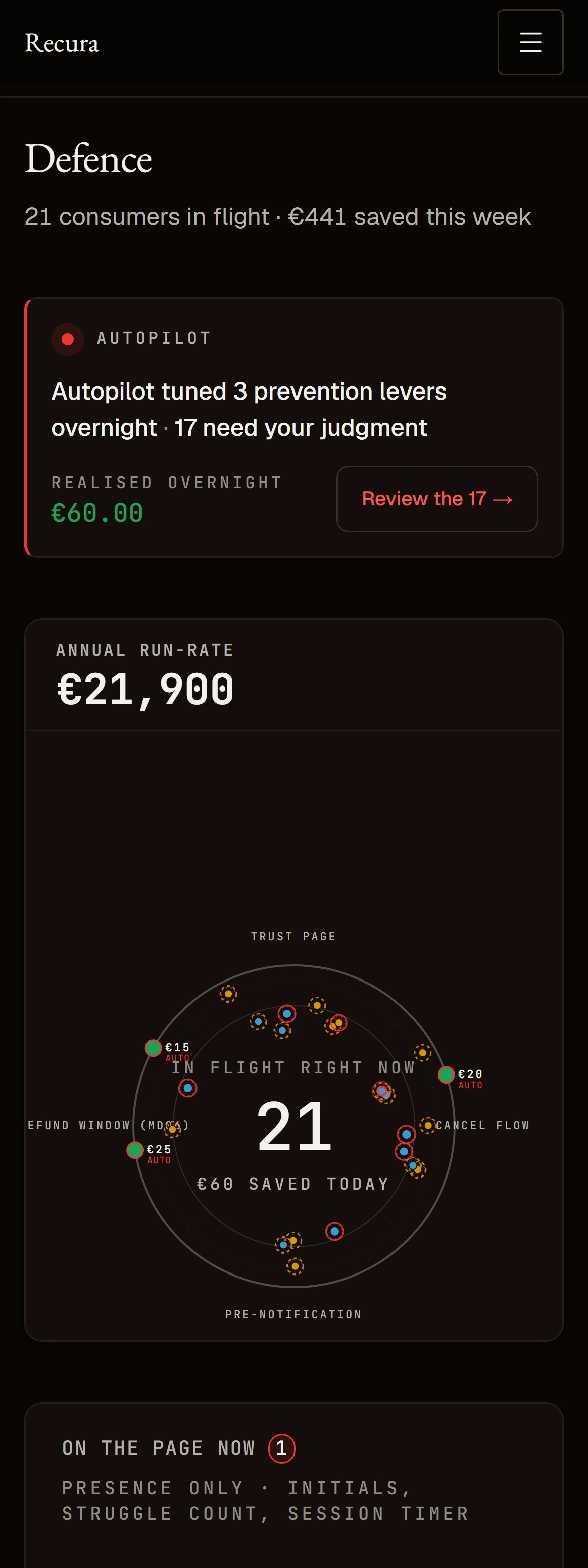
Before each debit, Recura writes to the customer in the business’s name. I made the notice offer more ways to stay than to leave, so customers who would have taken the debit back can keep paying or cancel cleanly.
- The customer’s own page
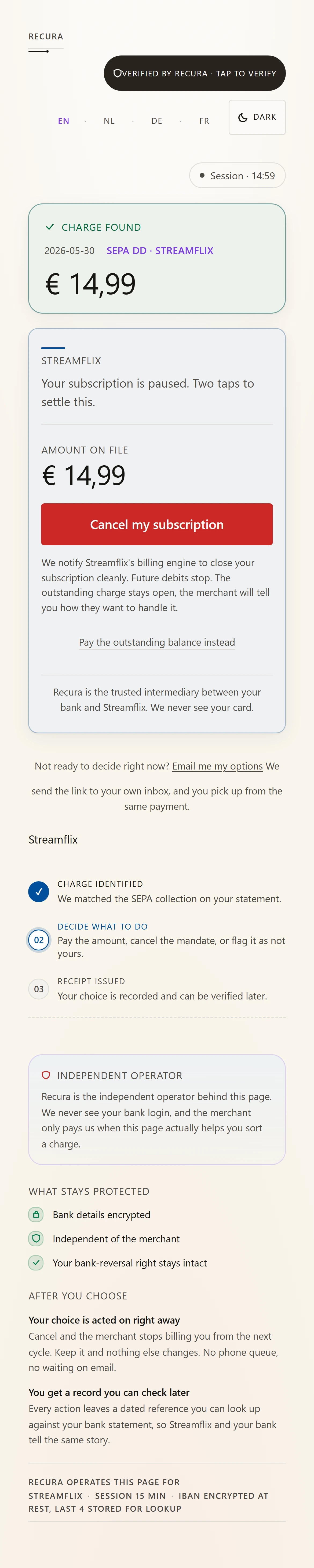
A page in the business’s name shows the customer why the debit is theirs and lets them settle it there, so the business gets paid or a clean cancellation, not a refund at the bank. I had it say their bank is still open to them, so they trust it enough to settle.
- Handling every return
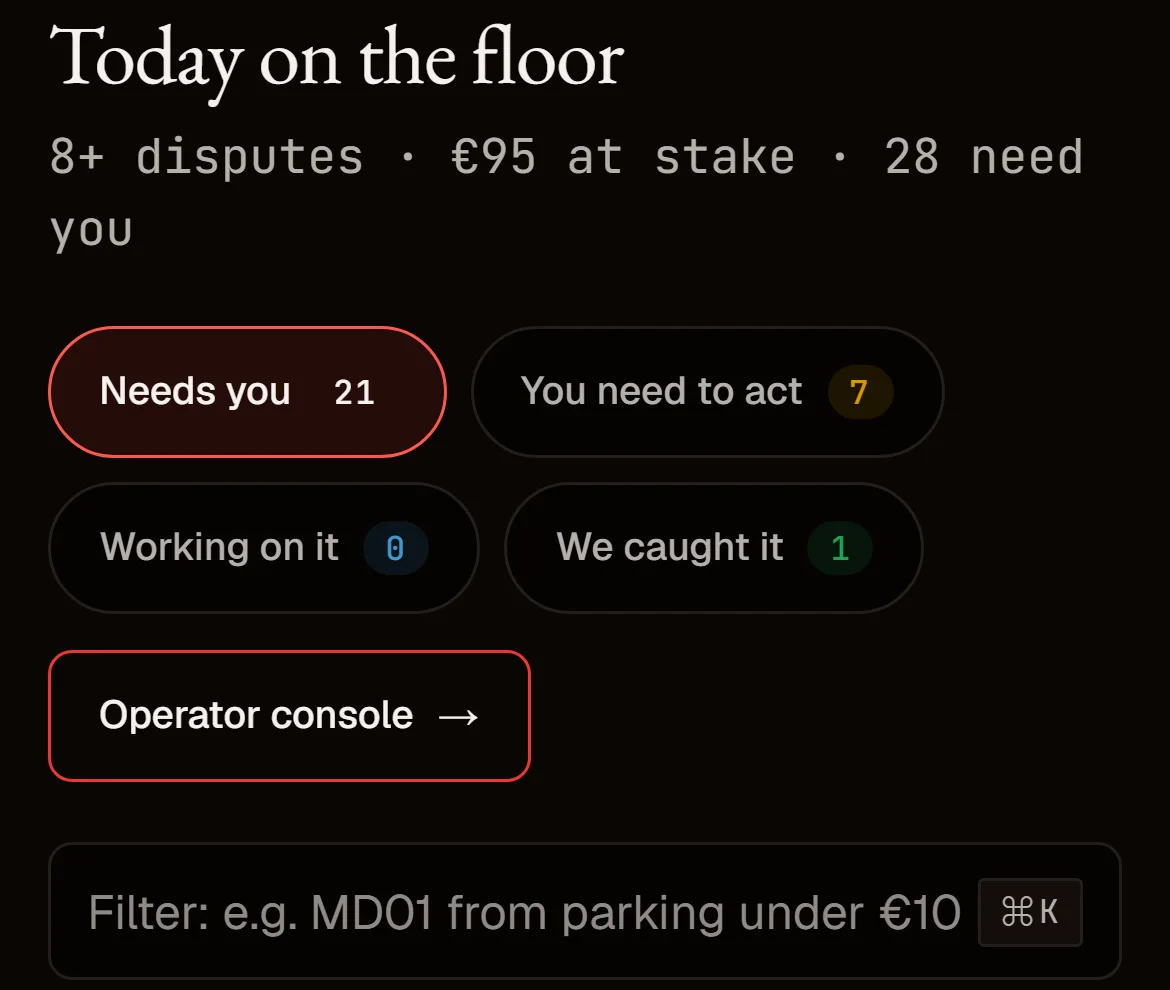
Recura keeps working every return until the money is back or the business lets it go, even when the customer says they never gave permission. I had it record how each permission is signed, so a claim made long after the debit meets proof.
- Recognising a customer across businesses
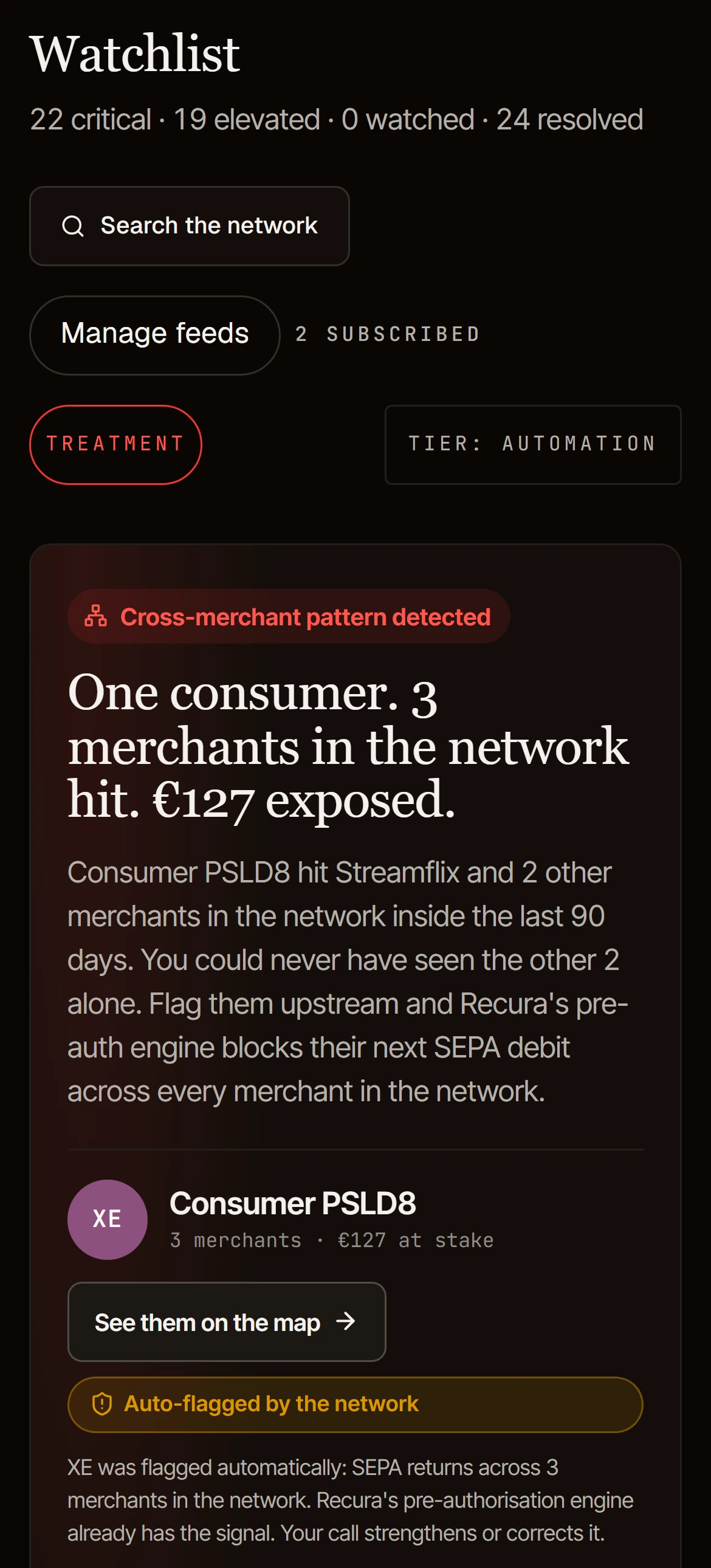
Recura recognises the same customer at every business on it, with no bank account number passing between them, and the debits stop of one who makes a habit of taking money back. I proposed this part myself.
- The overnight agent
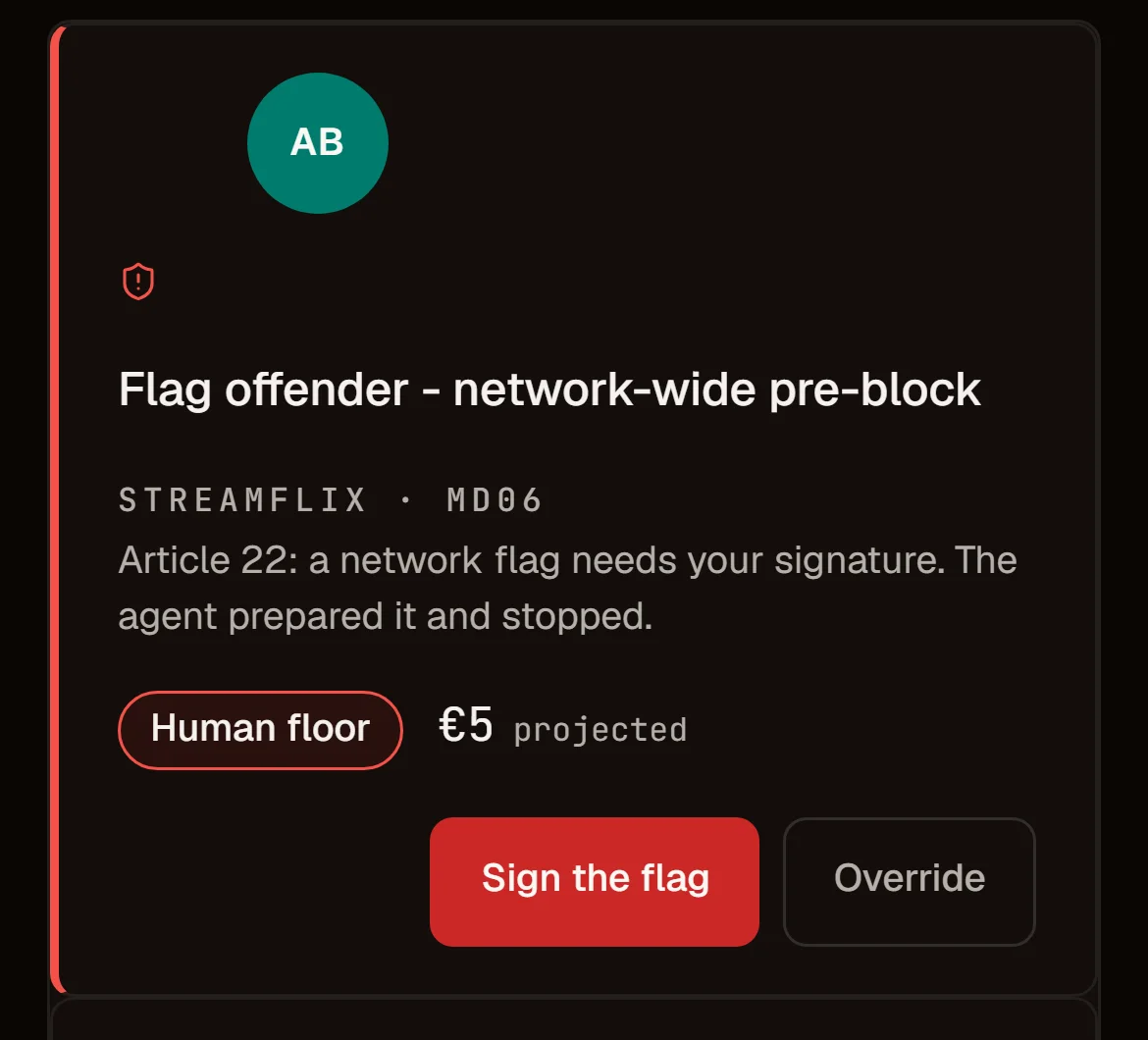
The agent is software that decides and acts on its own. It works through every return overnight, inside limits the business sets, and I let it act alone only on moves that can be undone.
- Proving what it kept, and charging on that
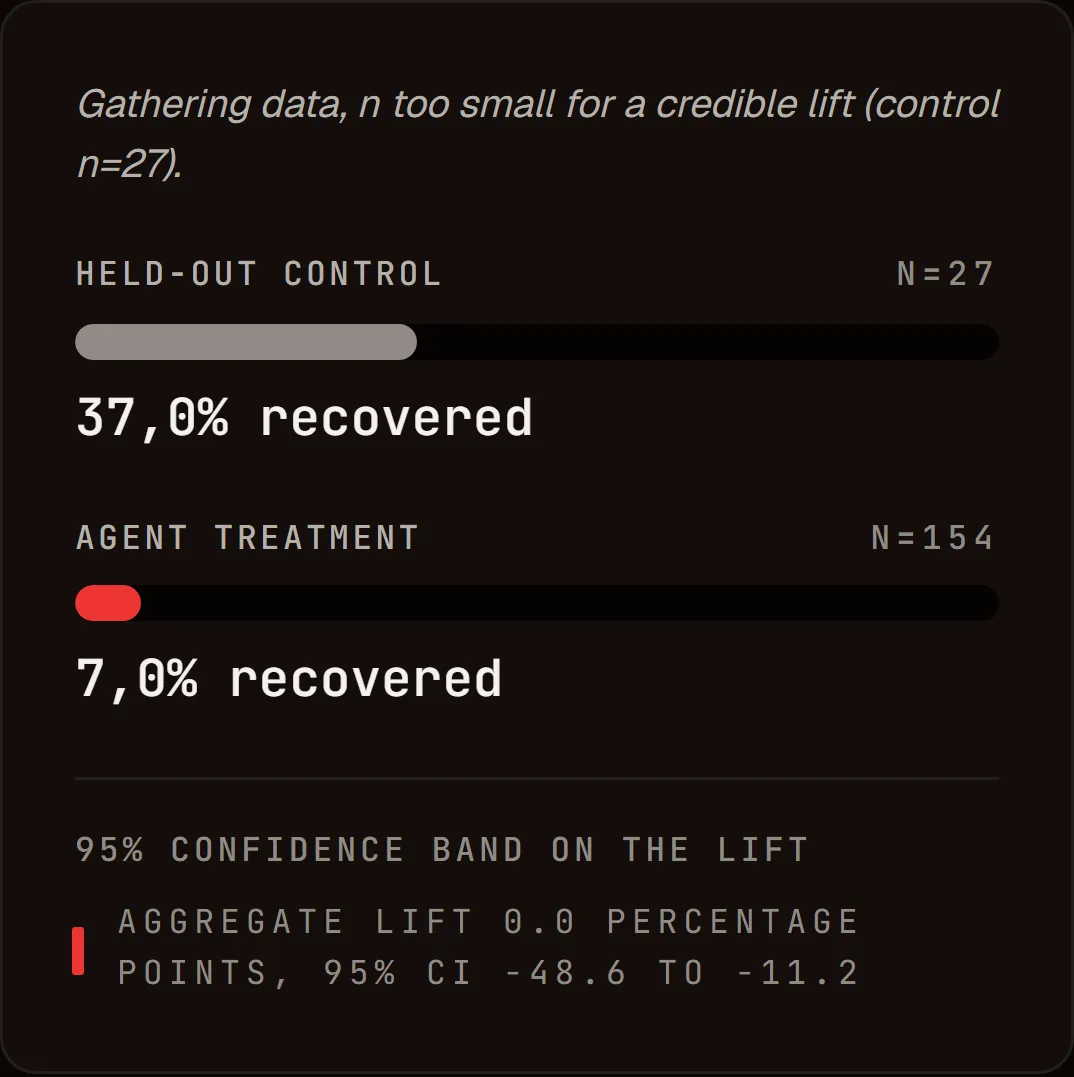
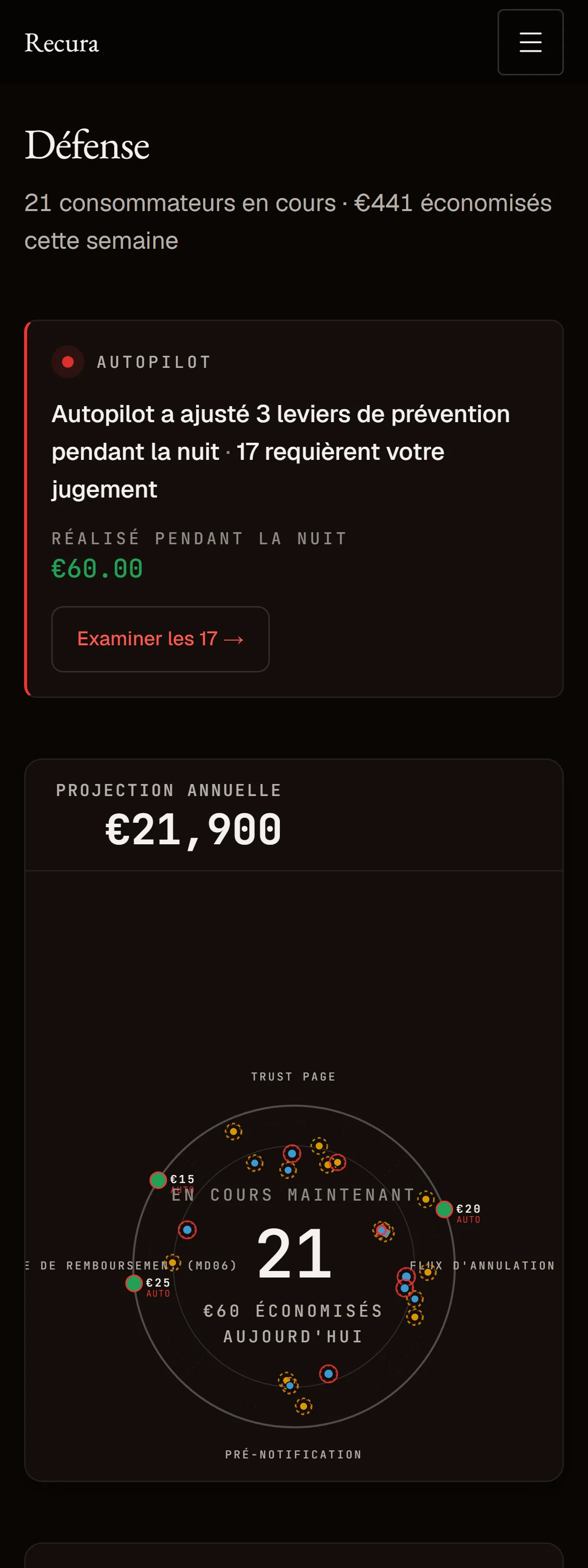
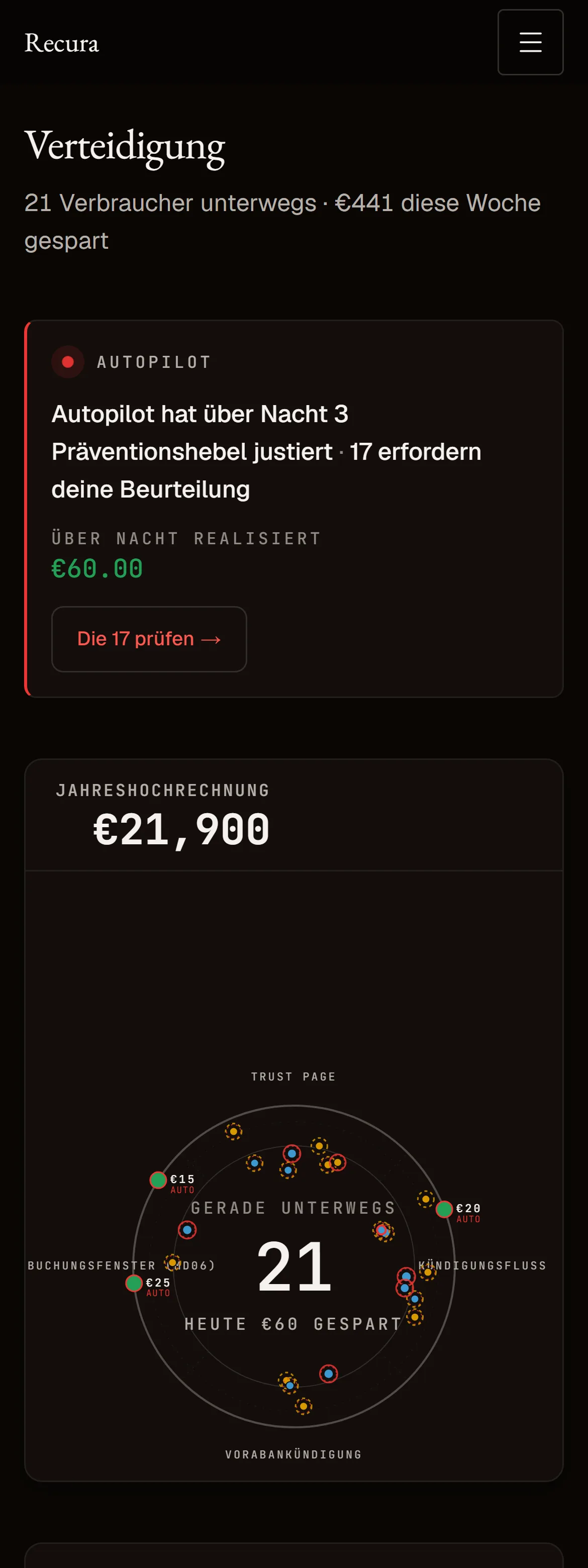
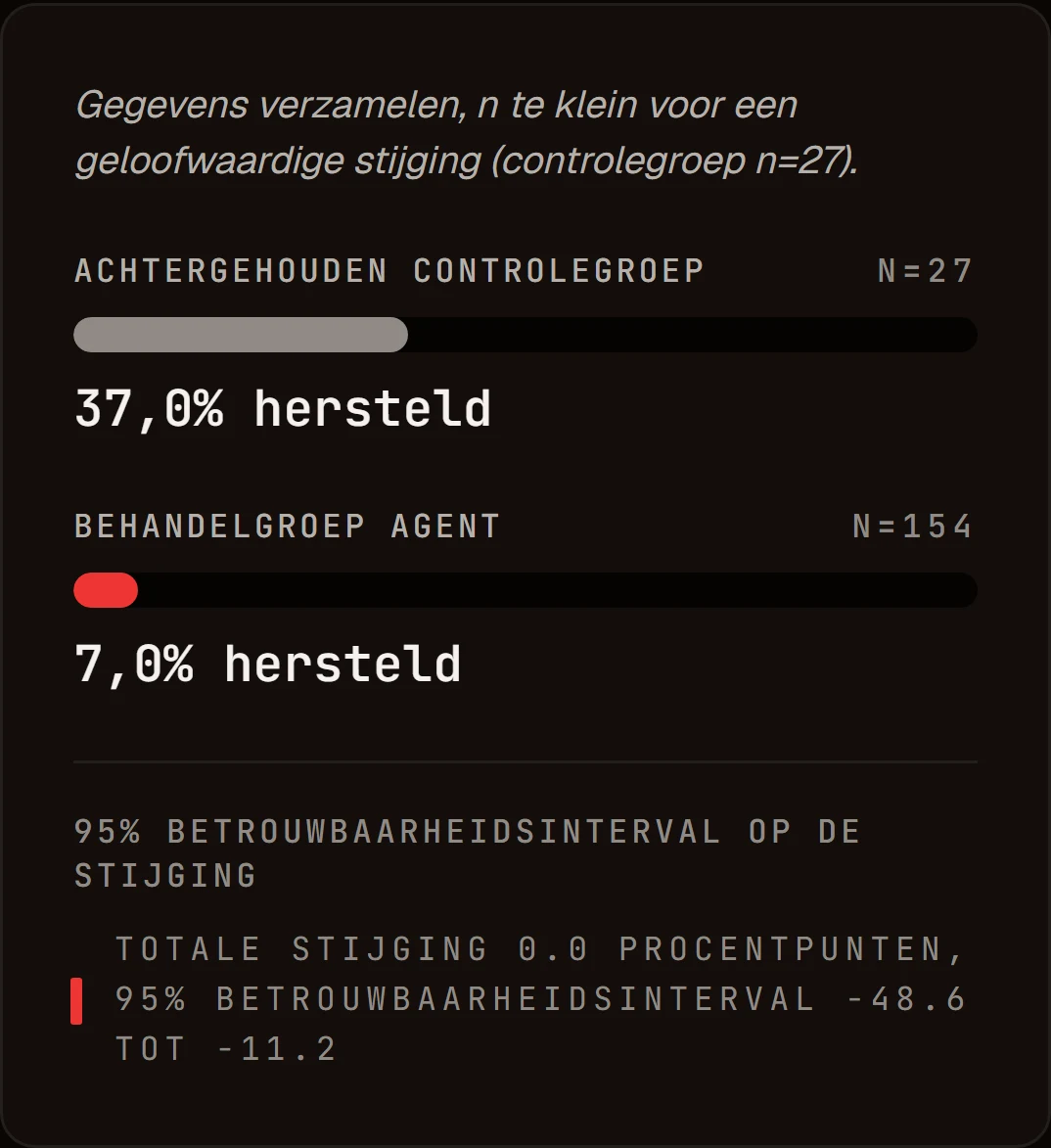
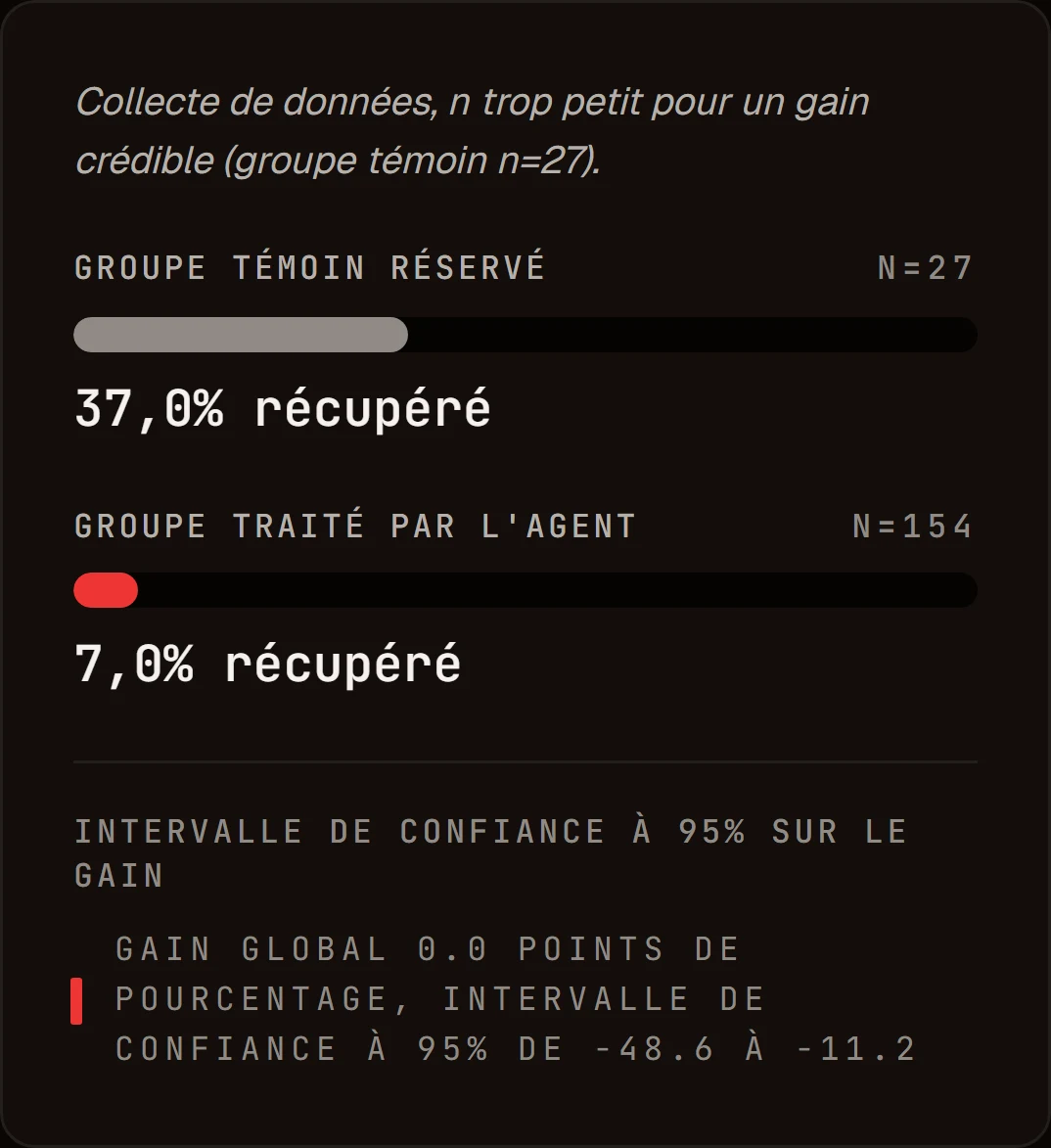
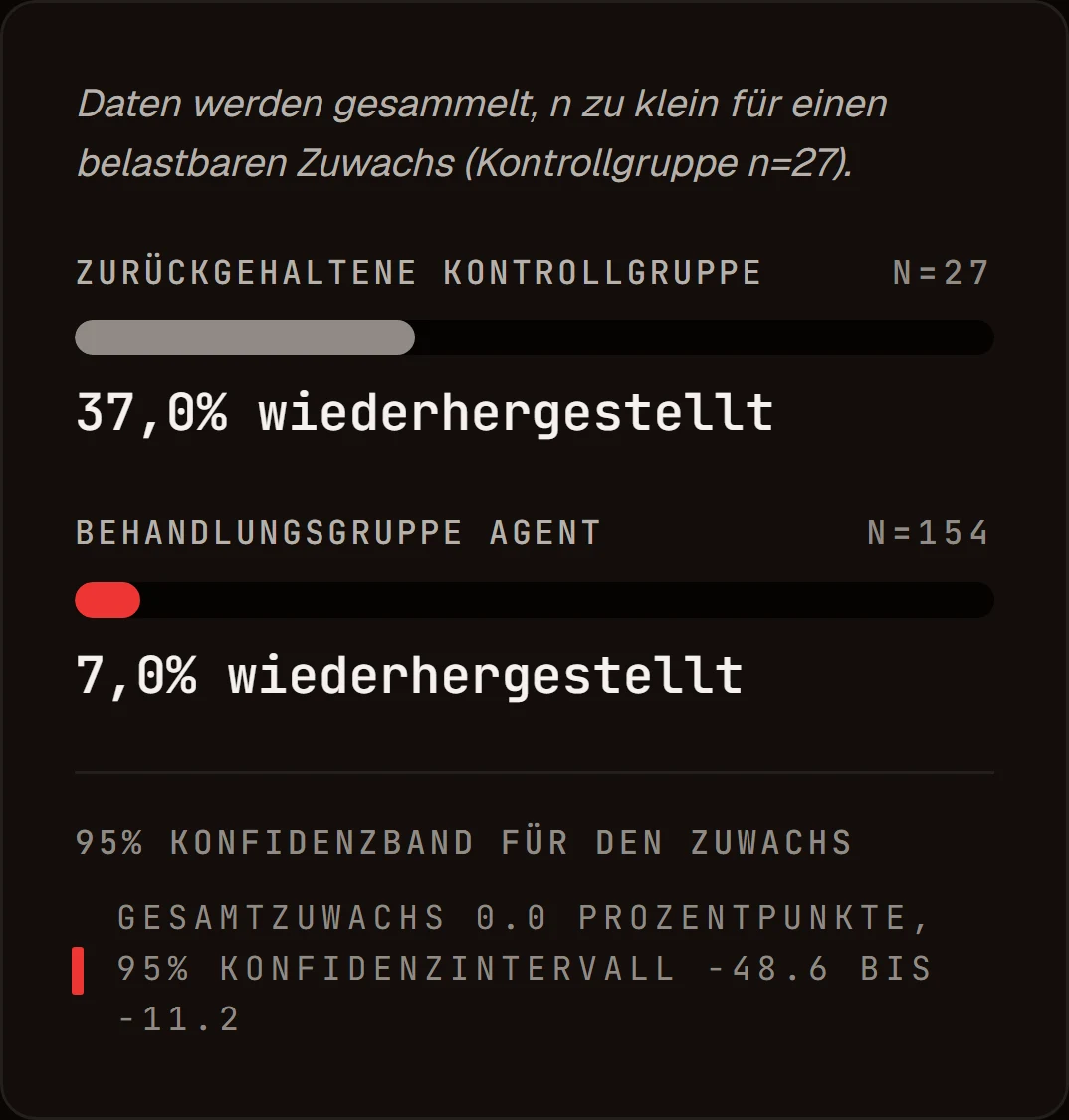
Recura proves to the cent what it kept for a business, measured against customers it leaves alone on purpose. I tied its fee to that comparison, so the business pays a share only of what Recura kept beyond what would have come in anyway. On this screen too few customers have been counted yet, so Recura bills nothing.



The other two make it a product a business can onboard onto, set up and run:
- Onboarding and setting it up
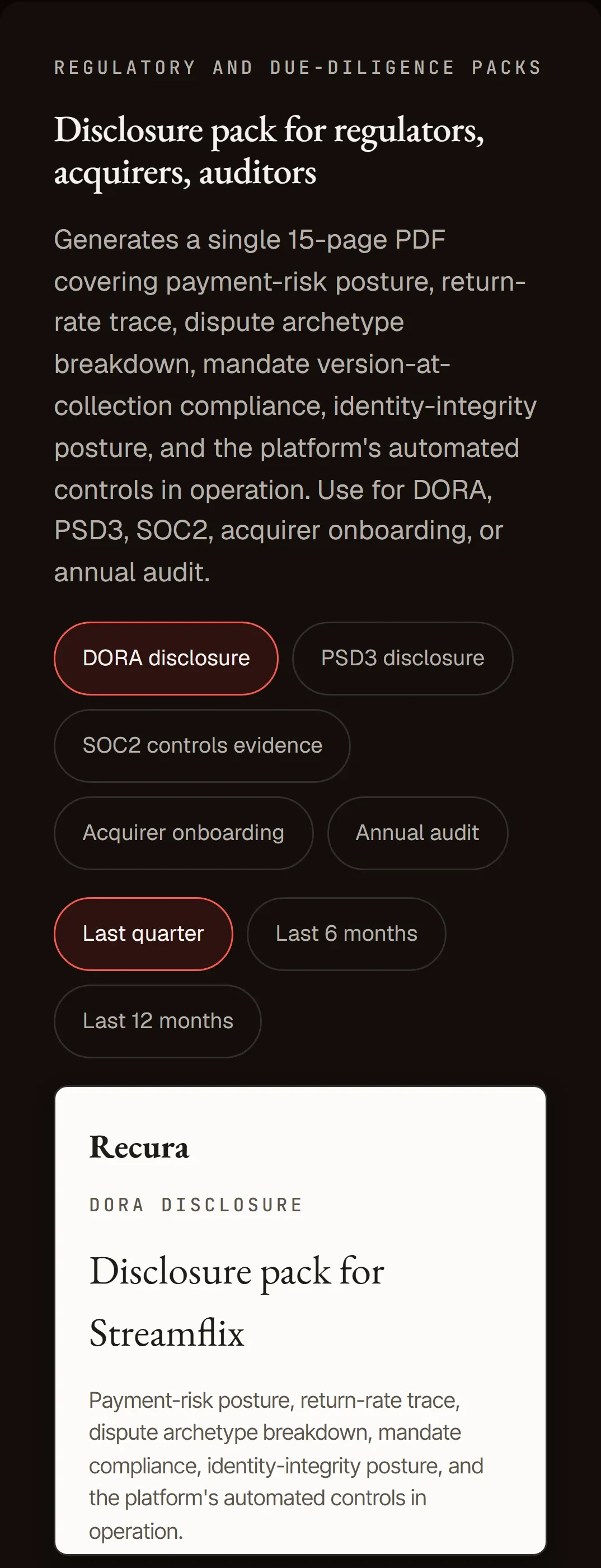
A business can read what Recura does and costs and try its own figures before it talks to anyone, connect its processor in a guided setup, and give its lawyers and auditors the papers they ask for, which Recura writes in minutes.
- The manual
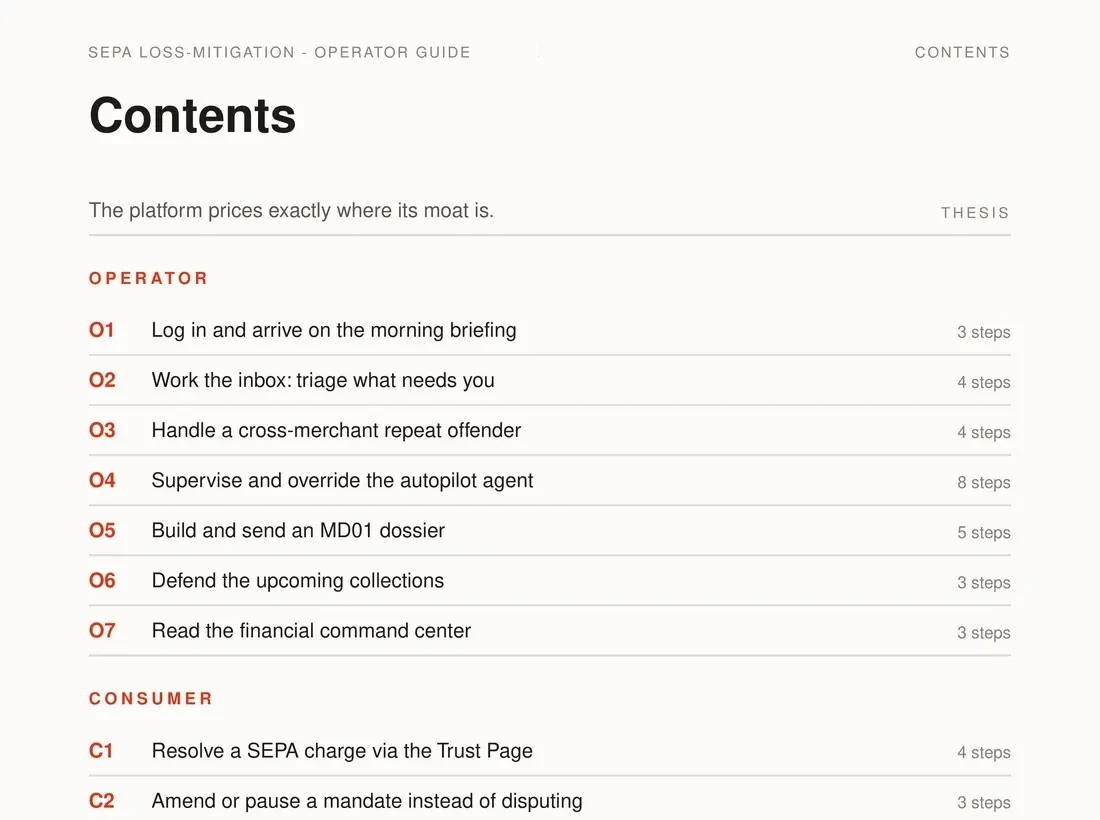
A guide teaches the people at a business to run Recura task by task, and a written procedure for each kind of return and exception means the business runs it without me.

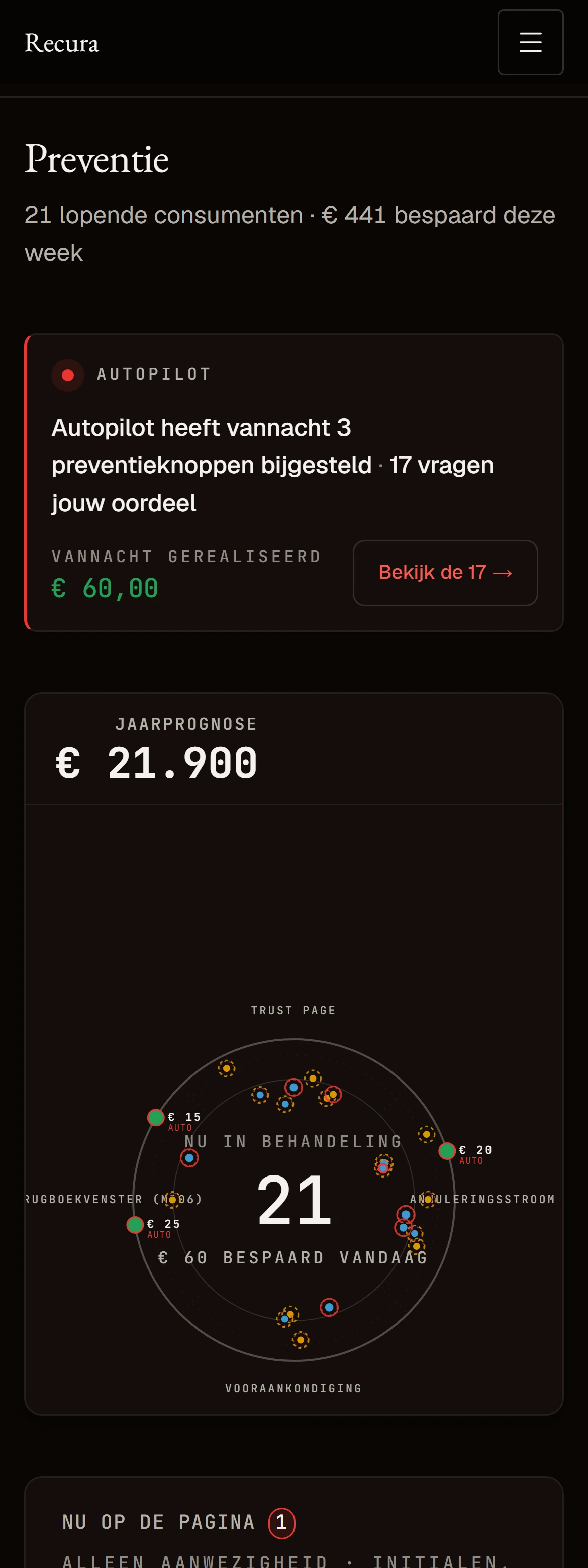
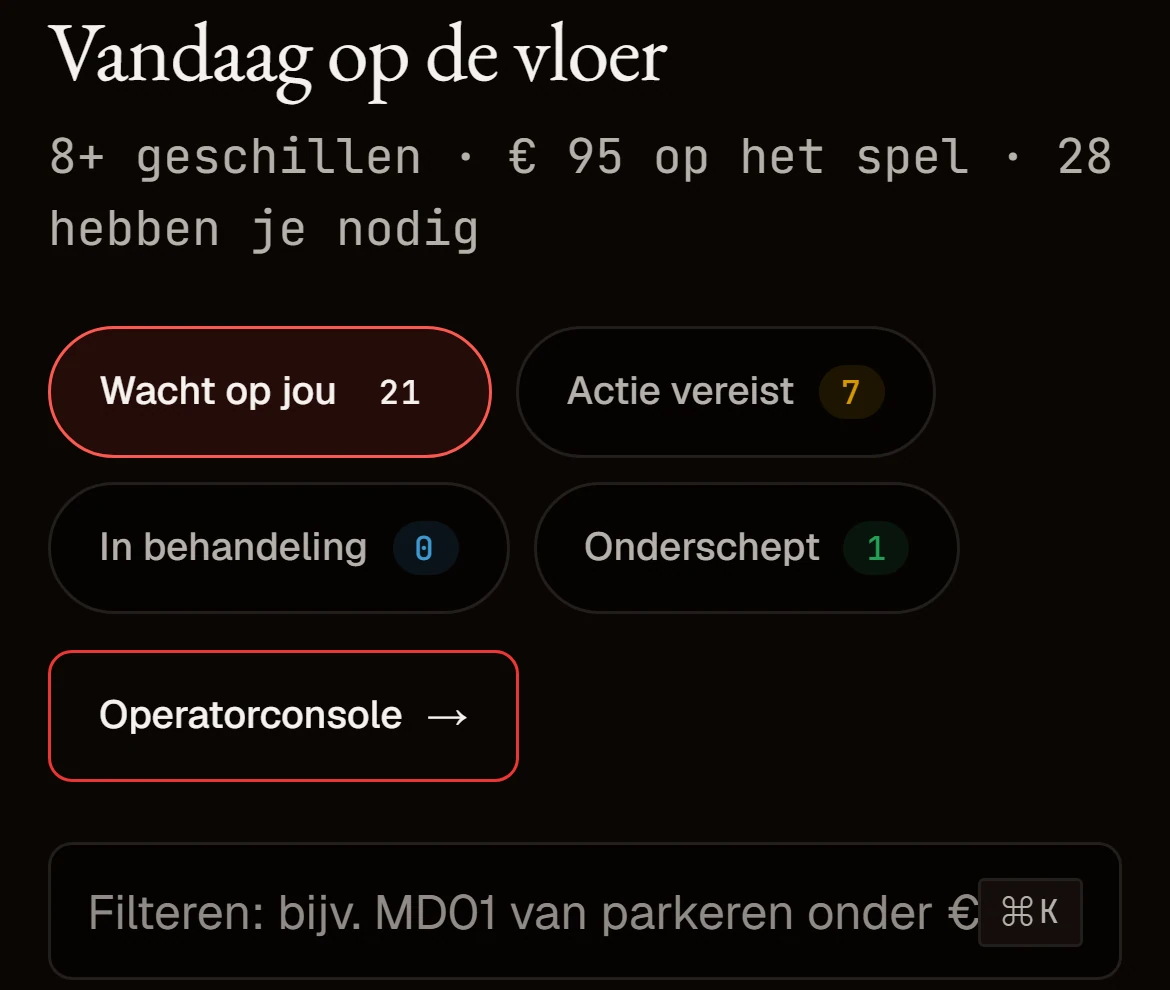
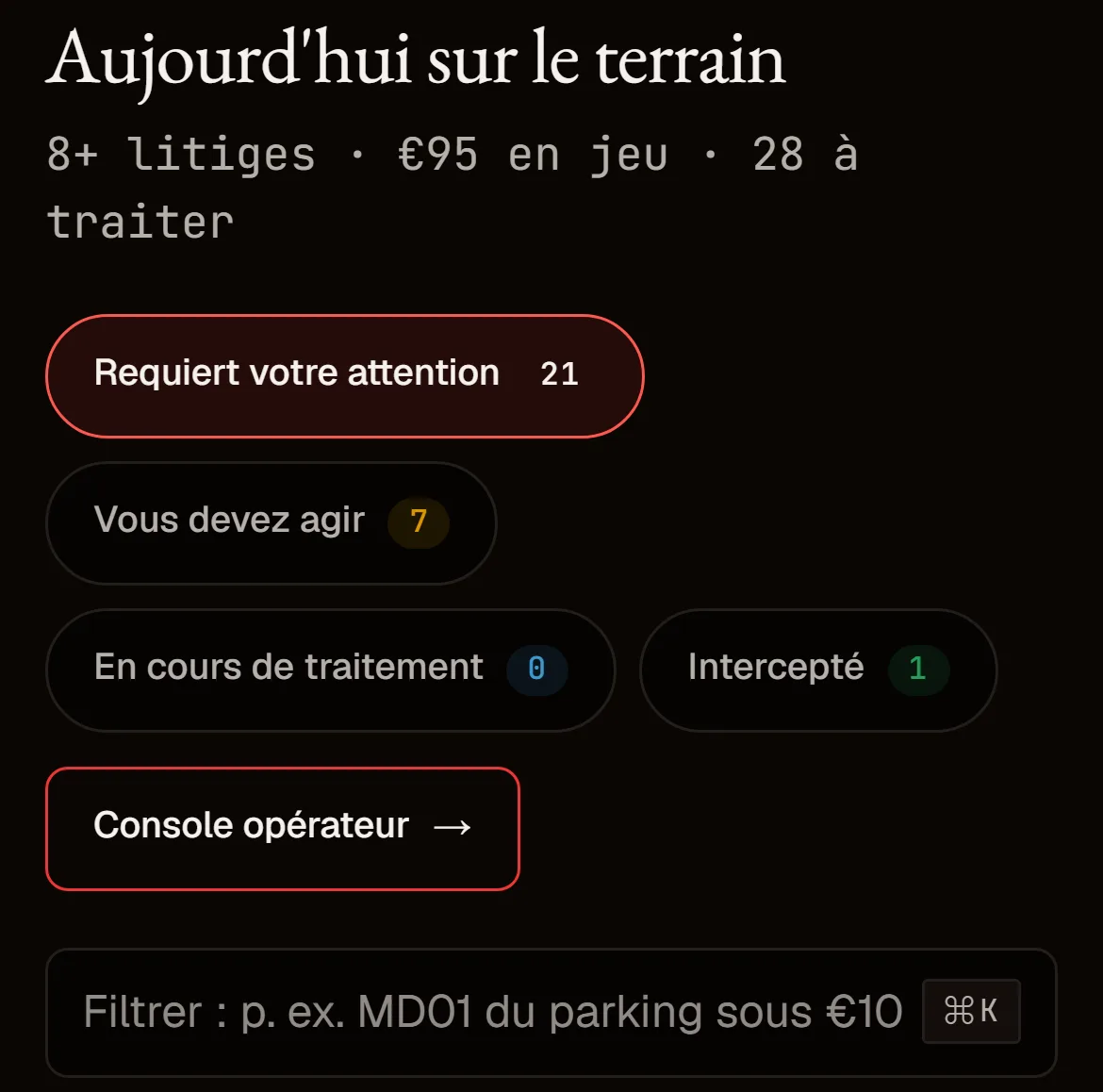
A business’s payments team, the people who handle its payments, works in one console. They sign in to it each morning, in English, Dutch, German or French, and see what Recura did overnight and decide what it left for them, with a view for each part of Recura.
A company that brings several businesses onto Recura can run them all from one console above theirs. From there it brings a business on in one step and watches every business.
By the time anybody on the payments team opens a return, Recura has already matched it to the customer, the permission they signed and every payment taken on it before, and has picked the next move.
The business’s processor
The return
Recura
The customer
The permission they signed, with every earlier payment
The customer’s own page
The returned debit, settled there
The debit taken again, where the account was only short of money
The day the bank returned itTaken again 3 working days later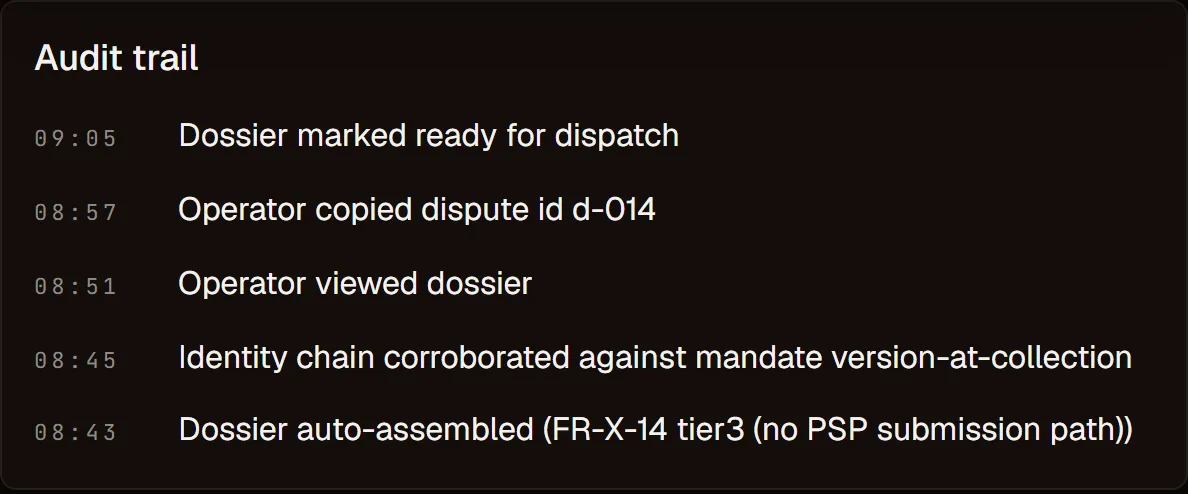
A file of proof that the customer gave permission
The customer’s debits at every other business on Recura
Stopped before they are taken
The payment let go, where it is less than the business chases
A €1.50 return
Preventing returns
By Recura’s estimate, about 25 of every 100 debits that would have been taken back never are. Card payments have services that head a dispute off before it lands, and direct debit has none, so Recura does it from the business’s side, in the business’s name.
Recura’s estimate, for every 100 customers who ask their bank for a debit back
Recura expects about 25 to keep paying or cancel cleanly instead, four in ten of these two kinds
What the customer gets before each debit
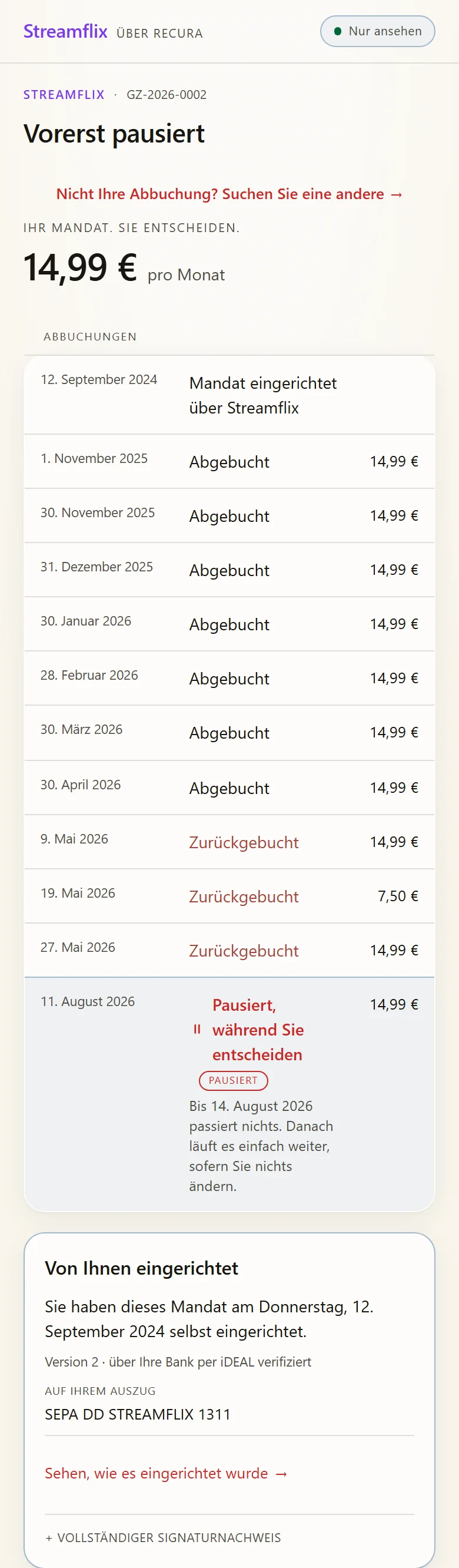
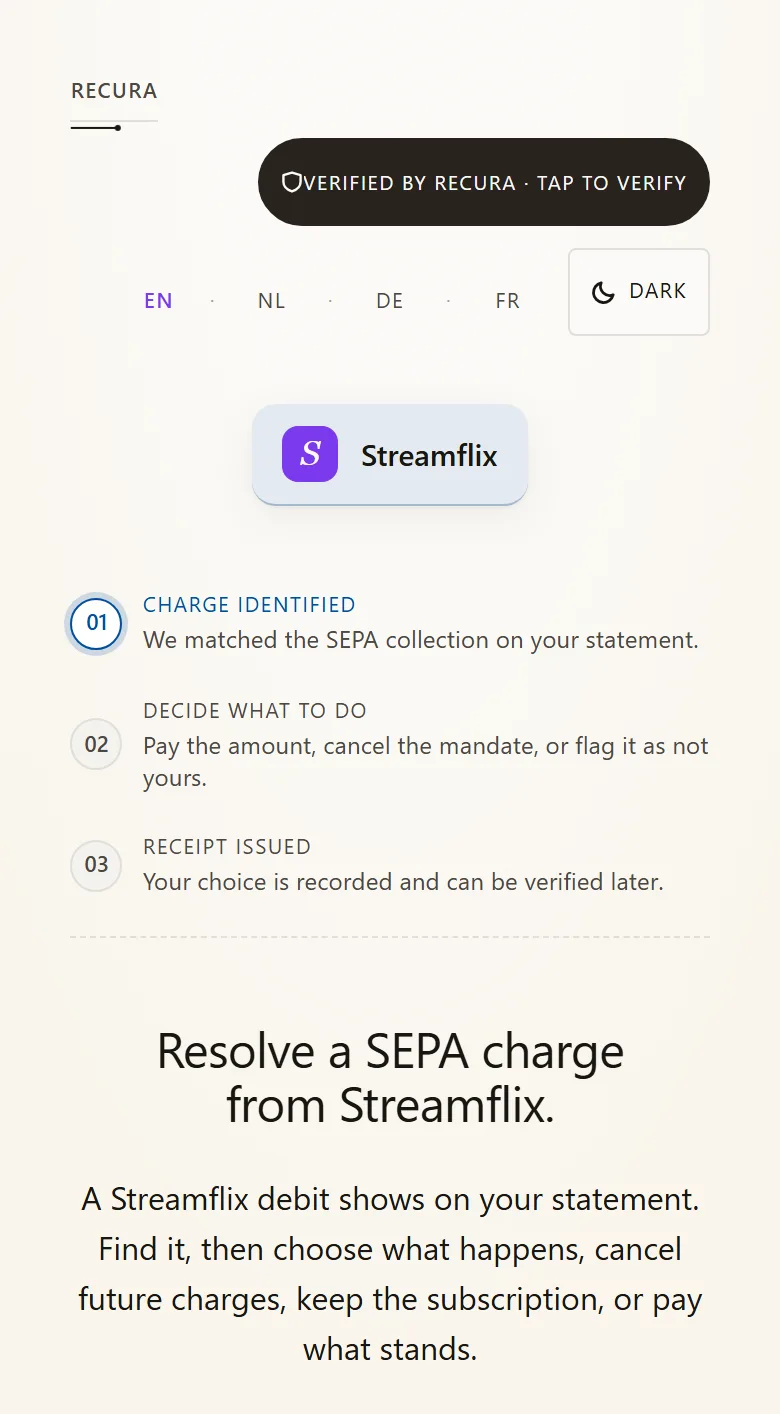
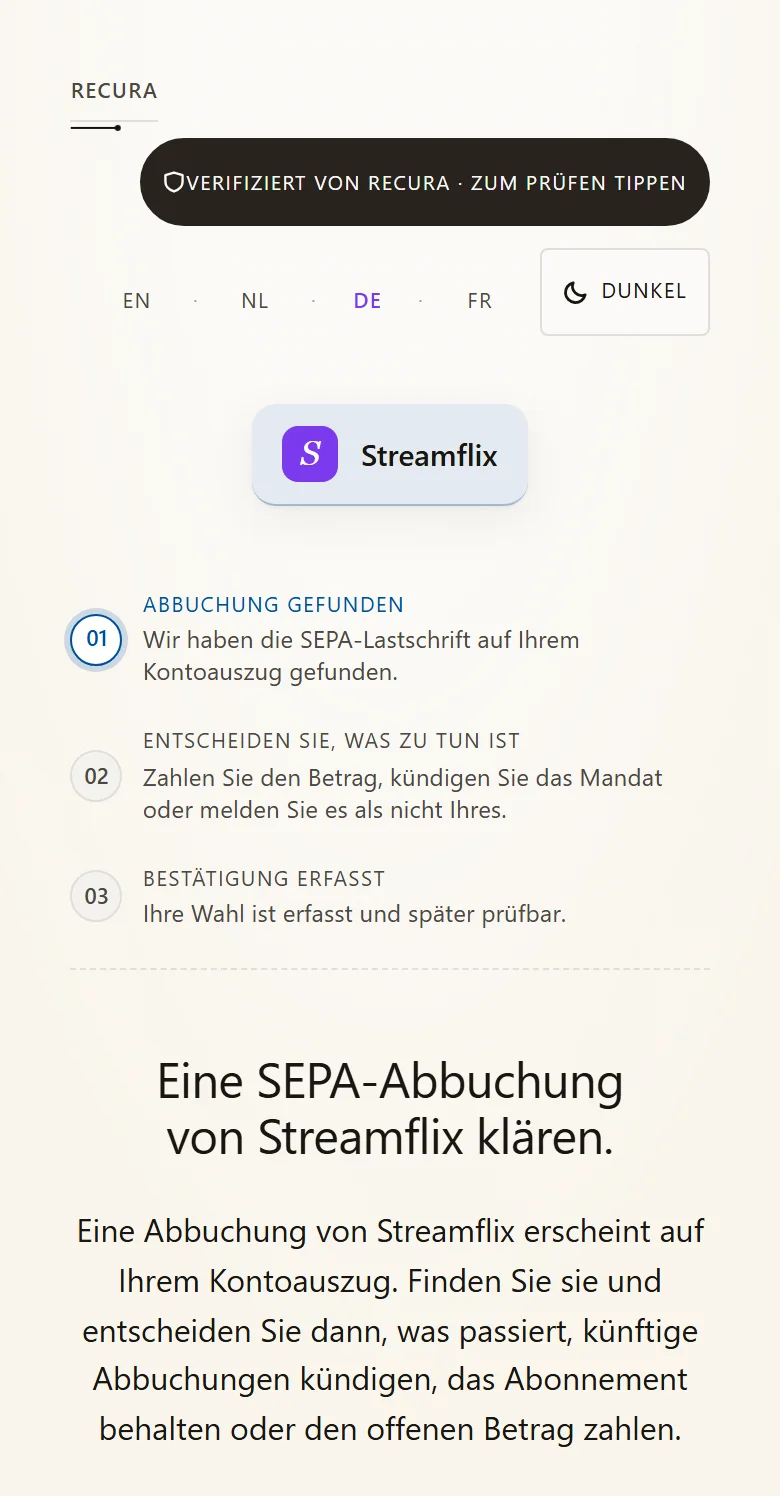
SEPA already has every business announce each debit to its customer, and Recura’s notice is that announcement. The businesses here are made up, so nobody’s customers are on show. Recura writes to a subscriber of Streamflix, in the two weeks before their €14.99 debit:
- Recura
- The subscriber
- Streamflix’s processor
- 29 May Notice in Streamflix’s name and colours Their bank statement will show SEPA DD STREAMFLIX 1311 Arrival of the notice recorded
- 9 June
- 11 June
- 12 June €14.99 taken from their account
Reminder, unless the notice has been opened
The reminder on 9 June reads:
Streamflix
9 June, 09:00
Your €14.99 payment to Streamflix is due 12 June
If that is right, do nothing. To cancel or if it looks wrong, one tap: recura.eu/…
The notice itself carries three links: change the amount or the date, pause, or cancel cleanly. Two keep the customer, and each shows only where it applies, so a one-off charge carries none of a subscription’s.
The reminder’s one tap opens the customer’s own page with that debit already found. A subscriber who wants out says why, which Recura records as a category the business can count, where a refund at the bank would have told it nothing; if a way to stay fits that reason, the page offers it first.
The subscriber
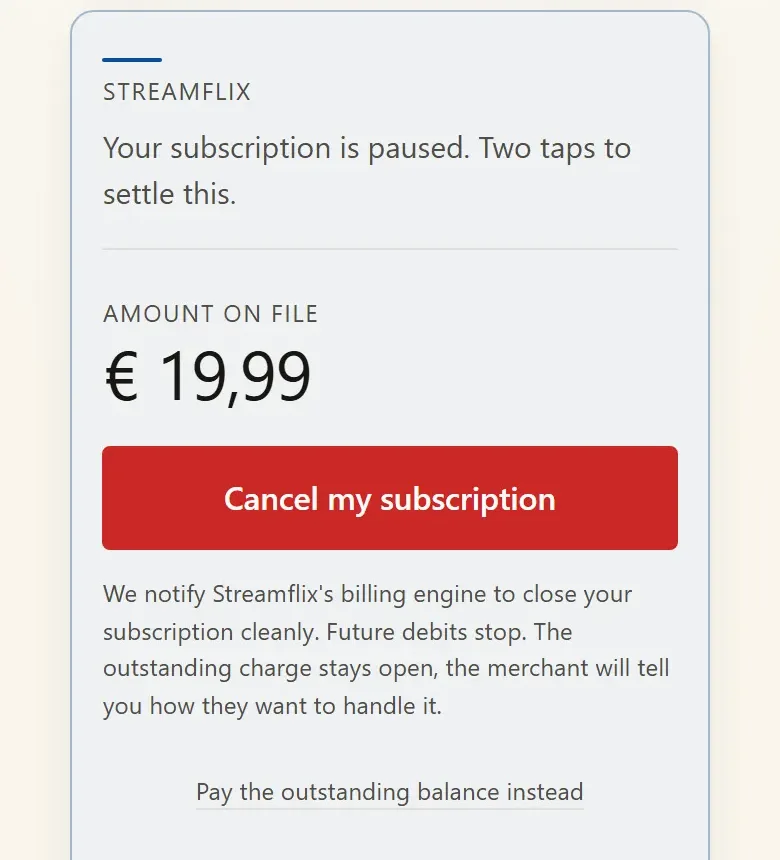
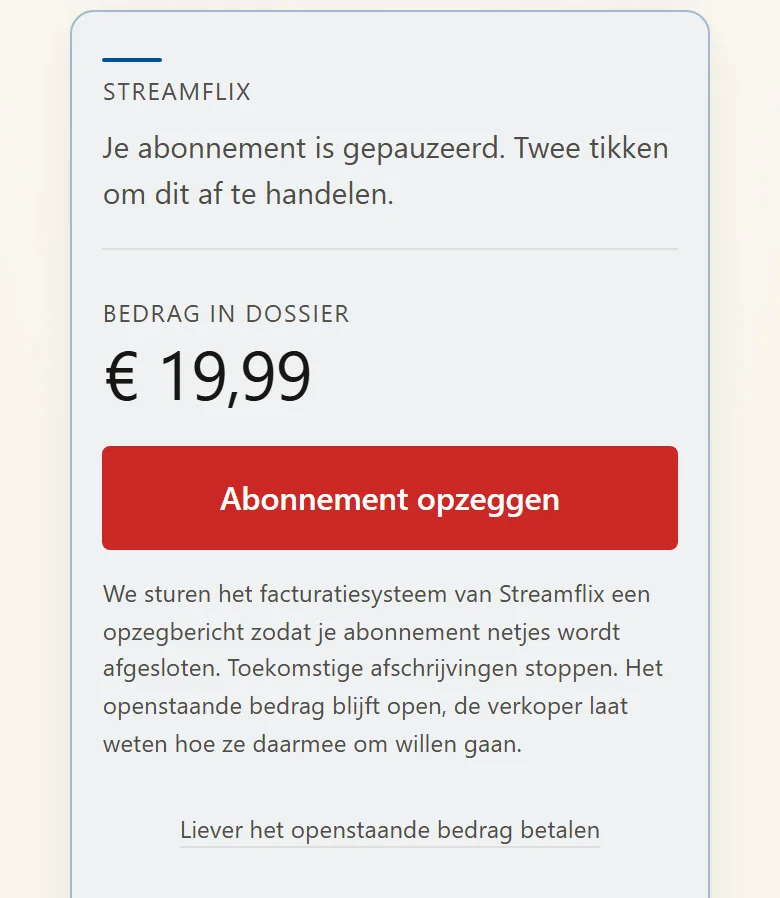
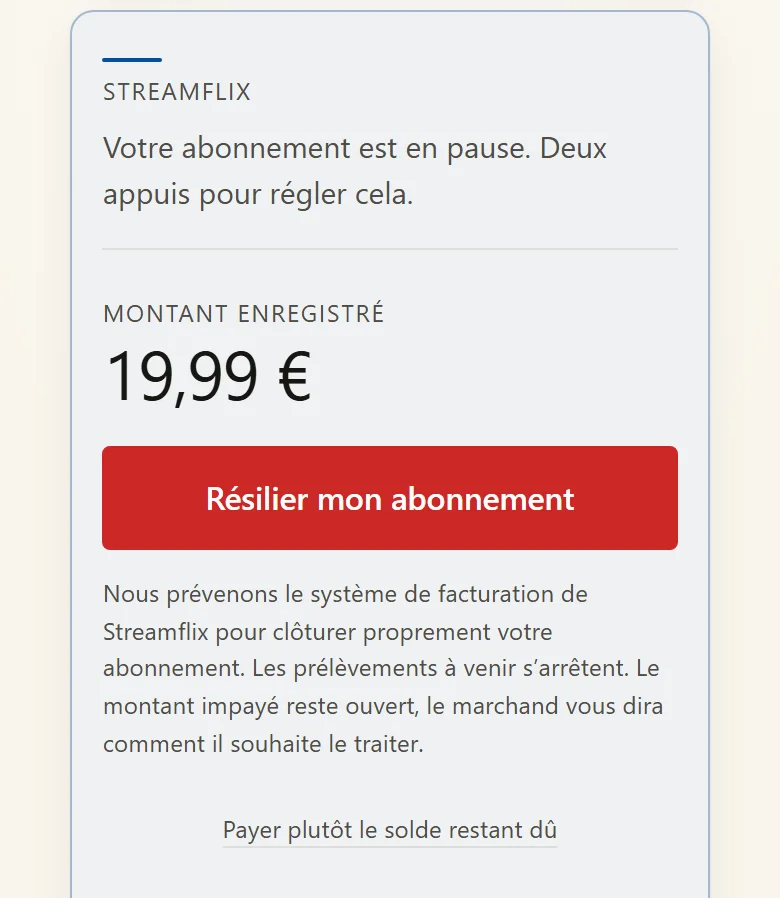

Their own page
A signed cancellation, sent straight by Recura
Streamflix’s billing system
Subscription ended before 12 June · €14.99 never taken
The cost to Streamflix: that month’s payment
Their bank
Refund after 12 June
€14.99 handed back
The cost to Streamflix: the same payment, a return fee, and a return its processor counts against it
What the payments team sees and can still change
Defence, the console’s view of preventing returns, lists every customer who looked at a debit on their own page or began to cancel and stopped. Each customer’s options are ranked by the money they recover for each minute of the team’s time, and each showsthe expected recovery, Recura’s fee and what the business netsbefore anyone presses it. One click makes the move, or the overnight agent does where the business allows it.
The same view lists the next batch of debits, which goes to the banks at six in the morning on the next banking day. The team can hold any of them until then or release a hold, and a debit whose notice never reached the customer is flagged. I had Recura record both when a notice was sent and when it arrived: arrival proves the customer was told.
The batch
Held two weeks
Recura’s estimate: chance of a return cut by 76%
Their own page, the same moment: “We paused your next debit for you”
Notice never reached the customer
Recura’s estimate if it is taken: at least even odds they tell their bank they never gave permission
Notice sent again by another route, debit five days later
Recura’s estimate: those odds cut by 82%
For a customer who was short of money, the team can move the retry to their payday. Recura estimates that settles 71 times in 100, against 38 for a retry on the next run, and the customer is always told first.
Forecasting when a business would cross its processor’s limit
Once more than, say, 1.5% of a business’s debits are taken back on a claim that the customer never gave permission, its processor and the bank behind it can review, slow down or switch off its direct debits, and a business switched off can go weeks without collecting. Processors watch a ratio like it on cards and Klarna. Recura forecasts the next 14 days of scheduled debits against that line, redraws it every night and offers the moves that keep the business under it.
Every debit due in the next 14 days
1.5%, the processor’s limit
As it stands: crosses the limit
Best to worst case
With a notice the day before every debit over €25 · Recura estimates it rises 62% less each day
How each prevented euro is counted
Each prevented euro is written against the one debit that could have been taken back, and measured against the customers Recura leaves alone on purpose, who show what the business would have kept without it.
Every 100 customers Recura acted on
11 more cancelled cleanly or kept paying than among those left alone
Somewhere between 7 and 16
I made a subscriber who stays count only for the months they go on to pay without taking a debit back, so a stay that ends in a return a month later counts for nothing.
3
The customer’s own page
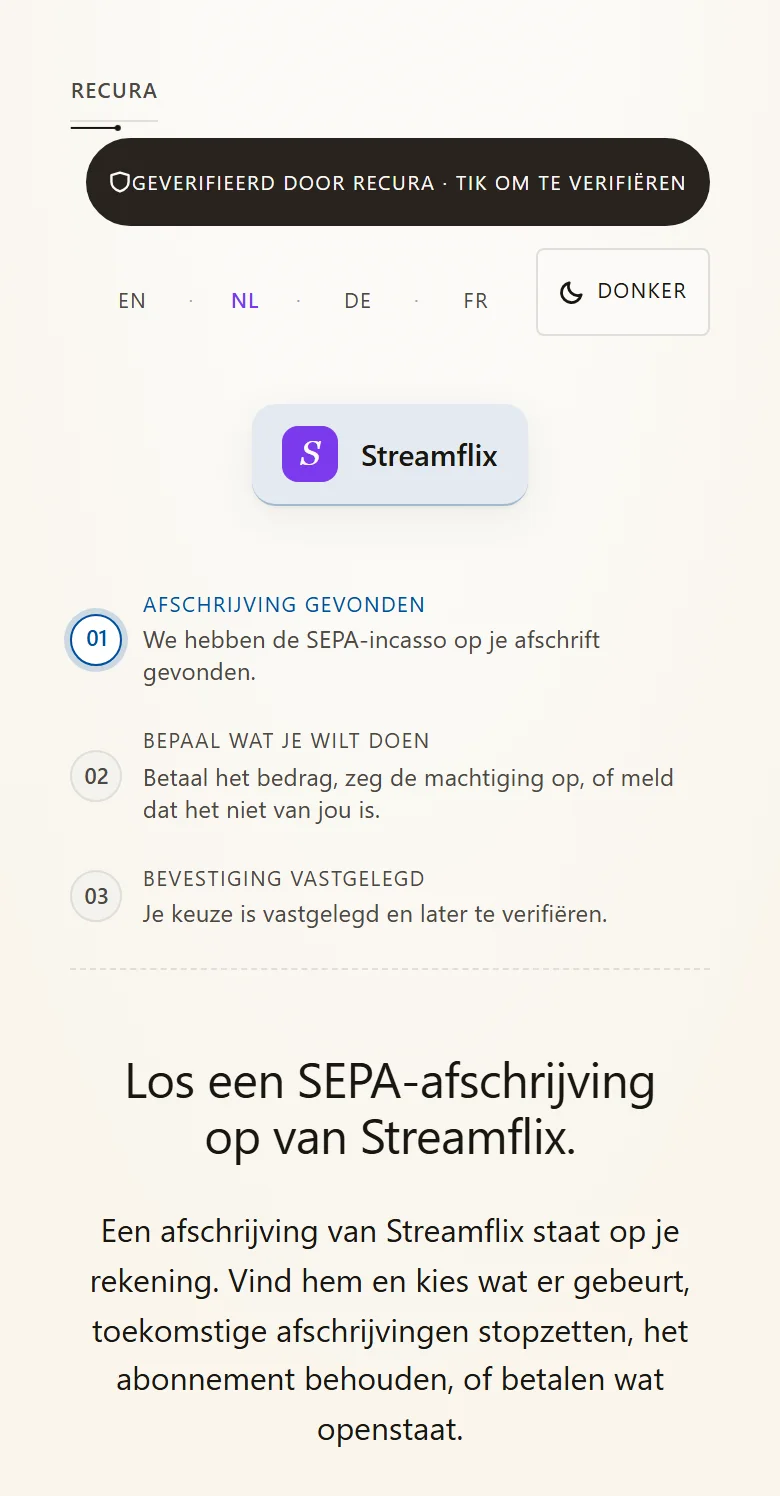
A customer who has taken a debit back can settle it with the business in a minute or two, on a page in the business’s own name and colours, so the return ends in a payment, a cancellation or a report to a person, not in a refund at their bank.
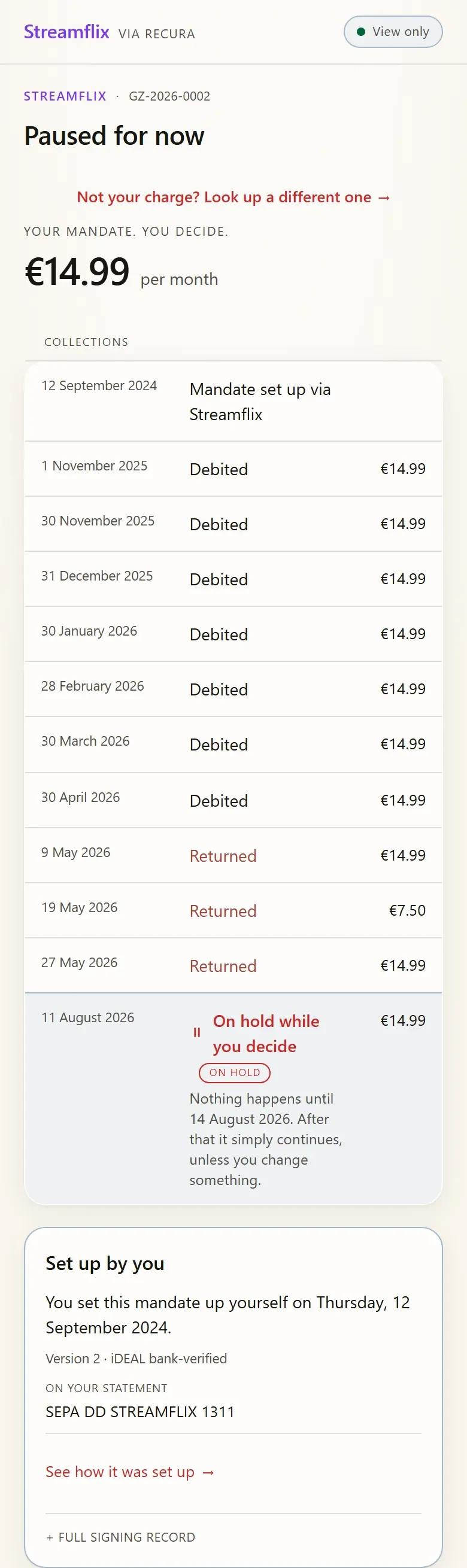
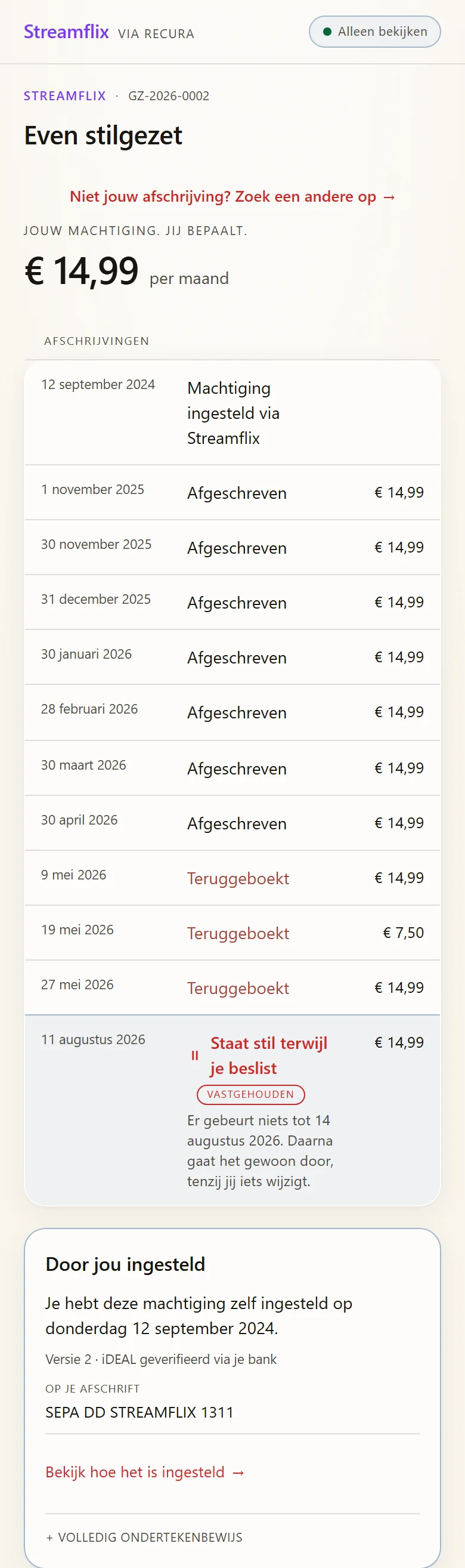
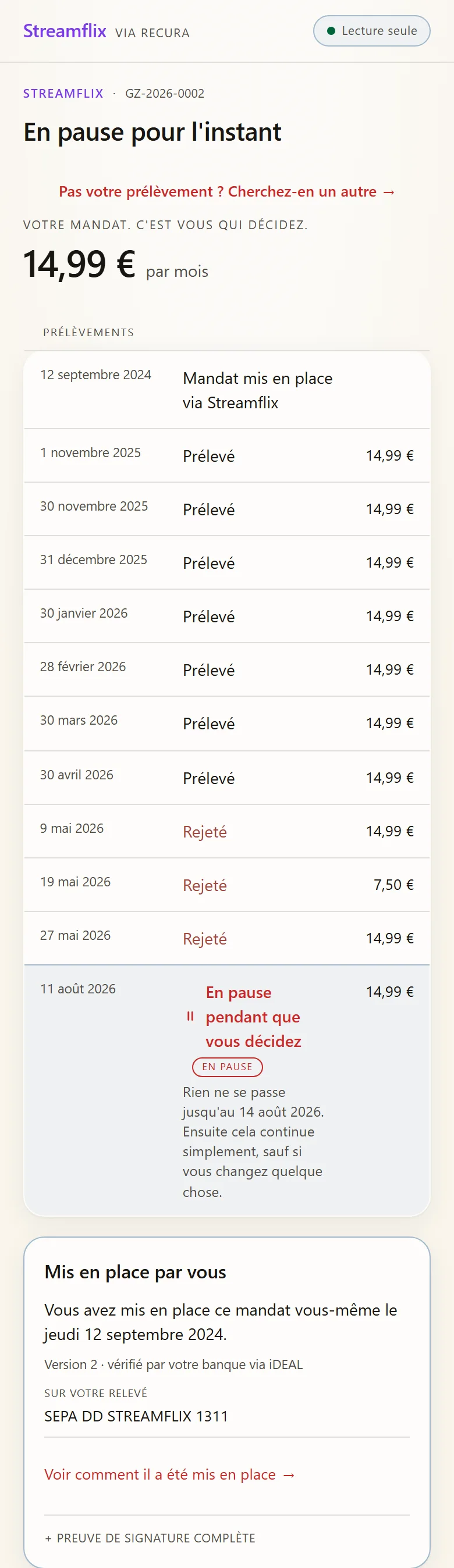
One Streamflix subscriber took back a €14.99 debit because they didn’t recognise it.
How a customer reaches the page, and why they open it
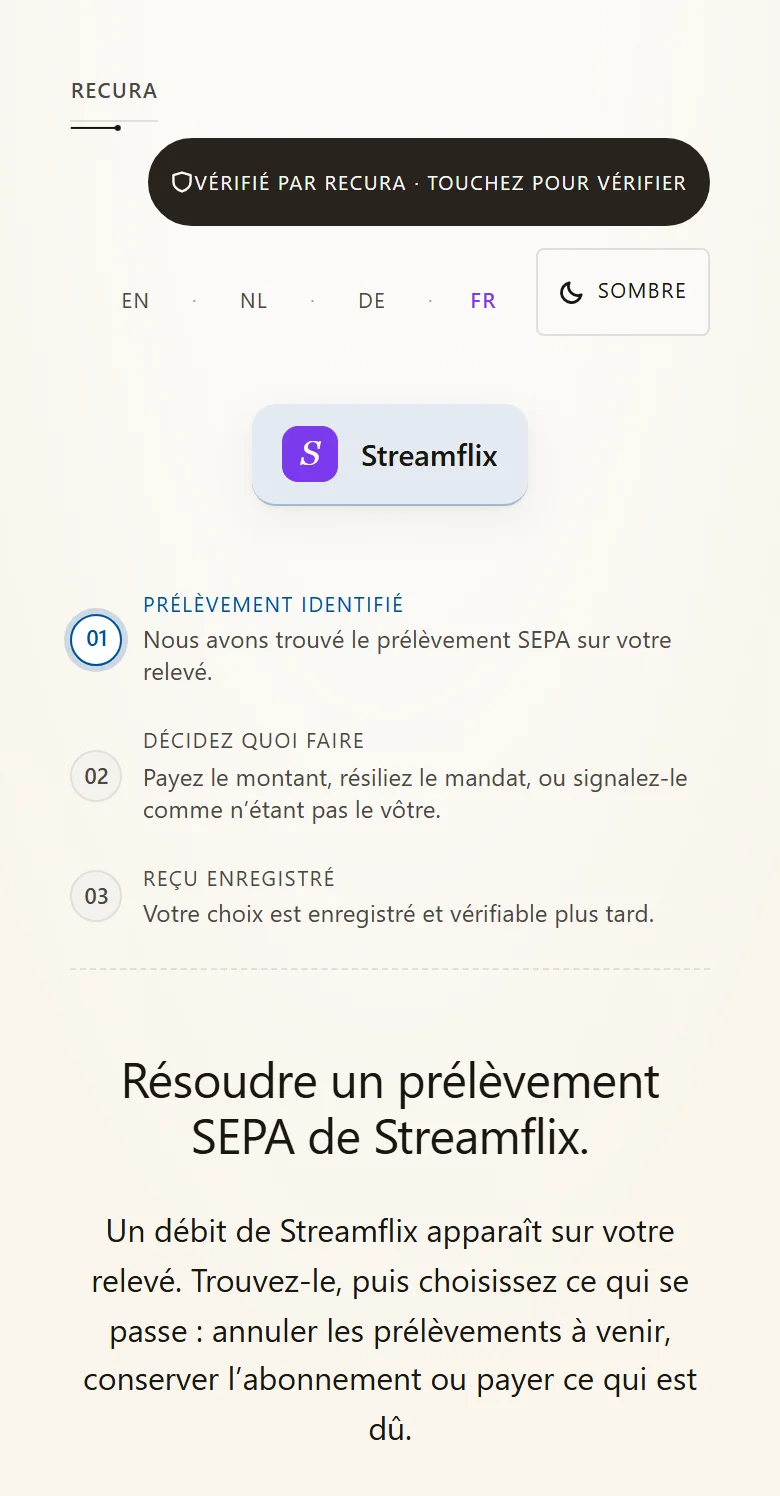
A message asking for money after a payment failed looks like a scam, and the customers a business most needs to reach are the ones who have learned to ignore it. Whenever the move Recura picks for a return is the customer’s own page, it writes to the customer in the business’s name, in English, Dutch, German or French. This is what the Streamflix subscriber received:
Streamflix via Recura
There was a problem with your payment to Streamflix
PAYMENT RETURNED
OUTSTANDING EUR 14.99
Your bank returned the collection. You can settle this in a couple of taps, or cancel cleanly.
A customer with only their bank statement finds the debit by the last four digits of their account number, the amount and the date, give or take four days.
The business can also put the page behind a QR code at a parking terminal or inside its own app.
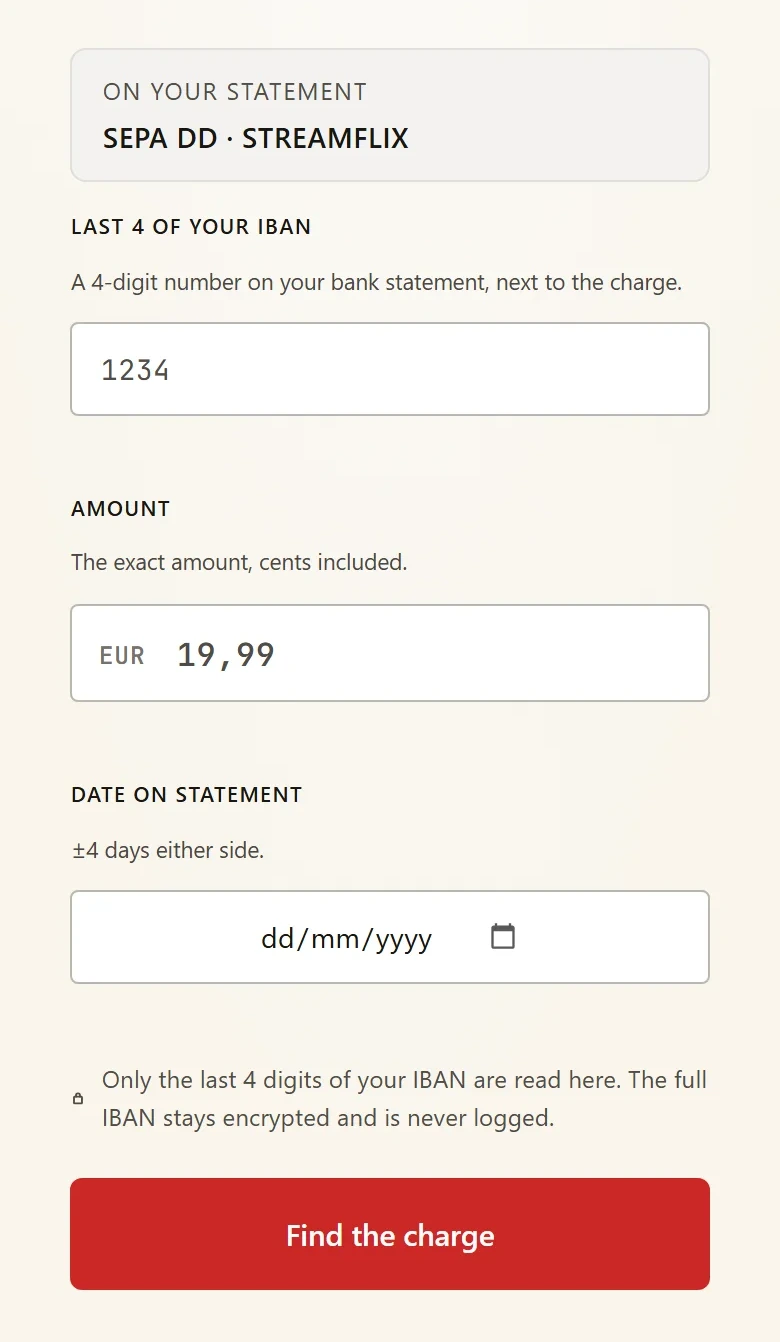
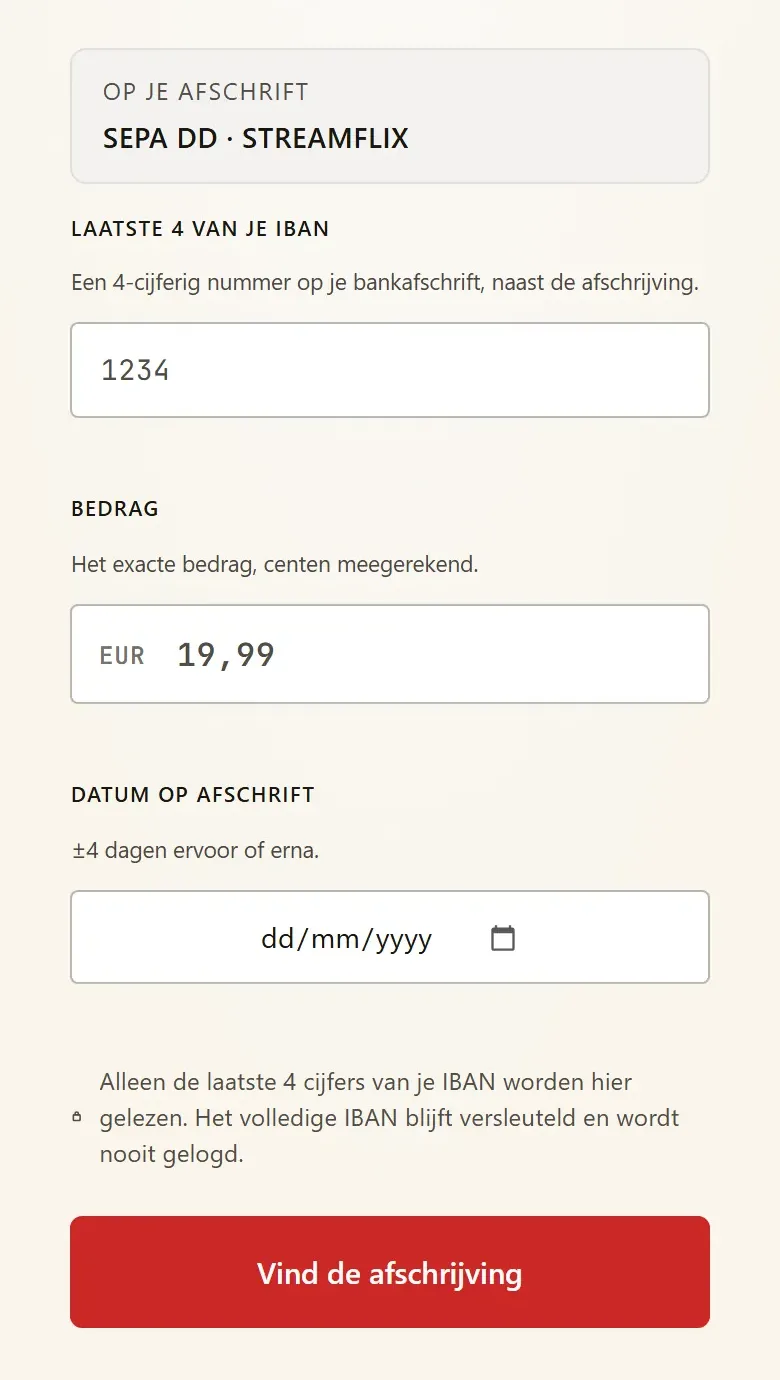
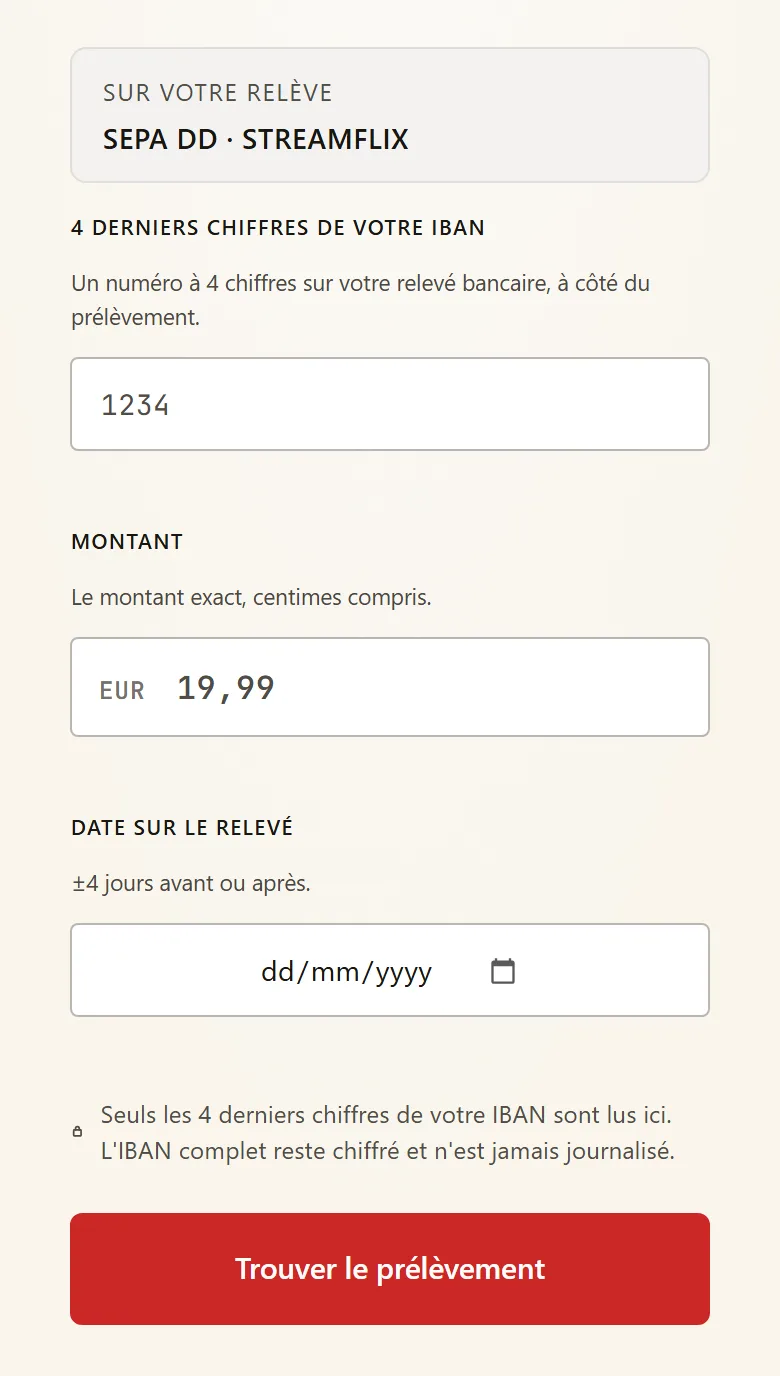
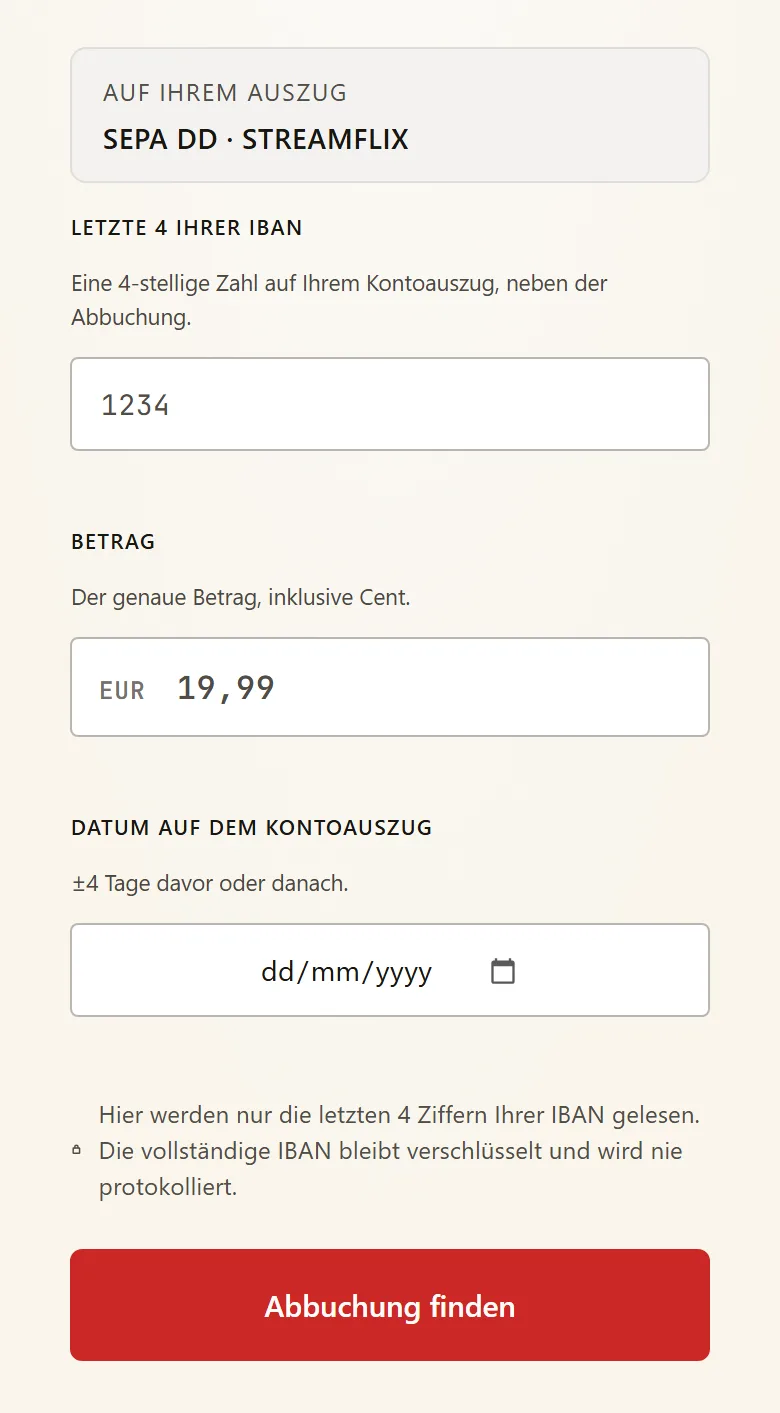
Before they pay or enter anything, the customer can check the page: it prints the address their browser should show, its reference is the one on their bank statement, and every receipt links to a public page anyone can check without an account.
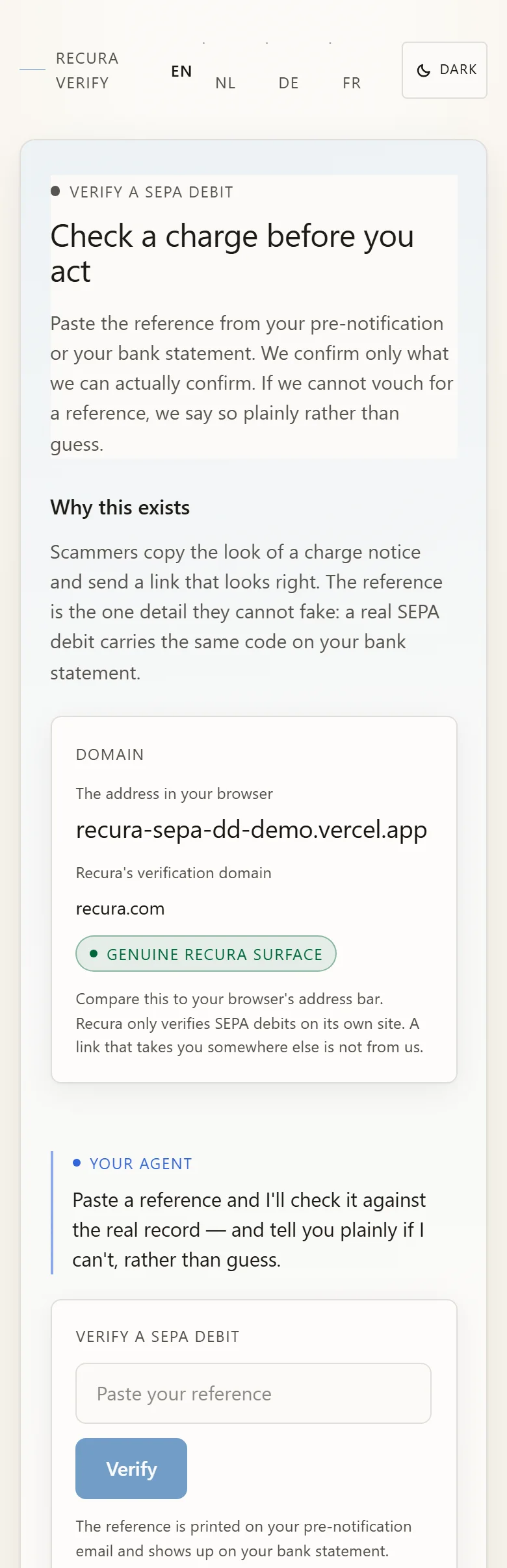
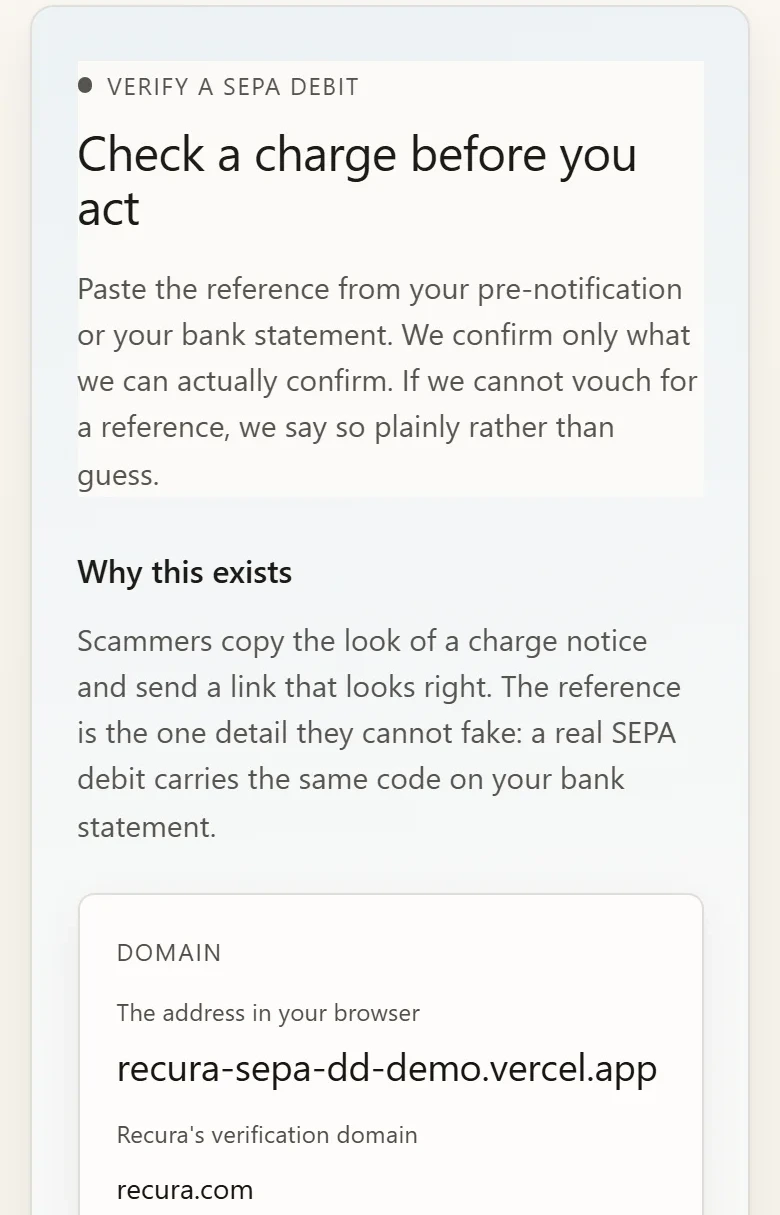
The page shows the customer why the debit is theirs
Most debits that feel unfamiliar are ones the customer set up a while ago, so when a customer presses “I do not recognise this”, I had the page show them the permission they signed before it offers a report.
The Streamflix subscriber reads that the €14.99 is their monthly subscription, set up on 12 September 2024 and confirmed through their own bank. They can open the record of that permission, which banks call a mandate, with every debit since.
A file of proof holds these same details when a customer tells their bank they never gave permission, and here the customer sees them first.
This subscriber recognises it. Recura holds their next debit while they decide, and they pay the €14.99 back on the page to keep the subscription.
What each choice on the page gets the business
Every visit ends in one result, booked with the business the same day:
A returned debit, open on the customer’s own page
- Paid in full through the business’s own checkout, straight to the business
- Monthly instalments, or one later day no fees added · the whole amount reaches the business
- Subscription cancelled future debits stopped · what they took back stays owed
- Reported as not theirs to somebody on the payments team · reviewed within 5 working days · no money moved
- Nothing chosen in the link’s 7 days recorded as lost or a file of proof that they gave permission, where they told their bank they never did
The page puts first the choice that fits why the customer came, read from the button they pressed in the email: instalments for one who can’t pay, a person for one who says the debit isn’t theirs. Every other way out stays on the page.
What telling a customer about their bank gets the business
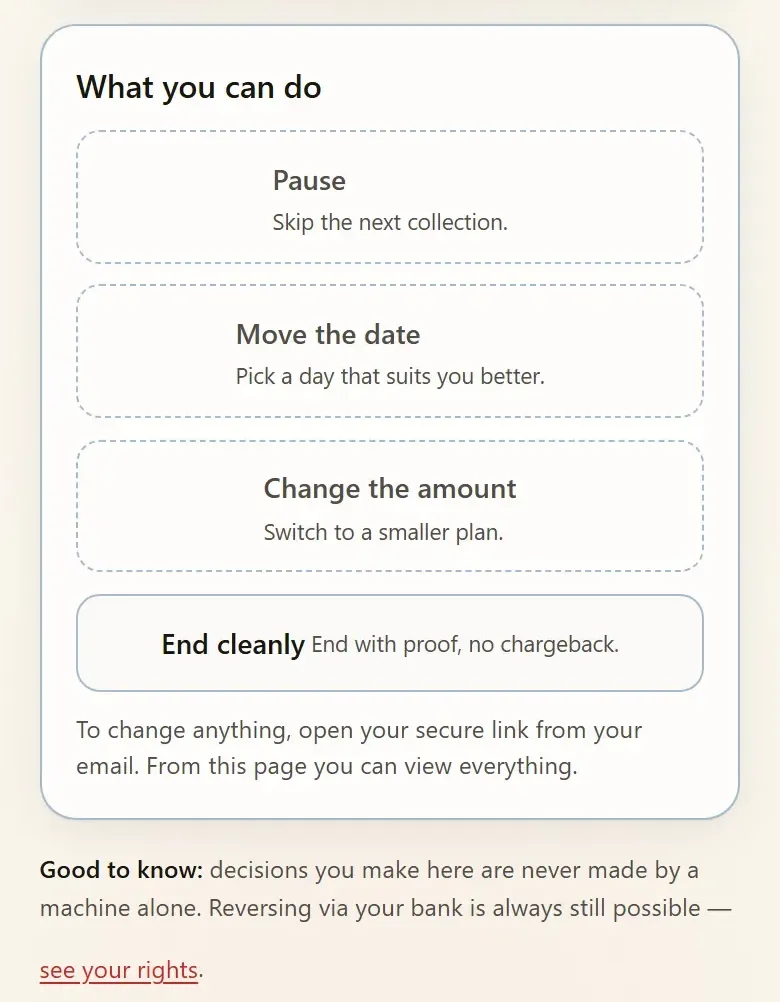
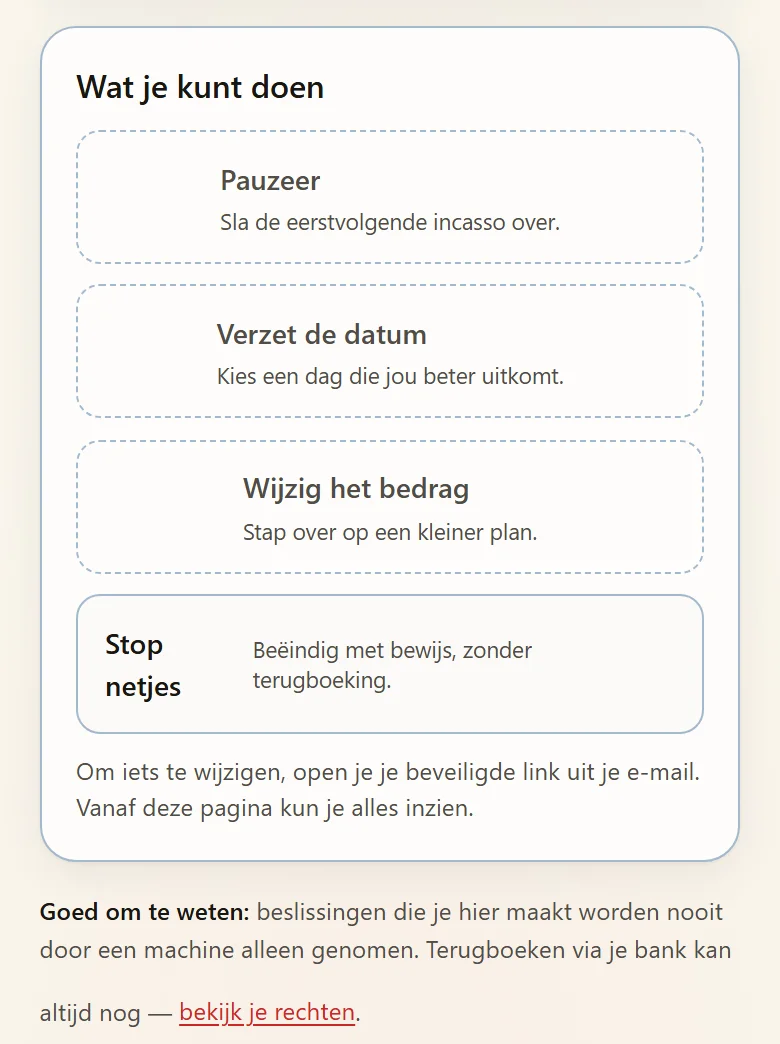
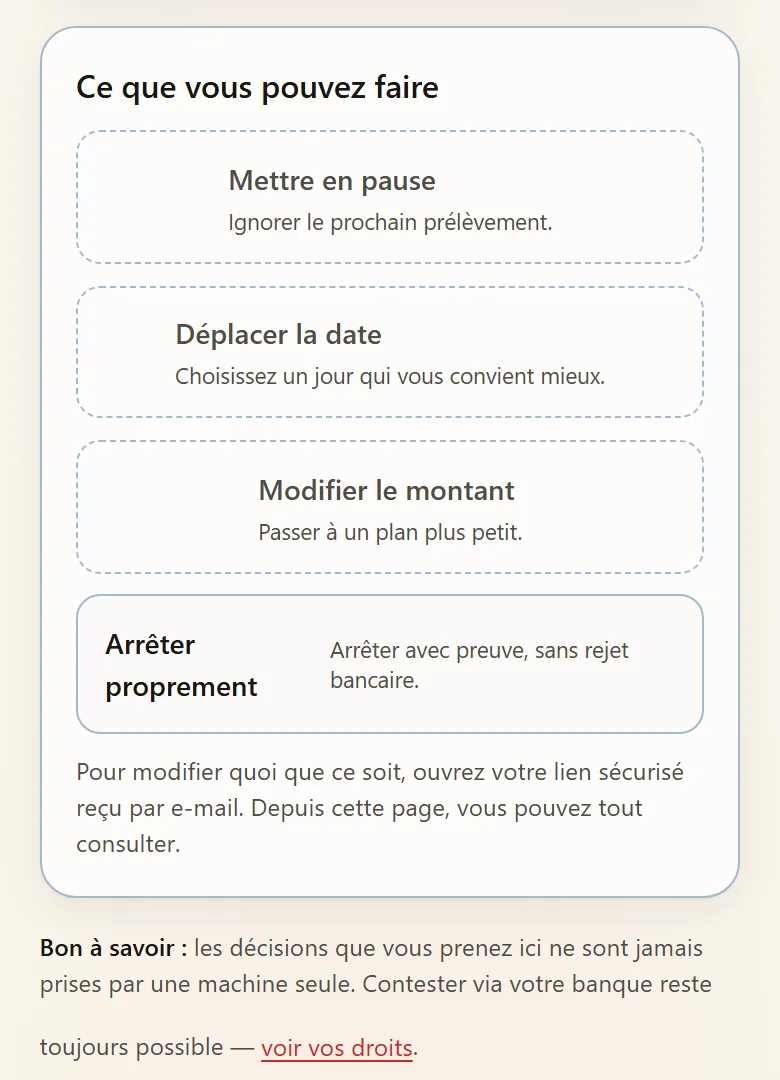
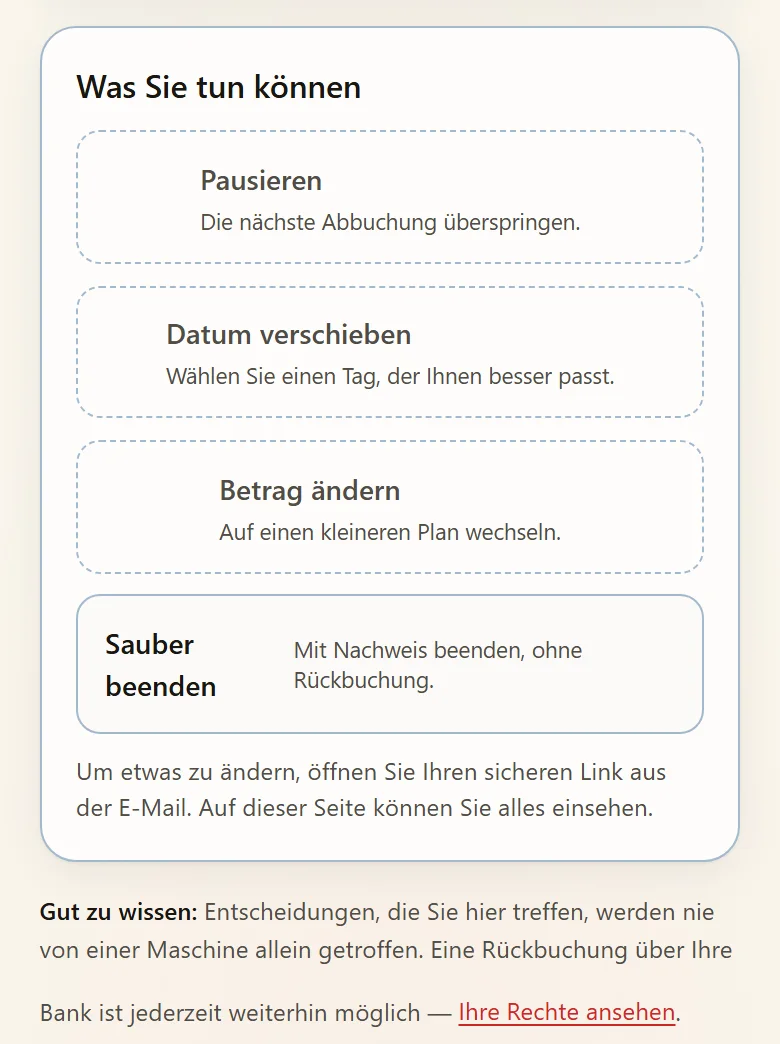
I had the page say plainly that the customer’s bank is still open to them. A page that hides the way out reads as a trap, and a customer who feels trapped goes straight to the bank; told first, they believe the rest of the page.
On a returned Streamflix debit, it reads:
Your rights here
1 Reverse it at your own bank
You can always have this debit reversed at your own bank — Streamflix cannot stop that. We never hide that path.
The money returns, but the agreement and the amount stay open: Streamflix can still contact you about it. Settling it here actually ends the matter.
What the customer keeps
Whatever they choose on the page, the customer leaves with a dated receipt and a link to the record of that debit, with no account to make, like a parcel’s tracking link.
I made it last thirteen months, as long as a customer can claim they never gave permission. A customer who cancelled holds a certificate they can show if another debit ever arrives.
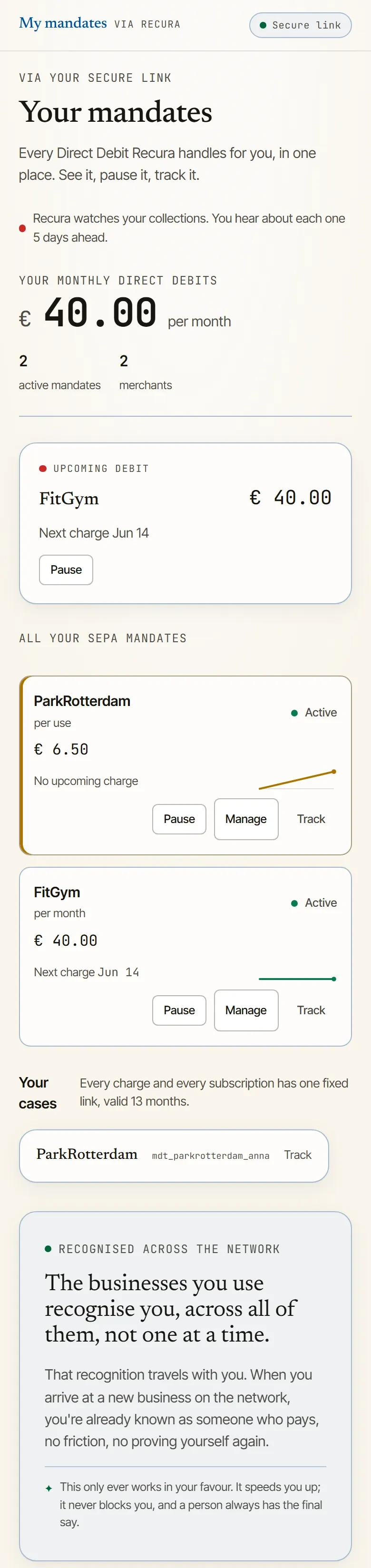
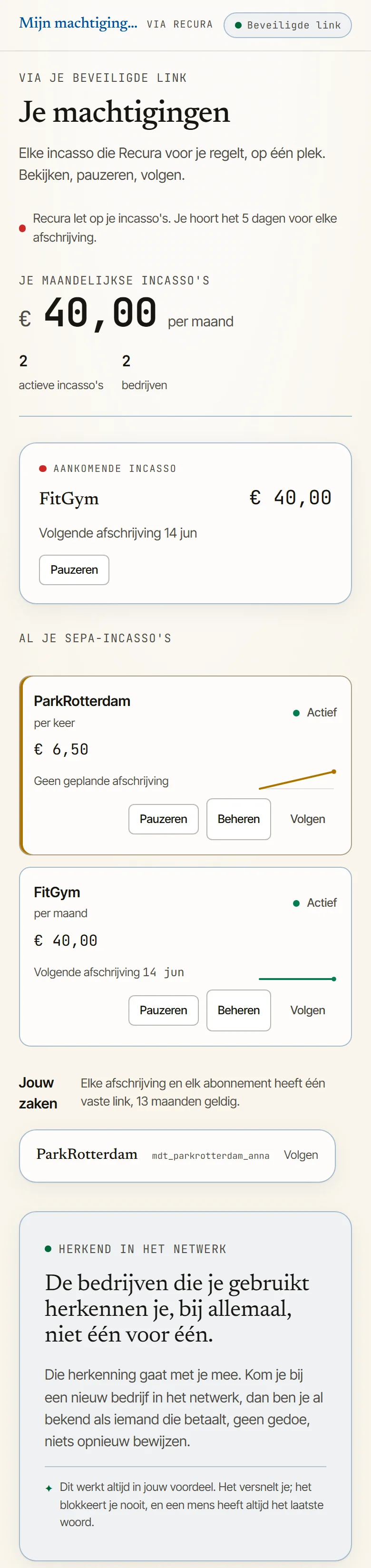
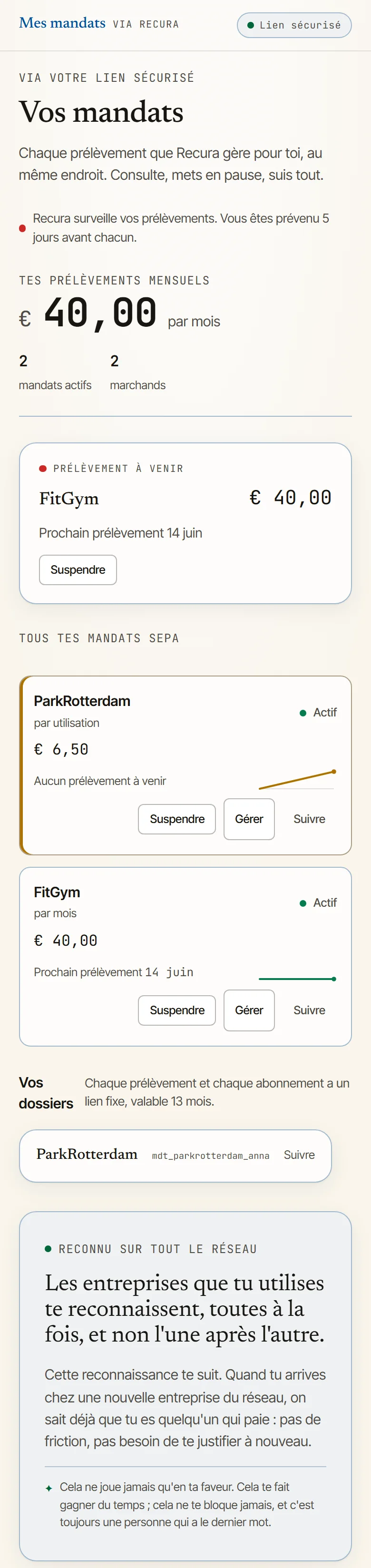
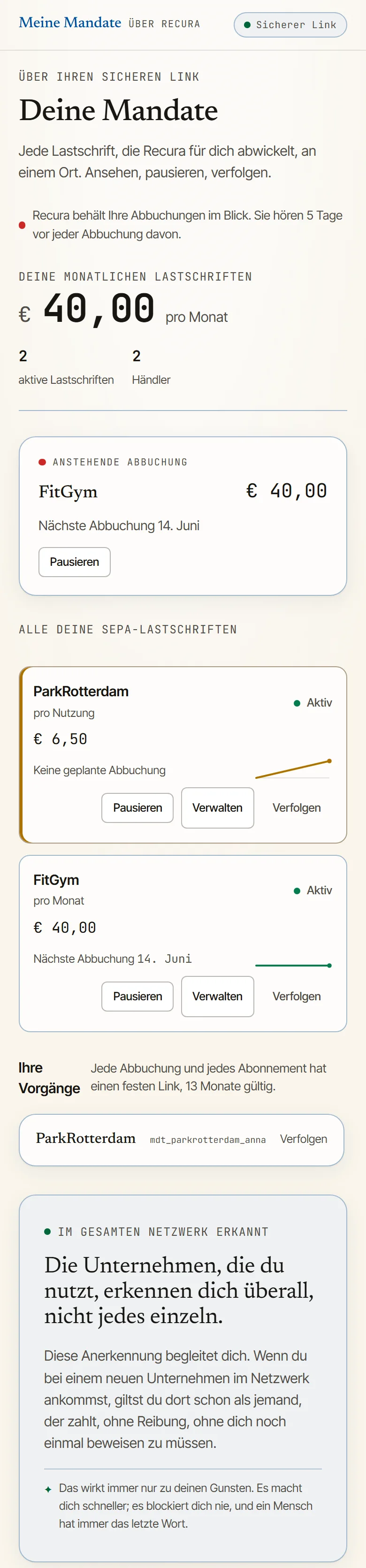
They can also open a list of every direct debit Recura handles for them, at every business on it, with the monthly total and when each is next due: a list no processor can show them alone, because each sees only its own.
One page for every business, in its own name
A business that comes onto Recura gets its page under its own address, in its own name, logo and colours, with nobody building one for it.
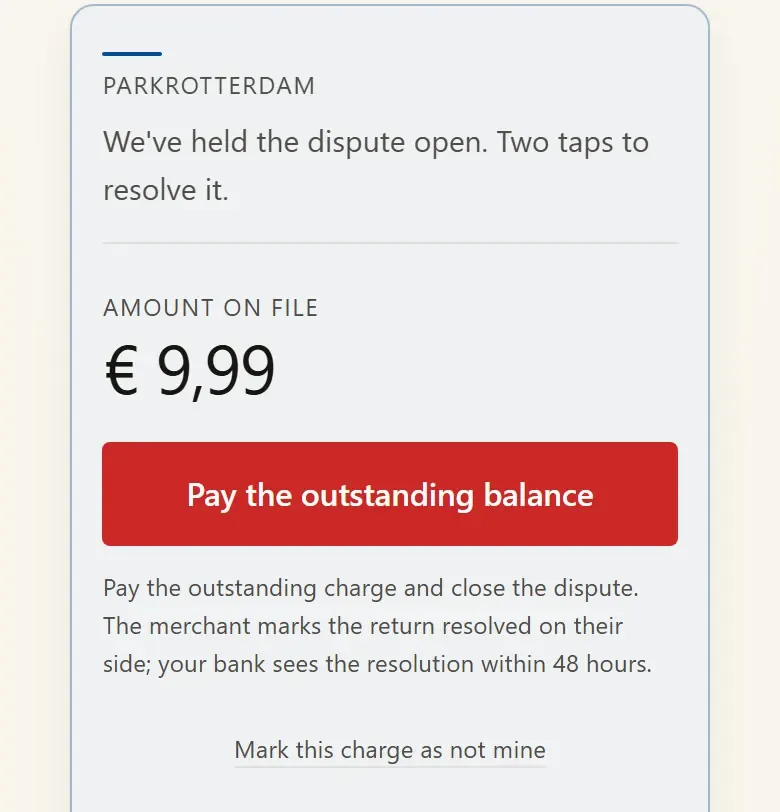
The page changes with how a business charges. For a business that charges per use, such as a car park, I had it name the charge by what it was, down to the parking zone and the minute, so the customer places a €9.99 parking fee at once. It leads with paying and has no cancel route, since a single charge has nothing to cancel.
What the payments team sees
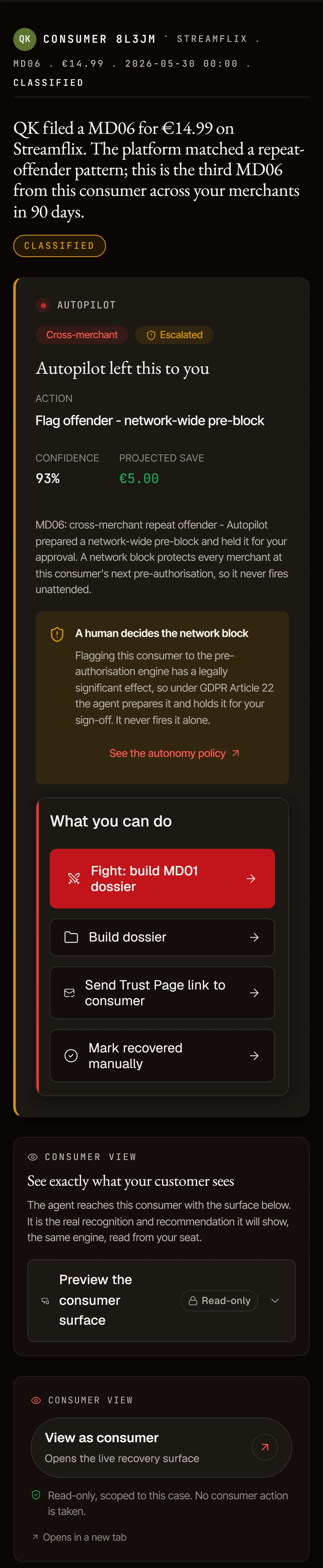
In the console, each return shows every step its customer took on their own page, from opening the email to the choice they made, and the team can open that page exactly as the customer sees it, so nobody has to ask the customer what happened.
The record also says why a return happened. A customer who tried to cancel properly on the page and couldn’t points at the business’s own cancel flow, and one who skipped the page chose to, which is a customer making a habit of taking money back.



Measuring what the page settles
The business gets the figure for its own returns and can change the page until it settles more.
The figure is measured against the customers Recura leaves alone on purpose, with nobody on the payments team touching a return.
4
Handling every return
A return reaches a business as a message from its processor, and Adyen’s reads:
- defendable:
- false
- disputeStatus:
- Lost
- defensePeriodEndsAt:
- 2026-11-12T23:59:59Z
Together the three tell the business it can’t defend the money, has already lost it, and still has a deadline to defend it.
When a processor calls a return lost, Recura’s work starts. It opens one case for every return, which it calls a dispute, and keeps it open until the money is back, the business lets it go, or nothing is left to try.
However often a processor reports a return, and in whatever order its messages arrive, it is one dispute. I set Recura never to write a return off just because a processor went quiet.
Each day the console opens on how many returns will run out of time this week, and the euros on them.
Each kind of return gets its own move
Every return carries a code from the customer’s bank that names its kind. Recura picks the move that keeps the most money from that code, the amount and what the customer has done before.
Recura
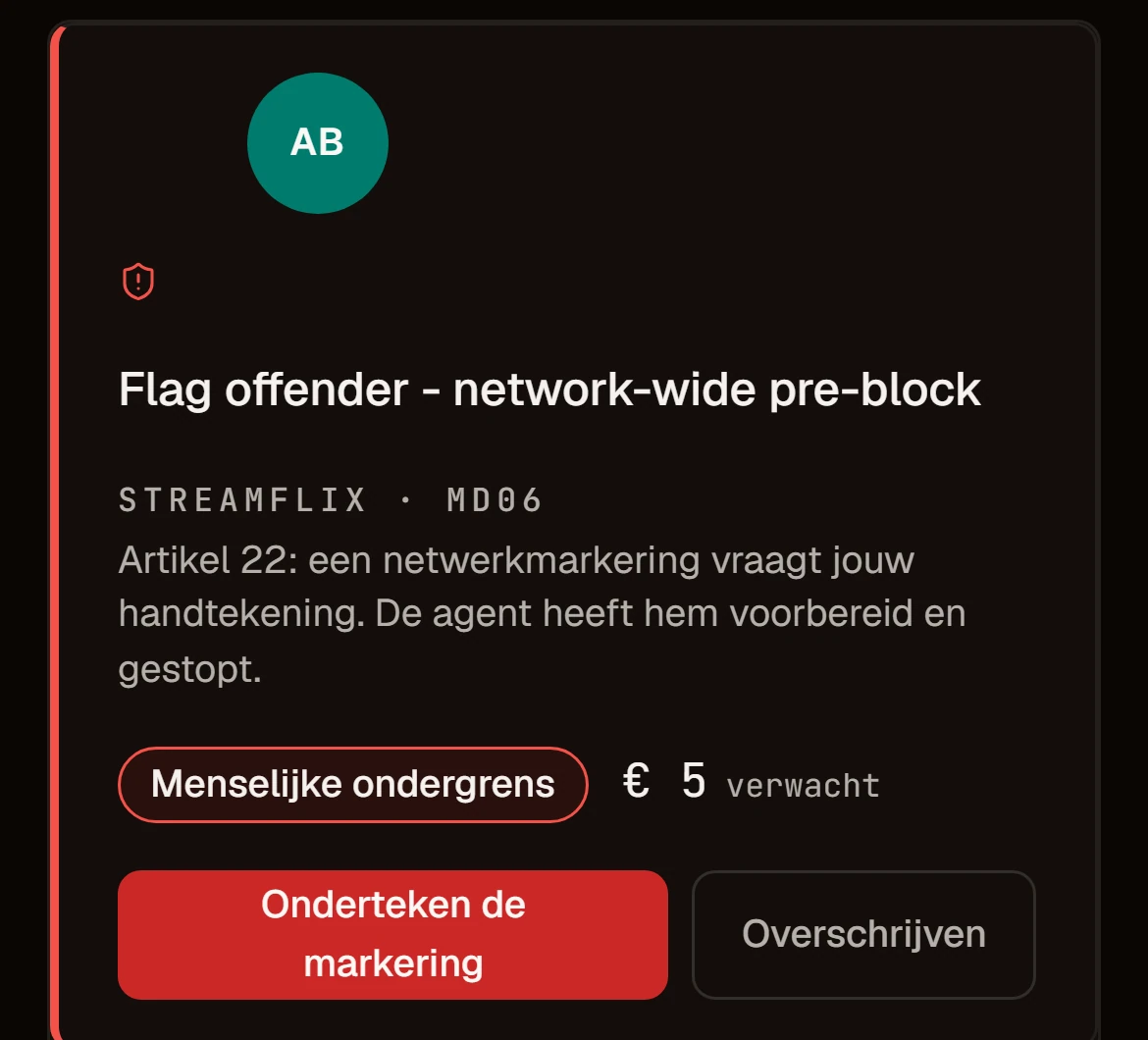
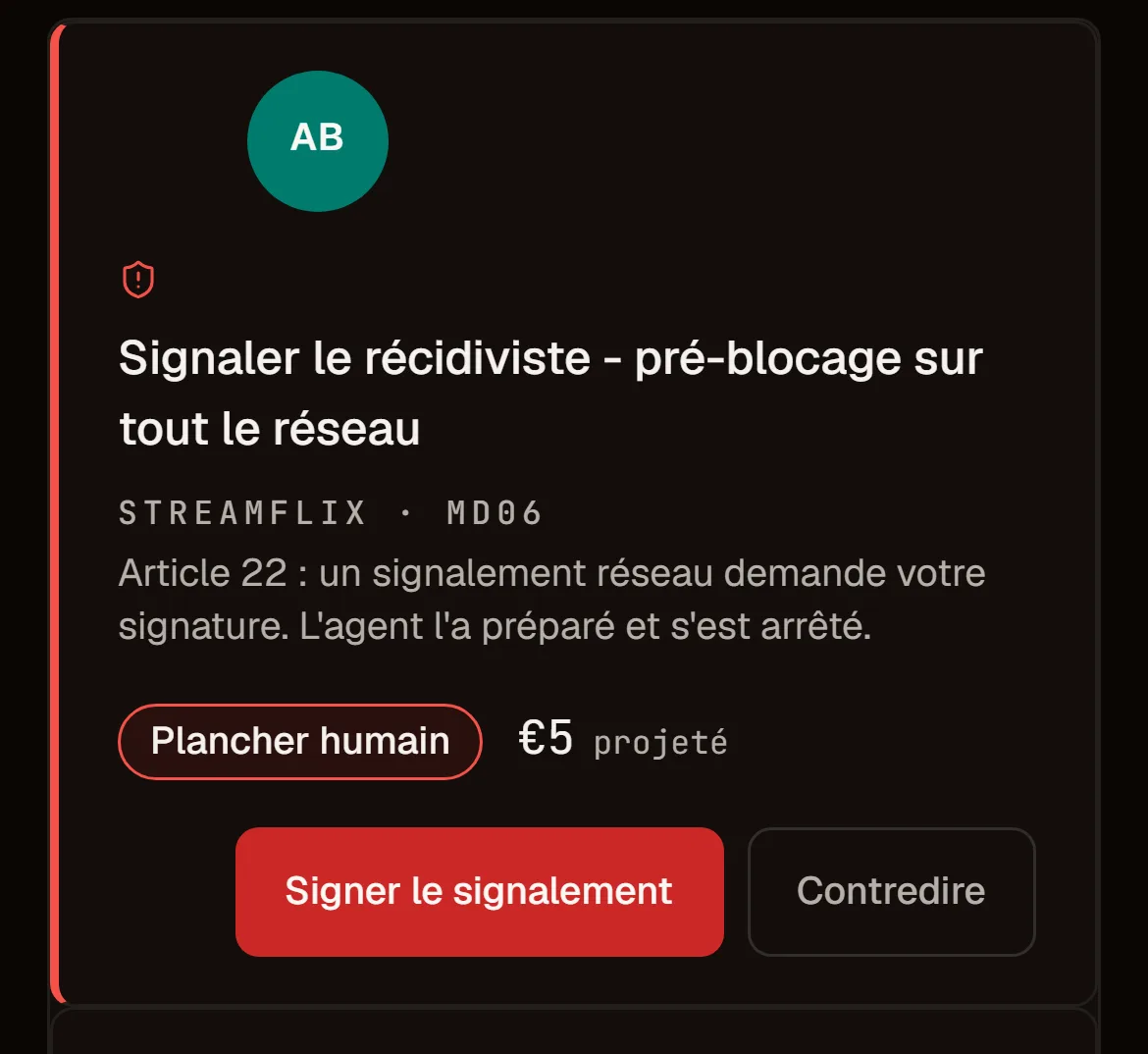
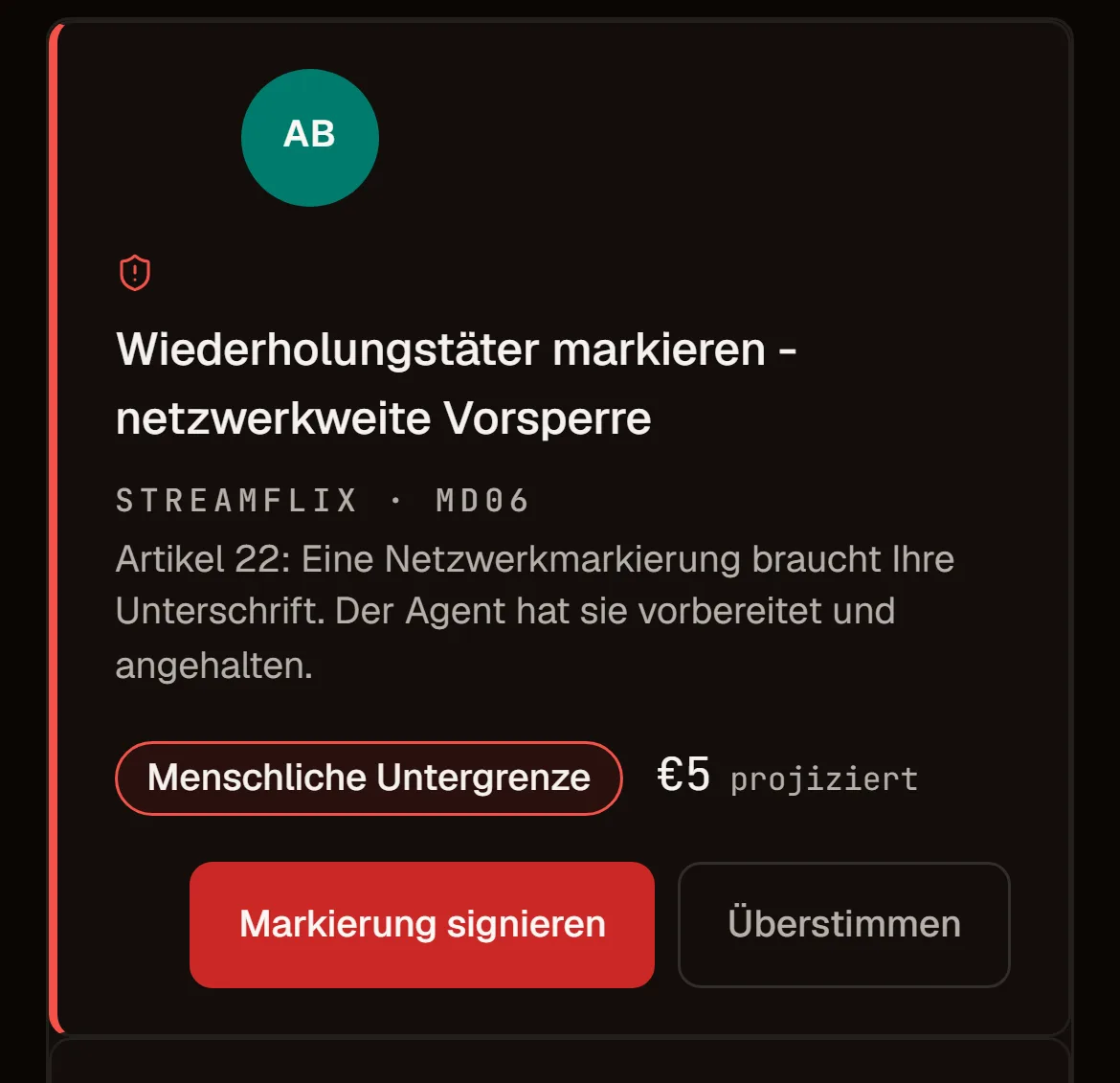
- Their third refund in 90 days MD06 Return let go Their debits stopped at every business on Recura, once the payments team signs if the three were at two or more businesses
- Any other refund in the eight weeks, or a debit they refused MD06 · MS02Sent to their own page to settle it
- A claim they never gave permission MD01 A file of proof that they did, for the payments team to use
- Bounced, the account short of money AM04
- Customer told it will be taken again
- Taken again 3 working days later
- Once more 5 working days after, if that fails
- Account closed or blocked AC04 · AC06 Return let go No more debits from that account until they give a working one
- Less than the business chases €1.50 return at a parking business Its charges: €2 to €8 Returns under €3 let go Still counted toward spotting a customer who keeps taking money back
- A code that gives no reason, or one never seen before MS03 Handed to somebody on the payments team
Whichever processor reports a return, Recura gives it the bank’s code for its kind and keeps the processor’s own wording beside it. A code it has never seen still opens a dispute, which waits for somebody on the payments team to classify it.
Behind every processor the dispute, its deadlines and its file of proof stay the same, and the startup went on to open its dispute handling to Mollie’s and MultiSafepay’s businesses.
Each dispute shows why Recura picked its move
The signals that decided the move are listed, each raising or lowering how sure Recura is of it, and one is the customer’s refunds at every business on Recura in the last ninety days. When Recura is unsure, or its signals disagree, it leaves the move to somebody on the payments team, with its reasons.
Proving that a customer gave permission
A customer can tell their bank up to thirteen months after a debit that they never gave permission; the claim reaches the business through the banks, which ask it for the signed permission, and the rulebook lets the business that can show it keep the money. Recura builds the file of proof on its own in about two minutes, against the 22 it estimates a person needs by hand.
Recura records when, how and from which internet address and device a customer signs a permission, taken from the signing itself, never from what their browser reports. The file shows the version in force on the day of the debit, even after the customer has changed plan and signed again.
Where the processor kept no copy of the signed permission, I had Recura draw up a record of the signing from those details, so the proof exists even when the claim comes thirteen months on.
Recura grades every file out of 100 for how much proof it holds; one Streamflix subscriber’s file for a €14.99 debit grades 100.
4 March 2025 Signed through their own bank
14 debits paid
14 May 2026 Notice delivered
28 May 2026 €14.99 taken
100 of 100
- 35 every file starts with
- 25 signer confirmed
- 15 notice delivered
- 10 risk score recorded on the day of the debit
- 10 three or more debits paid before
- 5 signed through their own bank
From the file of proof to a demand for payment
The file of proof
- A strong file A demand for payment, payable through a link to their own page
- Cooperative demand · 14 days to pay
- Firm demand · 7 days
- Final notice · 5 working days
- Handed by the business to a collections agency or its lawyer
- Thin proof of who signedAn invitation to settle on their own page Keeps the customer, and the money can still come
- A notice that never reached them A request to confirm their contact details No further debit until they do
Recura drafts each demand from the file, in English, Dutch, German or French, and somebody on the payments team signs it before it reaches the customer. Signing seals the file: the customer, or a lawyer the business shows it to, can check on a public page, with no account, that none of its facts has changed since.
The demand for the Streamflix subscriber reads:
Payment-demand letter draft
Your bank returned the payment of €14.99 dated May 28, 2026. The mandate you signed on March 4, 2025 authorises this collection. We invite you to settle within 14 days via the secure link below.
At one parking business, customers pay 14% of the €5 to €10 charges they told their bank they never gave permission for, within 30 days of the demand. A payment closes the dispute, counted to the cent with everything else Recura kept for the business.
Every ending says where the money came from
A debit stopped before it was taken is booked to the block, signed at another business, that stopped it.
Every correction the payments team makes is kept as a labelled example, so the startup’s own team can train a model on them. A win rate is counted from endings like these.
- Settled on the customer’s own page
- Paid on a demand
- Taken again and cleared
- Entered by the payments team
- Debit stopped by a block signed at another business
- Let go
The ending, with its euros and its source
Labelled examples, corrections included, for training a model
5
Recognising a customer across businesses
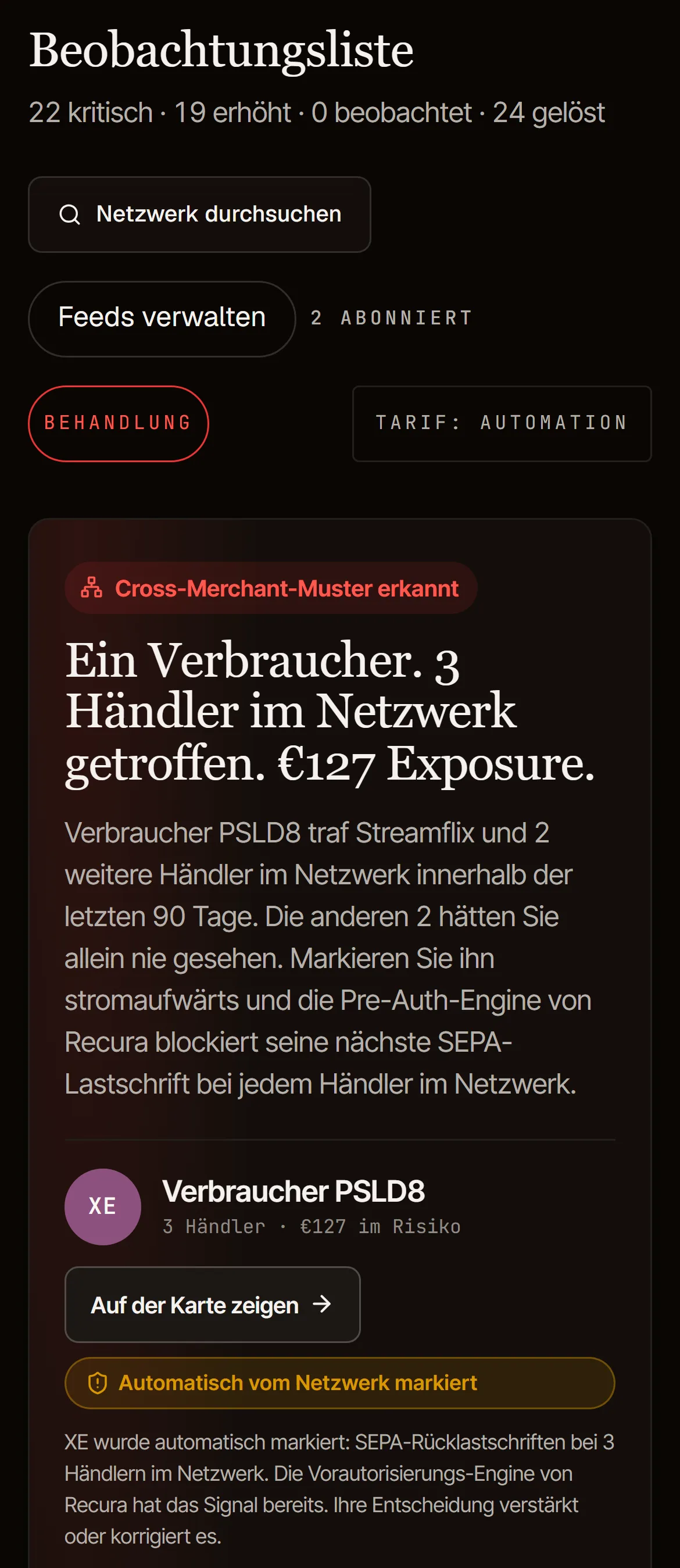
Recura puts one customer’s refunds at every business on it together, so a habit no business can see alone is stopped before the next debit is taken.
On the platform, 85% of the customers a business has flagged have also taken money back at other businesses.
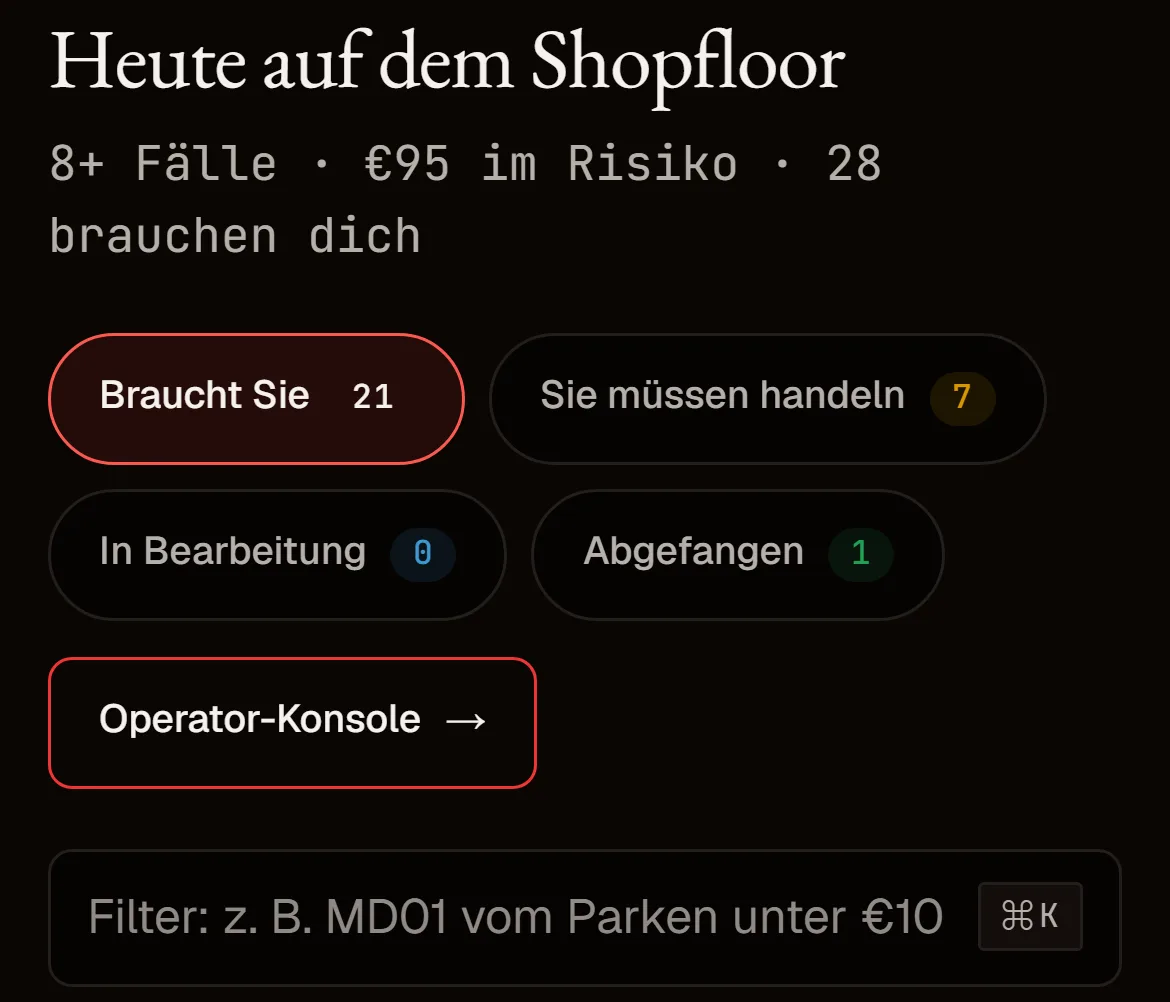
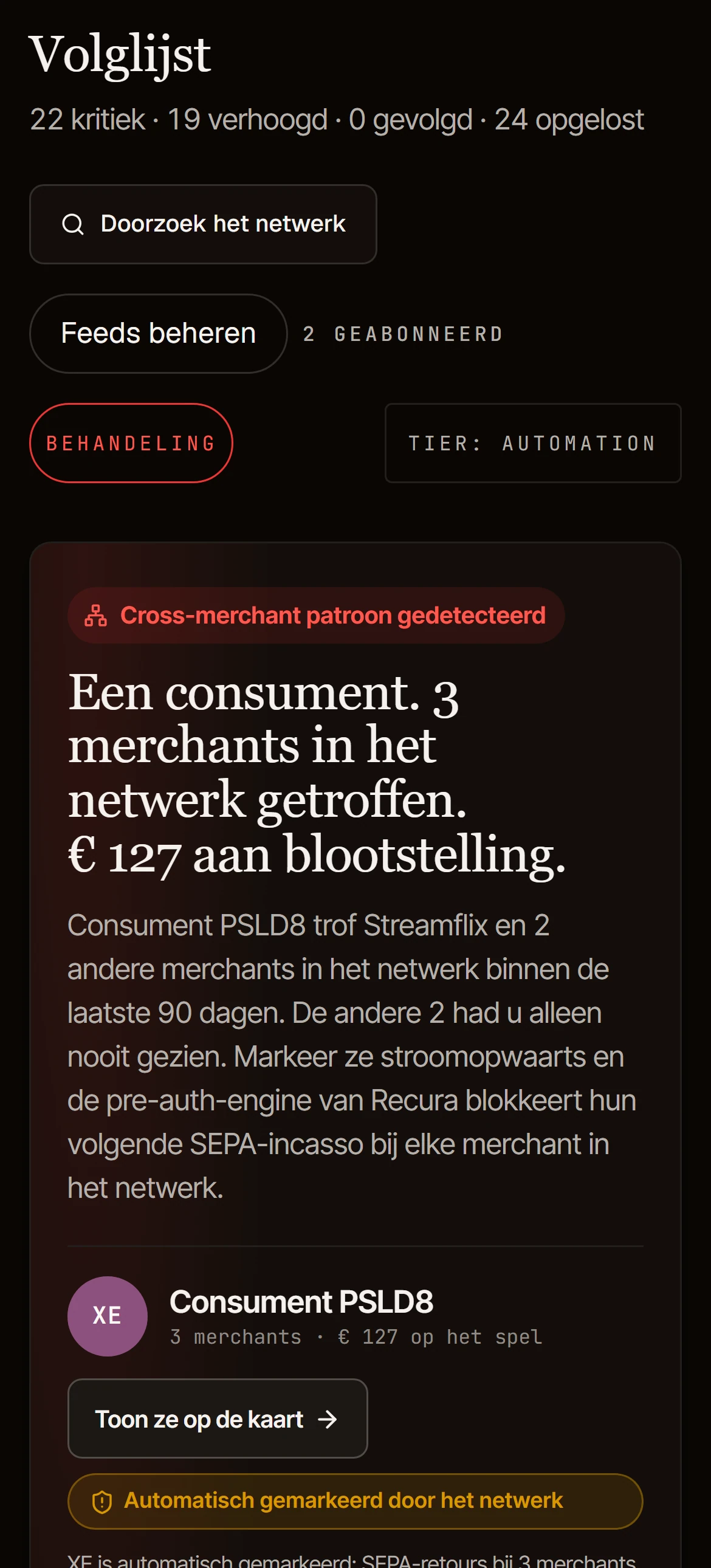
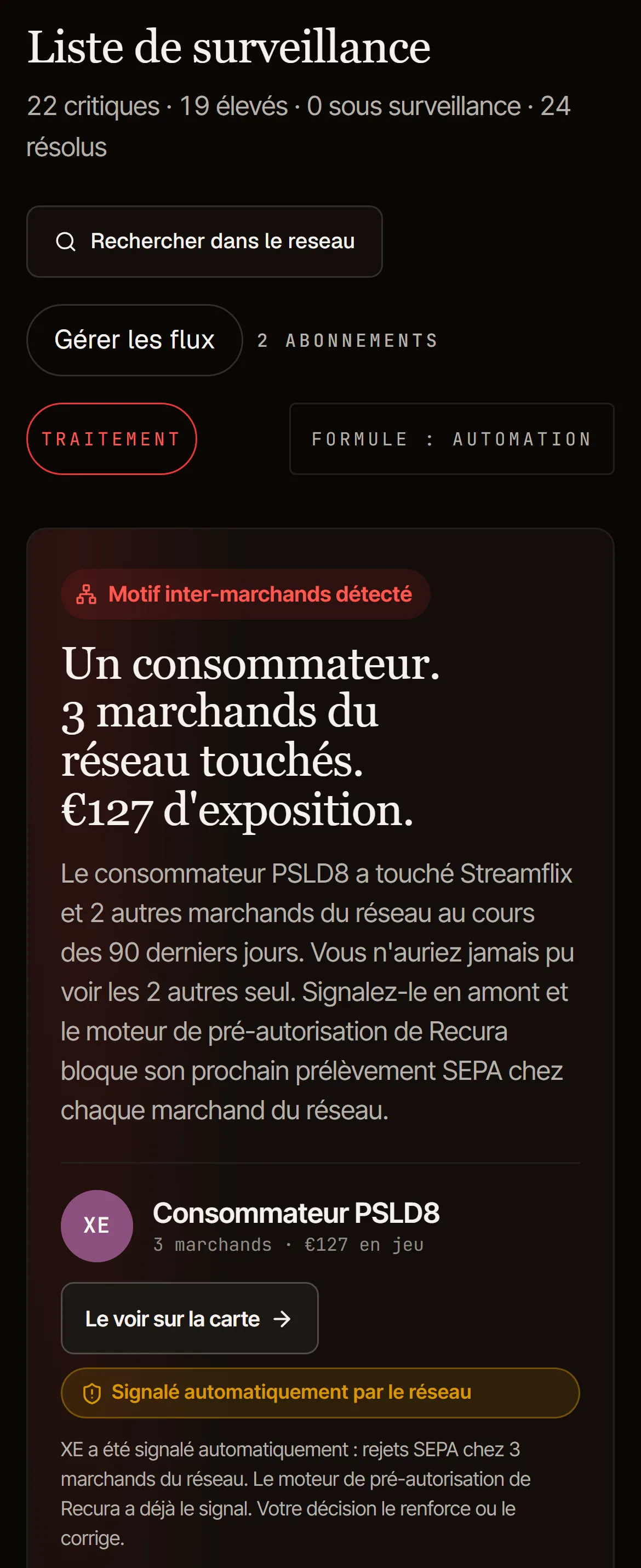
The watchlist, a view of the console, lists these customers with how many businesses on Recura each has taken money back from.
It tells three kinds of customer apart:
- one who looks deliberate, with three refunds inside two weeks;
- one whose refunds all sit at a single business;
- and one who pays when asked and is invited to settle on their own page.
How Recura knows it is the same customer
A business gets the benefit of every other business’s refunds without seeing their customers or a single account number, because Recura turns each customer’s account number into a fingerprint.
Streamflix
a customer’s bank account number, on a debit
ParkRotterdam
a parking business
the same bank account number, on a return
Recura’s secret key
one fingerprint, 64 letters and digits
There are so few Dutch bank account numbers that a computer can try every one, so scrambling them alone would protect nothing. I made the fingerprints with a secret key that never leaves Recura, so nobody can turn one back into the number.
A customer who takes money back at a business on one processor and at a business on another is still one customer. Each business sees only its own customers: what reaches it from the others is counts, and how sure Recura is of the match.
One customer’s refunds at two businesses, and her next debit stopped at a third
Streamflix saw two of her refunds and ParkRotterdam one, so neither saw a habit. Recura saw three in nineteen days.
- 11 May
- 21 May
- 30 May
- 31 May
- 1 June
Recura
all three refunds matched to one fingerprint
a block on her debits, prepared by the overnight agent
Streamflix
€14.99 debit she asked her bank to refund
€14.99 debit she asked her bank to refund
block signed by somebody on its payments team
ParkRotterdam
€7.50 debit she asked her bank to refund
FitGym
a gym that has never had a refund from her
her next debit, stopped before it is taken
the block, at every business on Recura
Whose debits stop
The debits stop of every customer with three refunds in ninety days at two or more businesses, as hers did.
130 customers making a habit of refunds
120 caught
69 of them that no business alone would have stopped
10 missed
the other 7,880 customers
none caught
Those 69 never had three refunds at any one business. I set the rule at three because at two it would also have caught 25 customers who weren’t making a habit of it, and at four it would have caught only 78 of the 130.
A business can also write a rule of its own, and see on its past refunds whom each setting would have stopped before it adopts one.
2 refunds · 41 customers · €1,638
3 refunds · 17 customers · €679
4 refunds · 6 customers · €239.60
5 refunds · 2 customers · €79.90
What the payments team sees and decides
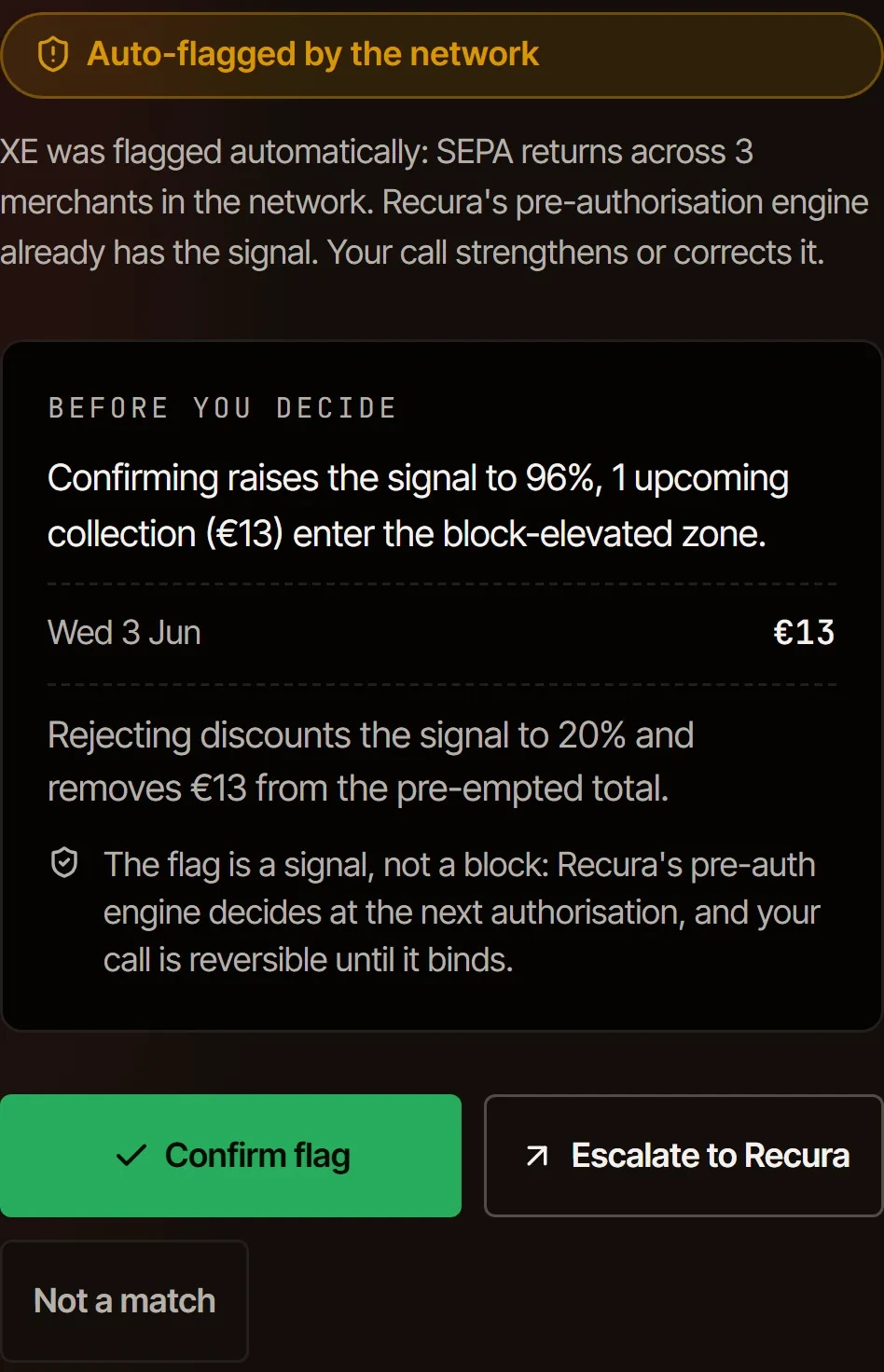
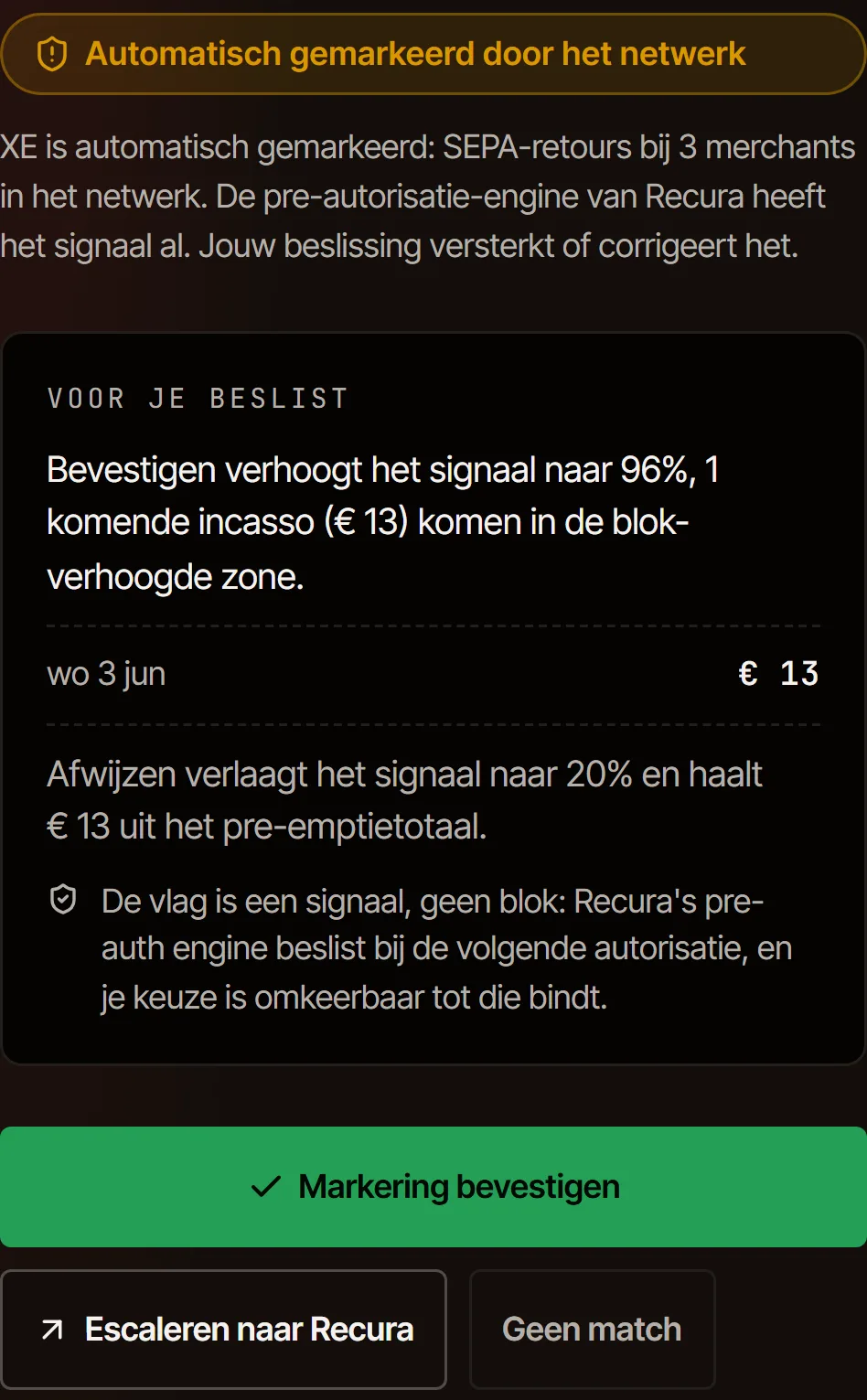
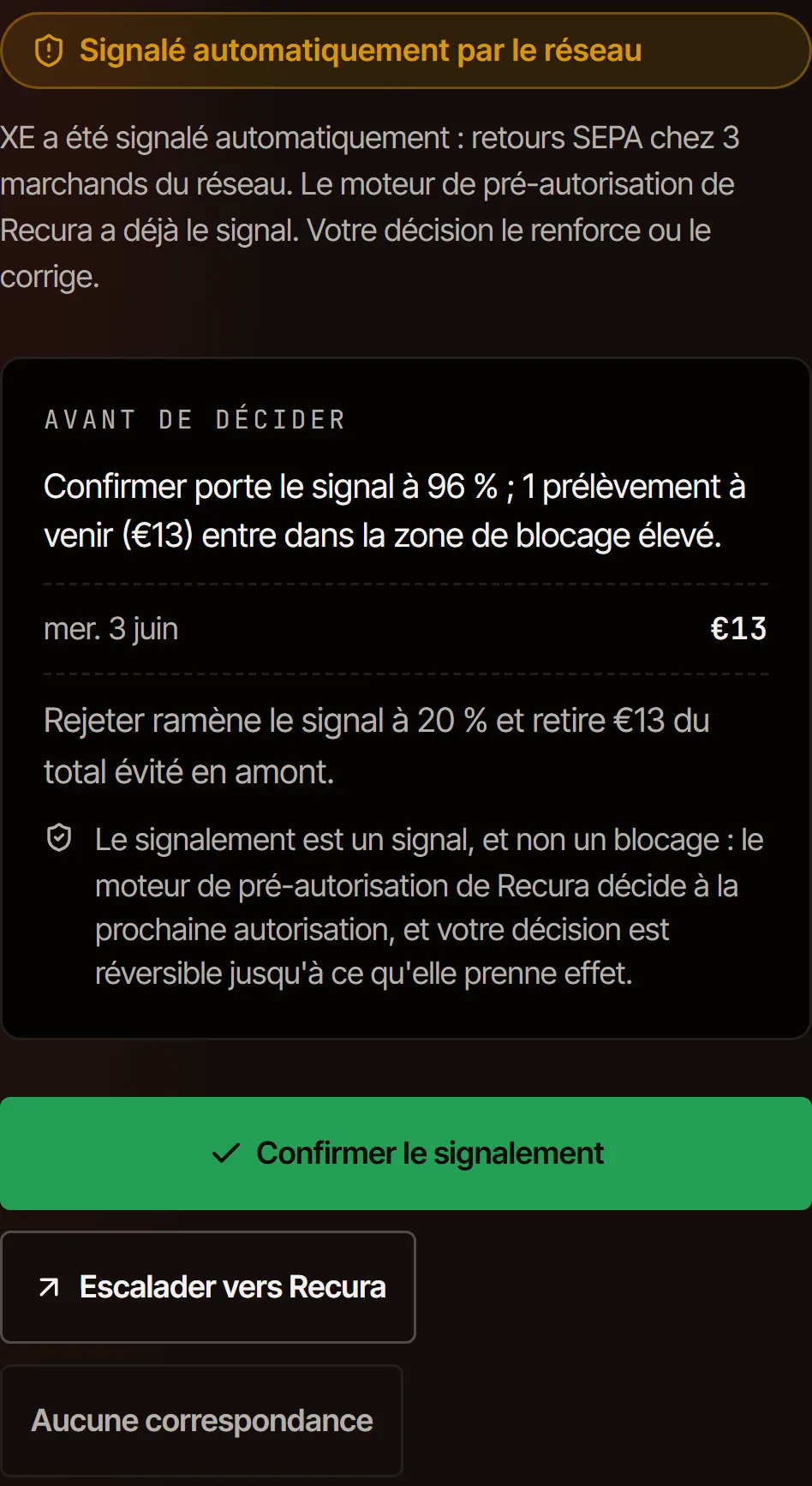
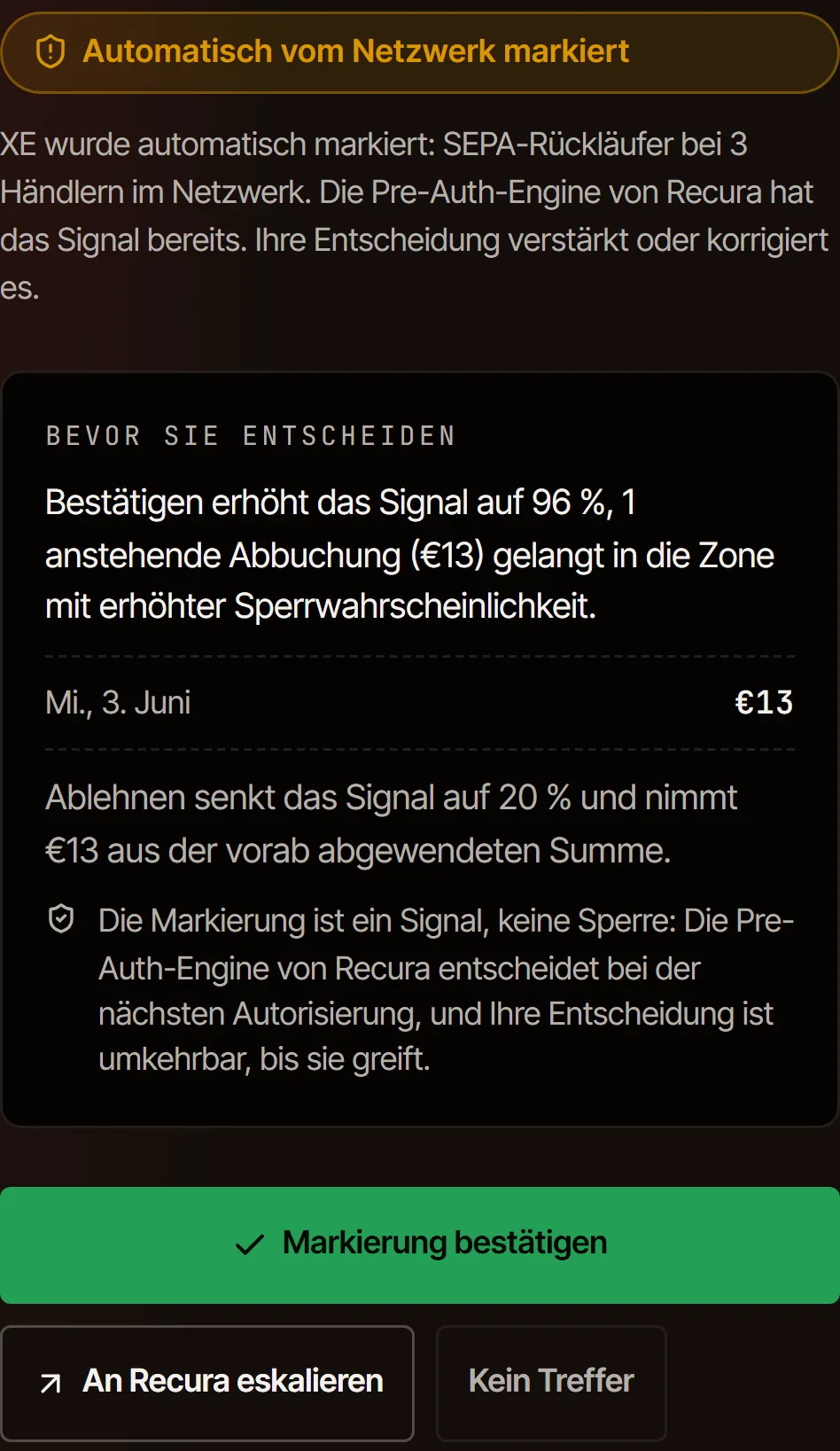
Before Recura’s flag on a customer becomes a block, the payments team sees the business’s own upcoming debits it would stop, with their amounts and dates.
When the team authorises it, Recura sets what the customer has cost this business beside what the same pattern puts at risk elsewhere, and ends on how much was protected and at how many businesses.
The standing a customer carries from business to business
A customer who pays every debit at every business on Recura is in good standing, and any business they start paying sees that before it takes their first debit.
A refund counts against a customer’s standing. I made one the customer then pays back count in their favour, though the refund stays in their history. Settling a charge on the business’s own page counts too, and that page tells the customer what each way of settling leaves on their standing.
The customer sees it too, on their own list of every direct debit they pay.
6
The overnight agent
The overnight agent is an AI agent that doesn’t wait to be handed work. Every five minutes it goes through the business’s open returns, each with its own deadline running, and takes up any that nobody owns yet, so a return doesn’t run out of time because nobody got to it. A business with 100,000 orders a month can have thousands open at once, and the agent works them while the payments team is away.
For each move Recura picks, the agent does one of three things:
- Makes the move alone.
- Prepares it, ready for one click from somebody on the payments team.
- Leaves it to the payments team to decide.
The console lists what it prepared and what it left in one view, and each item says why the agent did not act alone.

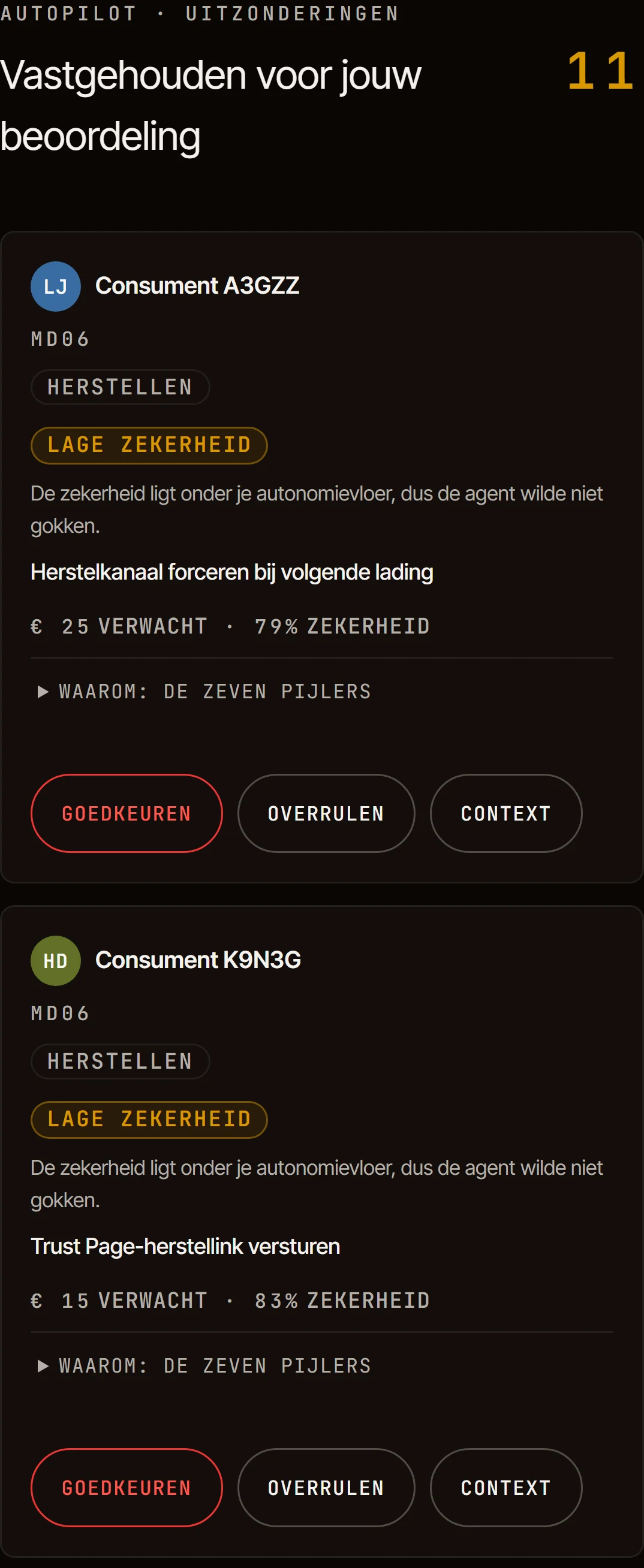
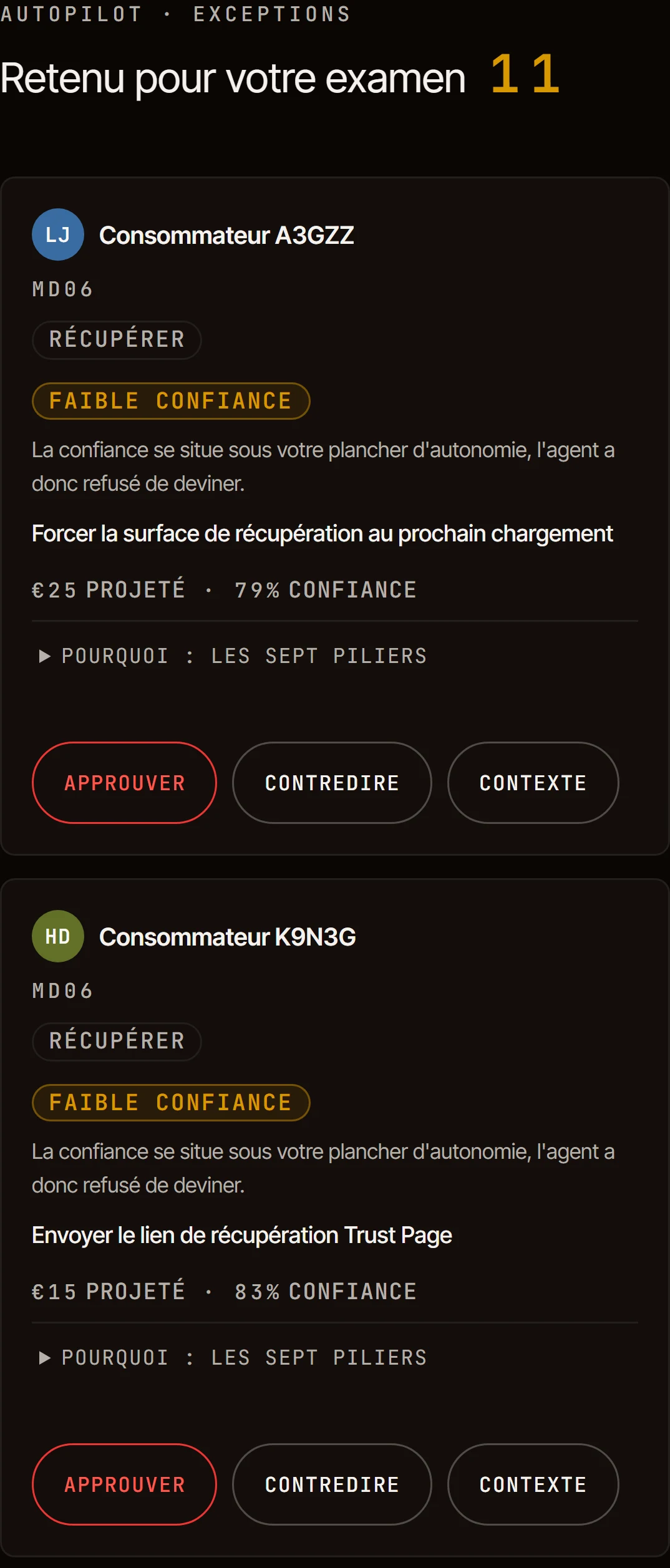

How far the agent goes on its own, and what always waits for a person
The business chooses one of three levels: Conservative, Balanced or Aggressive. Each sets how sure Recura must be of a move, and how much money it may involve, for the agent to make it without asking.
I built the agent to the standard I call money-grade AI, and set it to act alone only on moves that can be undone and decide nothing about the customer, whatever level a business chooses.
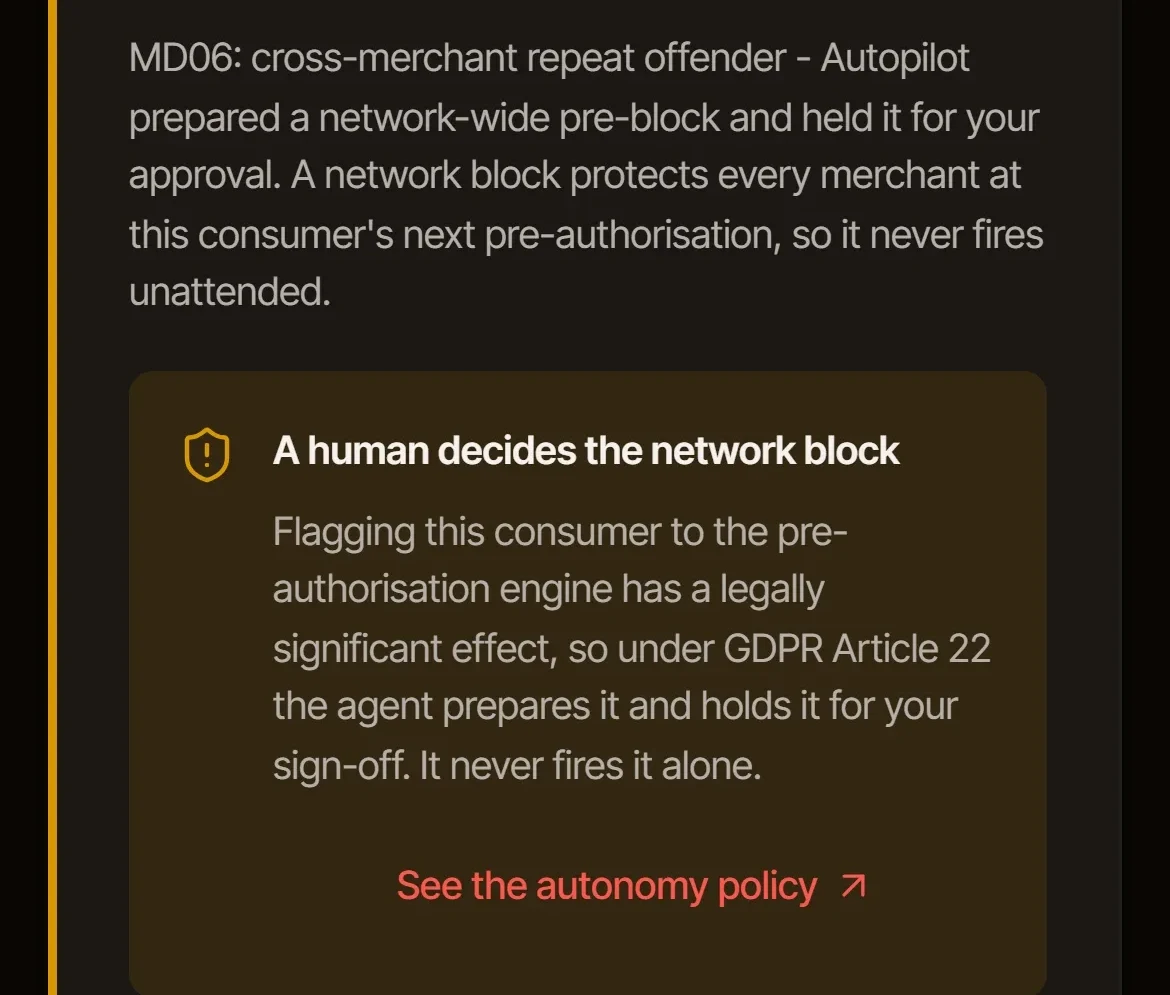
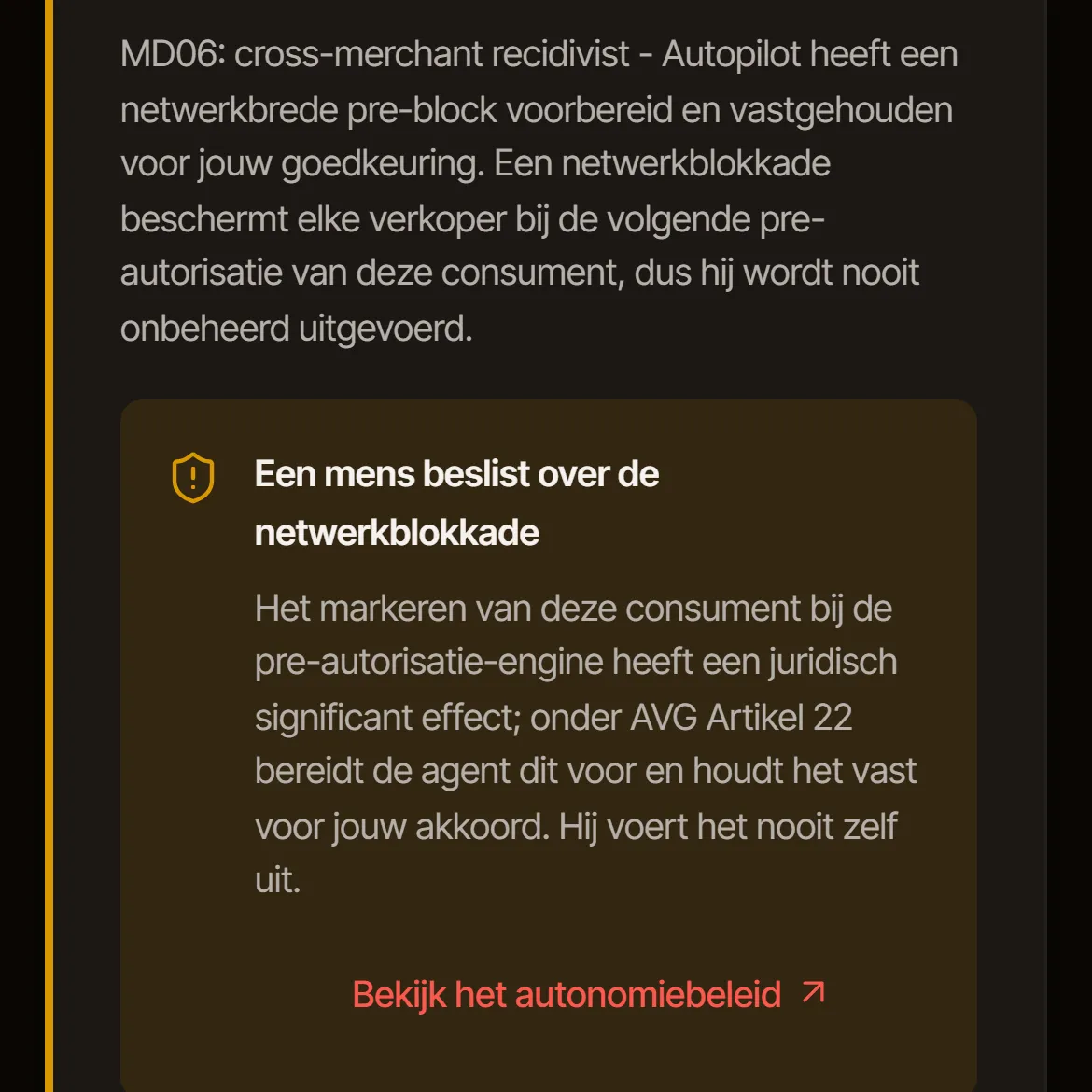
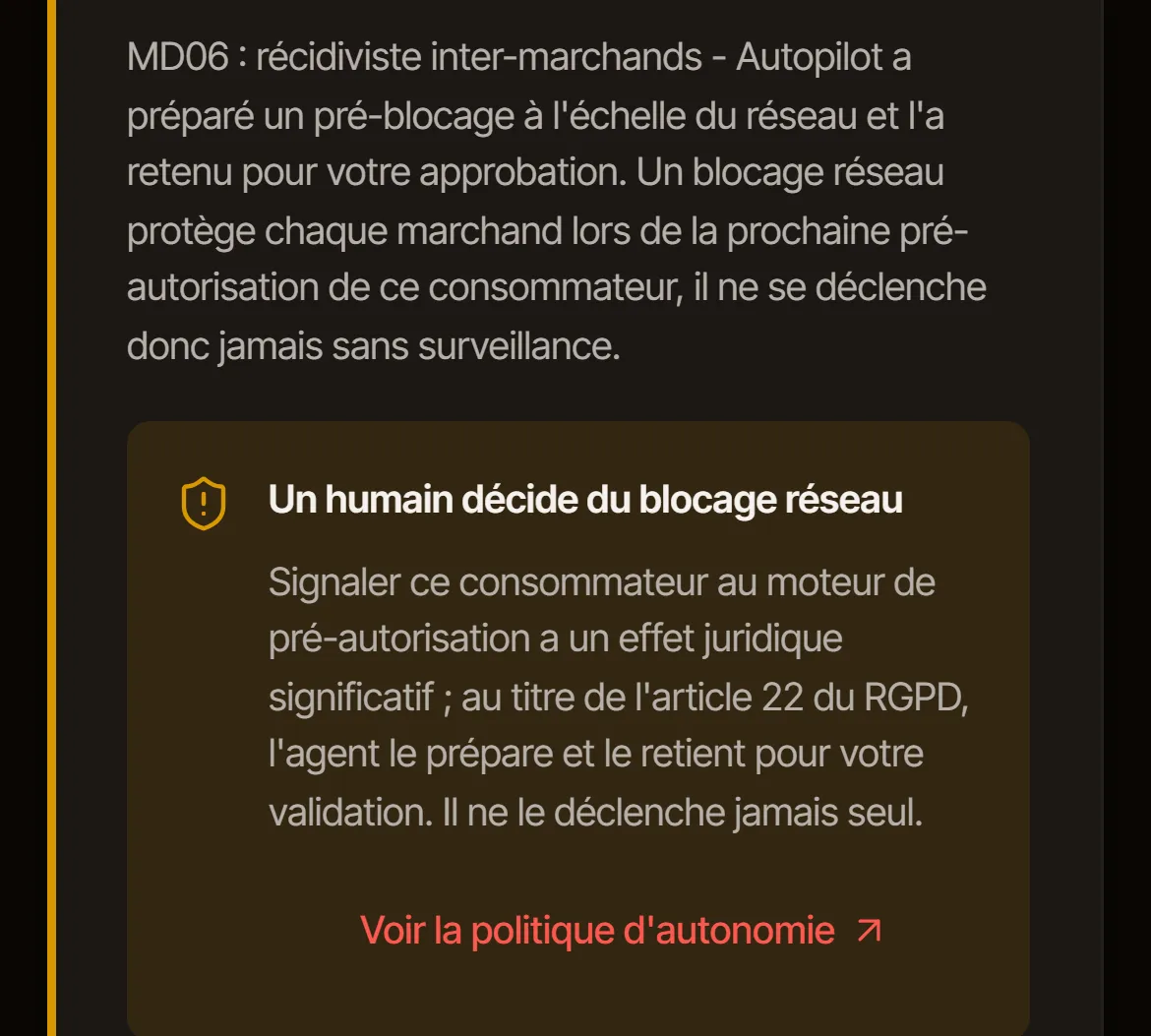
A demand for payment can’t be undone once a customer has it, and neither can a block on their debits at every business on Recura, so the agent prepares both and a person signs. Article 22 of the GDPR gives a person the right not to be cut off by a decision that only software made. I locked the signature into the code rather than a setting, so no level a business picks lets the agent make a block alone.
Inside a level: made by the agent on its own
- Account closed, return let go · 92% · €6.50
- Refund at FitGym, link to their own page · 90% · €20
- Bounced debit, taken again · 82% · €5
- First refund after 11 paid months · 70% · €12.99 · prepared for one click
- No reason given · 40% · €49 · left to the payments team
Below its level, the business can set each kind of move on its own, down to leaving it entirely to the payments team. I built every other setting to narrow a level and never to widen it.

Before a new level takes effect, Recura replays the business’s own last 30 days under it, and nothing changes until somebody confirms. A level up would have meant 14 more moves by the agent alone, involving €195.
A rule the business writes as one sentence, such as how many refunds in how many days at which businesses, is replayed on its past refunds first and shows the customers and euros it would have stopped.
14 more moves by the agent alone
The business’s last 30 days
€195 involved
Every move the agent makes on its own can be held back or undone
The agent’s moves are carried out at set times, most of them in a nightly batch. One press in the console stops the agent and holds every move waiting for a batch.
Link to the customer’s own page, for a €20 debit taken back at FitGym
Undone: the customer is the payments team’s to handle again
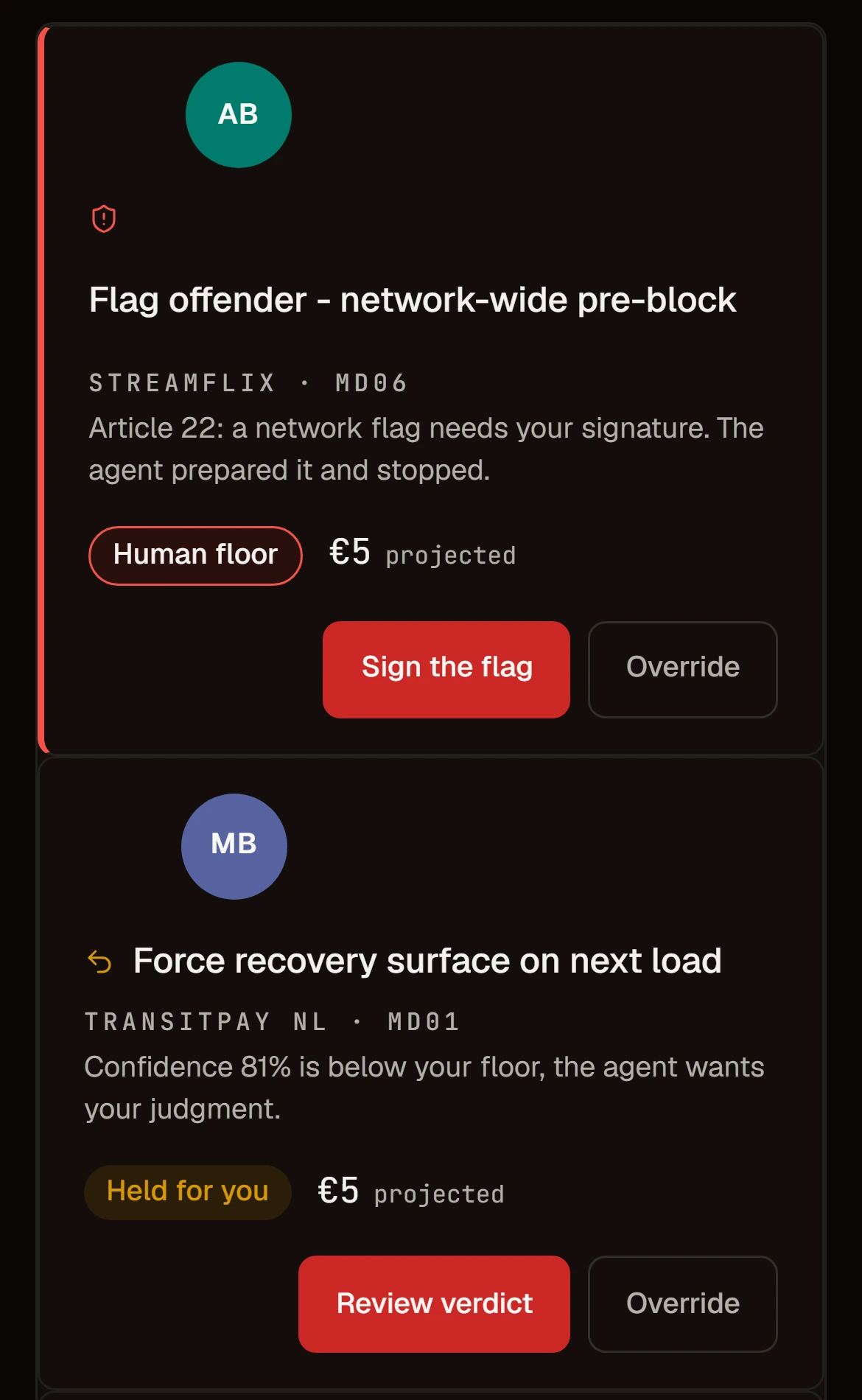
What the payments team finds in the morning
The night’s work is done by the time the team sits down, so the day starts on the decisions that wait for a person, and the report of it reads in fifteen seconds.
- 24 returns worked through
- 6 files of proof built
- 2 blocks prepared for signing
- 7 decisions left to the payments team
One press approves what the agent prepared, such as every waiting recovery under €50, after the team has seen how many there are and what they come to. Anything the team disagrees with, it overrides with its own decision.
Corrections make the agent ask first, and approvals widen what it does alone
The agent earns its freedom one kind of move at a time. At a new business it only prepares recoveries, files of proof and blocks for the payments team to approve, and a kind of move passes to it as the team approves that kind.
- Made by the agent on its own
- Prepared for one click
- Left to the payments team
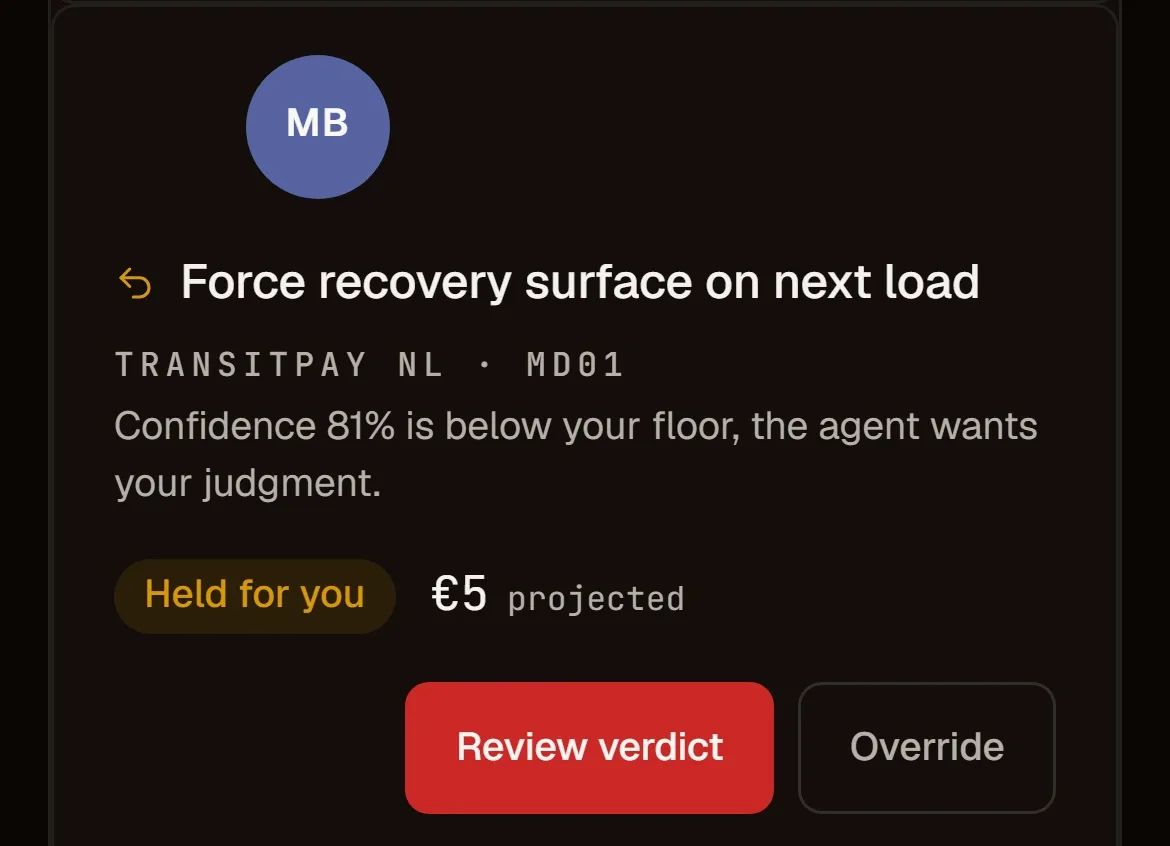
An override or a move undone · this kind of move steps back toward the payments team, and stays there when the level changes
5 or more approvals in a day · the agent offers to make this kind of move on its own, and takes it up once somebody accepts
9 approved in a day, 8 paid · Recura projects €4,070 a month from moves that no longer wait for a click
Every correction is kept as it was made, with what the agent recommended, what the person chose and why. The agent then says in plain words what it will do differently next time.
Each override makes Recura a little less sure of later moves of that kind at that business. I capped that at 15 percentage points, so the team’s corrections steer Recura without replacing its judgment.
The startup describes its own disputes work as mostly end to end, with the edge cases that reach a person feeding its model.
7
Proving what it kept, and charging on that
Some of the money Recura reports as recovered or prevented would have been kept without it. A returned debit is sometimes repaid with nobody asking, and a customer reminded before a debit may never have meant to take it back. I made Recura leave some of each business’s customers alone on purpose, so the business can see what Recura’s work added beyond that, and the fee follows the difference.
Which customers Recura leaves alone
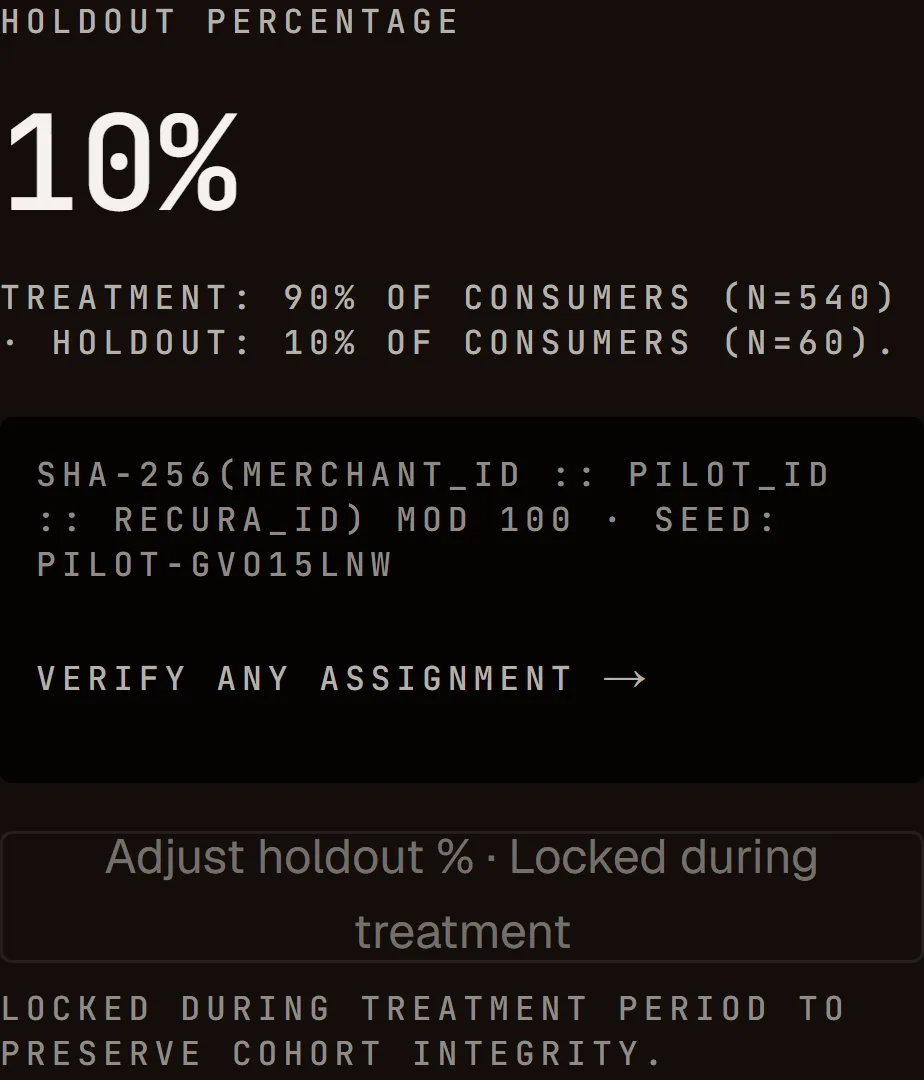
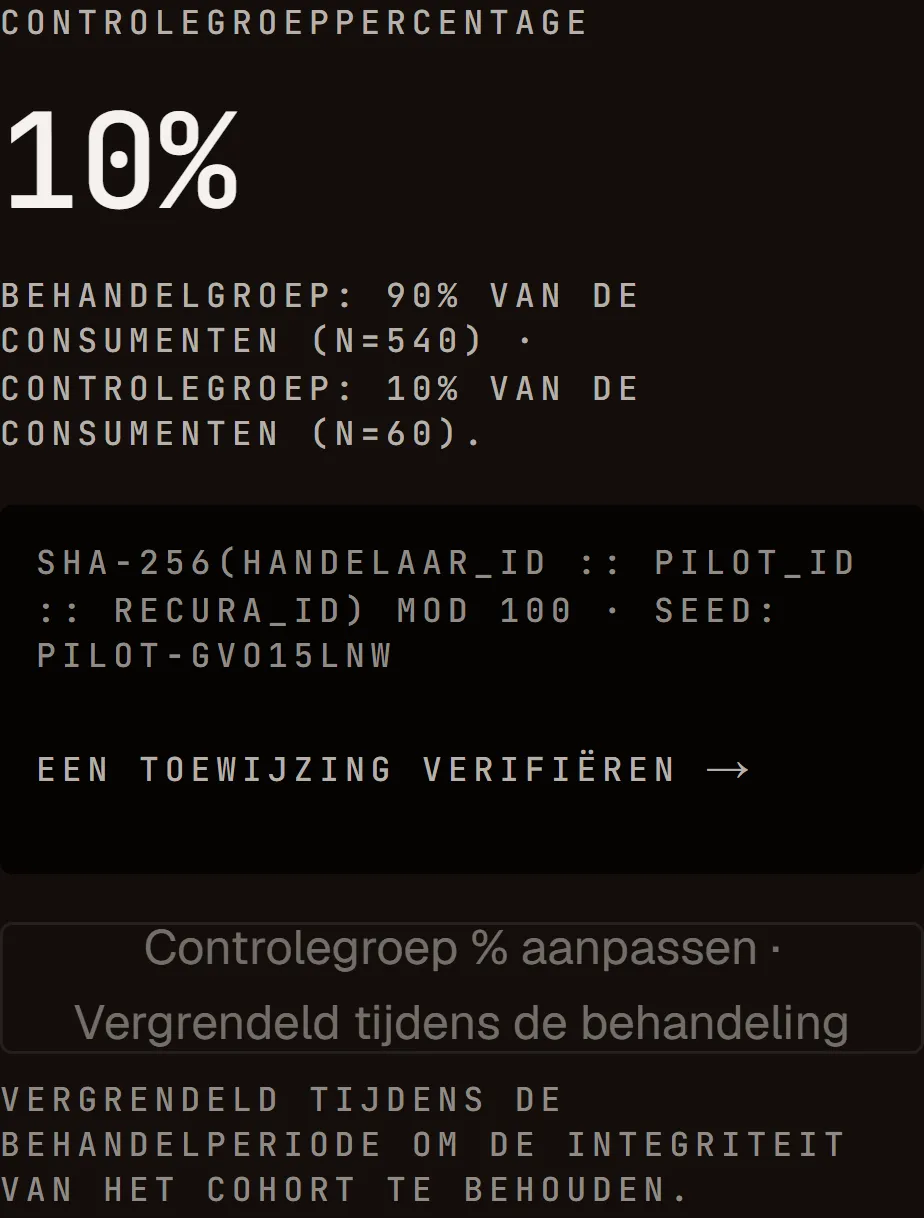
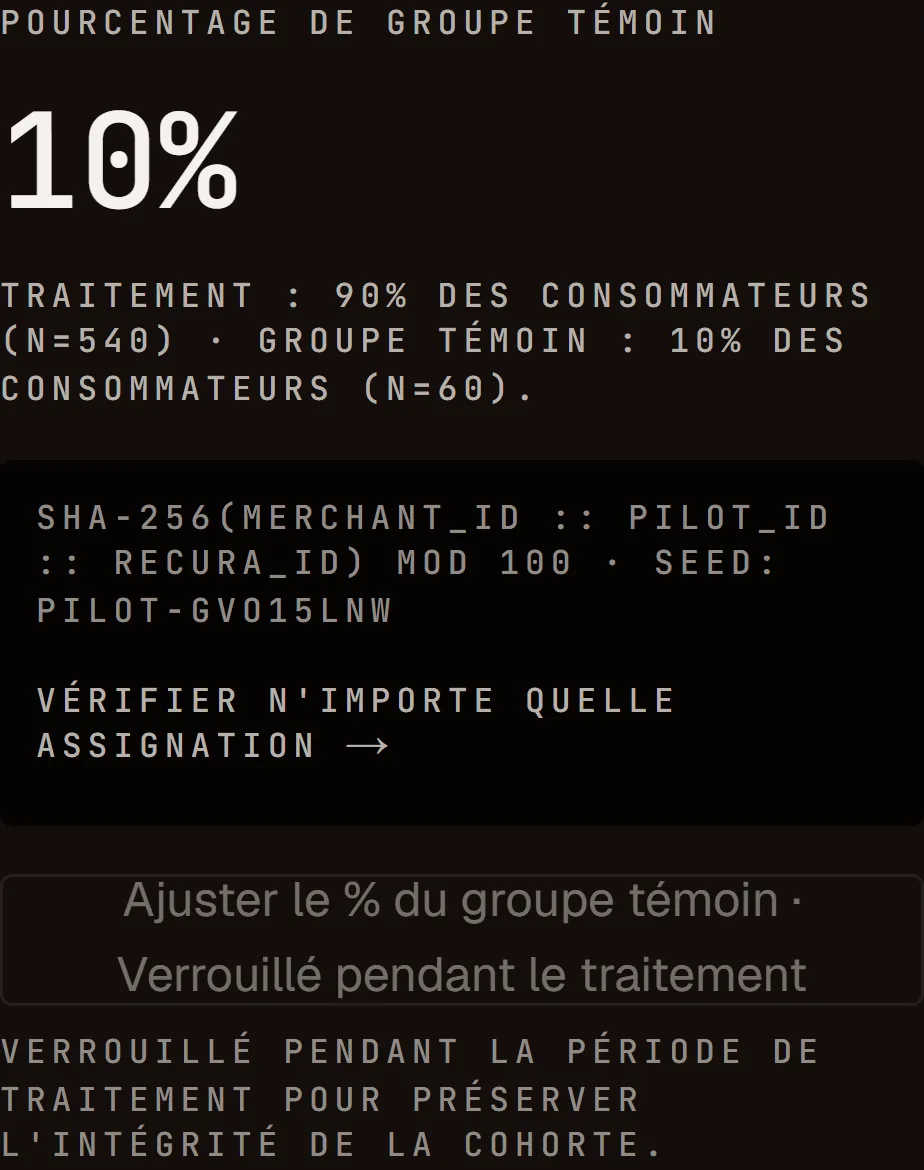
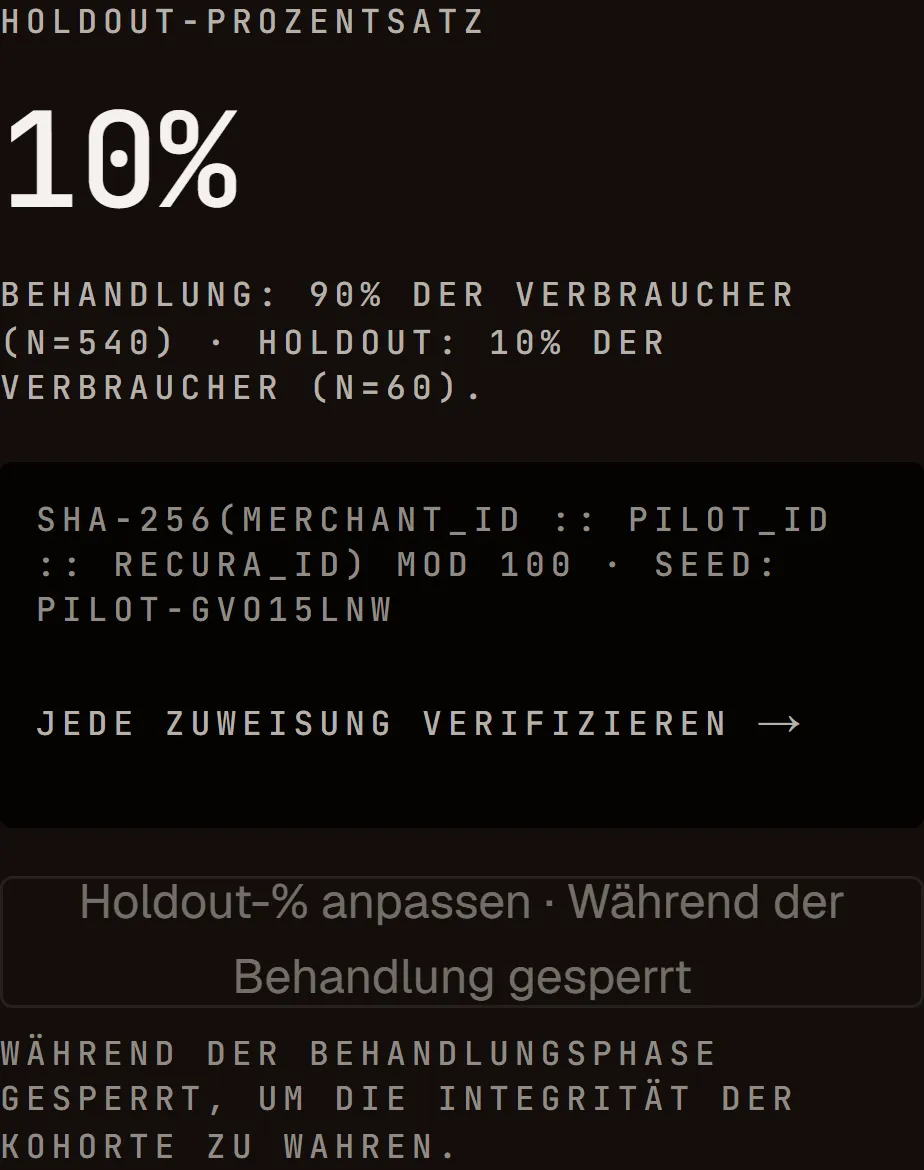
A published formula takes the business and each customer’s fingerprint and gives the same answer every time on whether Recura acts on them or leaves them alone, so nobody picks them, Recura included, and no month can be made to look better by moving customers between the groups.
Recura
90 that Recura acts on
a notice before each debit; after a return, a link to their own page or a demand for payment
10 left alone, or 5 or 15 if the business prefers
nothing sent
from all 100: every debit, return and payment, recorded
Recura publishes its method, so whoever the business shows its figures to, whether its auditor, its board or its bank, can rework every difference from four counts: the customers Recura acted on, the customers it left alone, and how many in each group paid. They arrive at the same figure Recura shows.
What the business’s finance lead and board see
Each figure the finance lead sees opens onto the debits or payments behind it and adds up to the cent: the €418 stopped before it was taken lists its 21 debits and sums to €418. The console, the bill and the board’s slides all come from one log of what happened, so none of them can disagree with the others.
€401 paid back on 23 returns, marked measured: only payments that came in
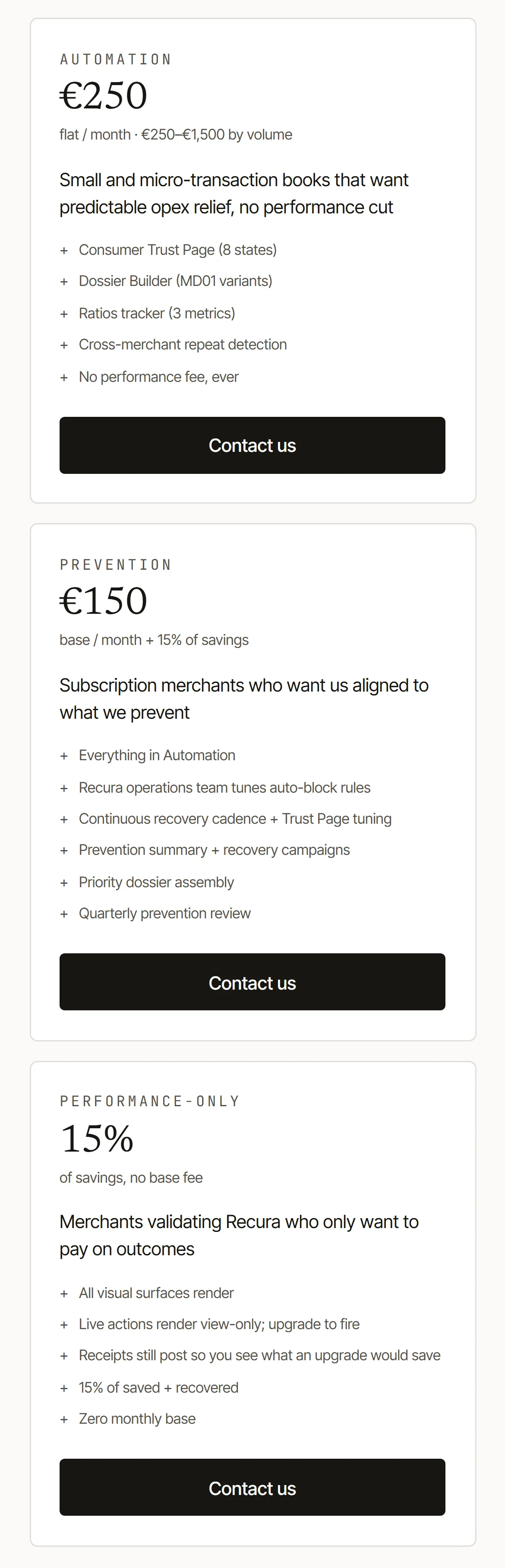
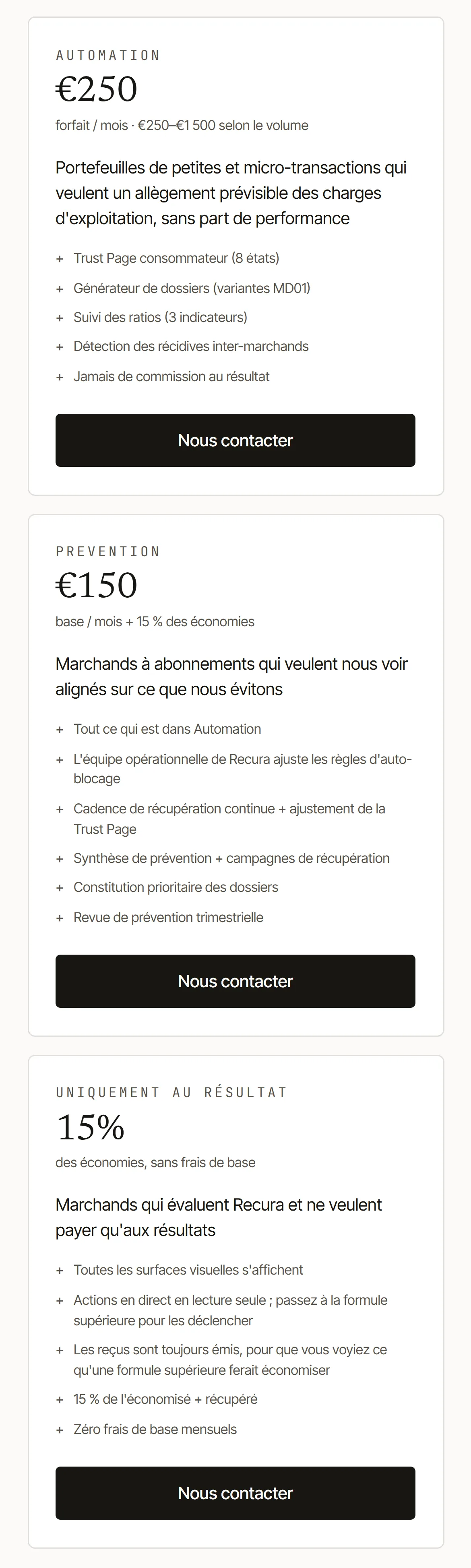
What a business pays Recura
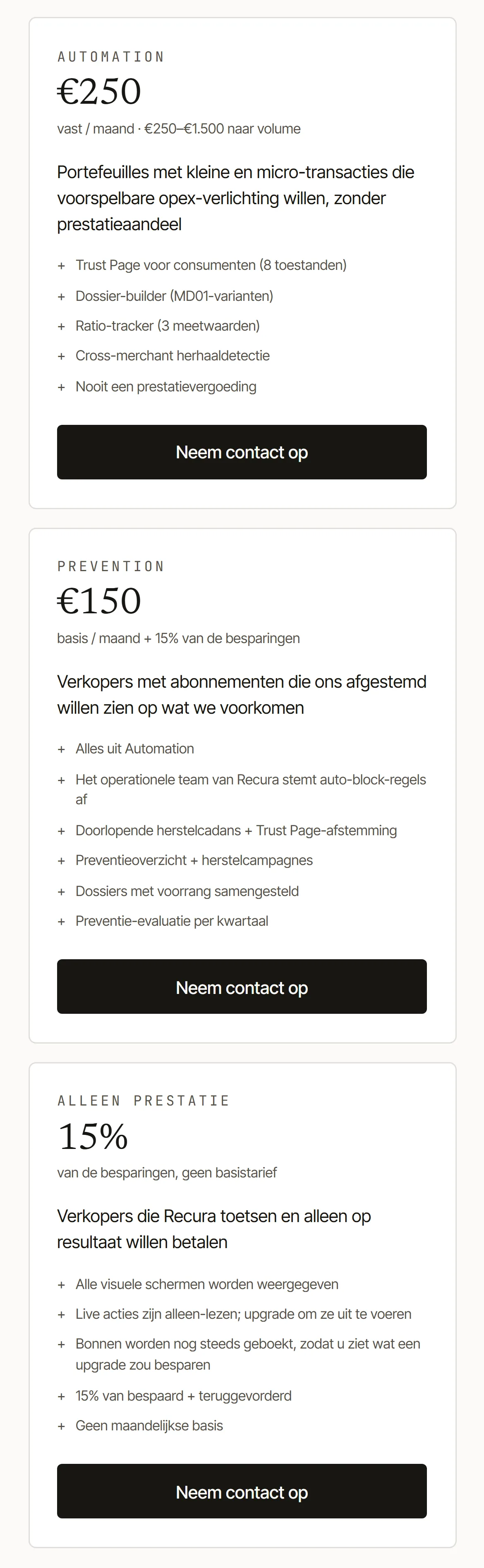
A business pays Recura in one of three ways:
money Recura proves it kept in the month, from €0 to €2,000
what the business pays that month
- €250 a month, or €600 or €1,500 for a business that collects more, and no share
- €150 a month and 15% of what Recura proves it kept, with Recura’s own team adjusting the business’s settings
- 15% of what Recura proves it kept, and no monthly fee
On the second way, Recura’s own team takes over the adjusting. It keeps tuning the business’s rules, when its messages go out and the wording on its customers’ page, and a named person at Recura is on duty. The time the business’s own team spends on those changes drops from about six hours a week to none. Handing over the whole job is how the startup sells to businesses.
Each month’s bill takes its value from the figure the finance lead already sees in the console, and ends on how many times its fee the business kept: 2.85 times over.
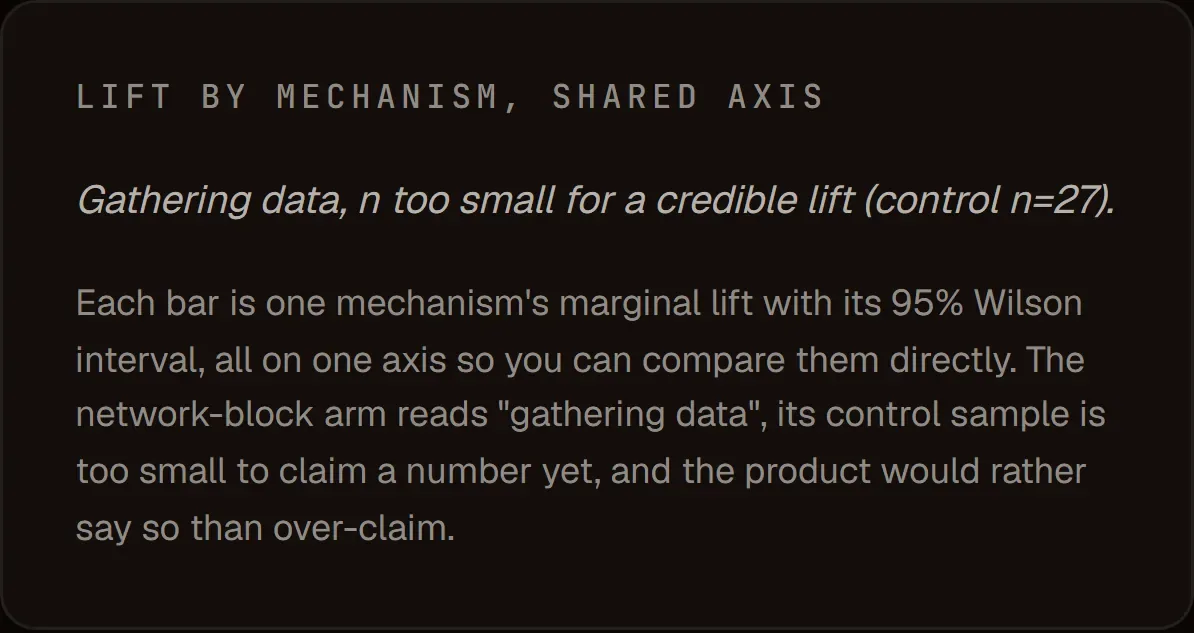
Recura’s share comes only out of what it caused
Trying Recura on the business’s own customers first
A trial runs on the business’s own customers and has no monthly fee, so a business sees what Recura keeps before it commits to anything.
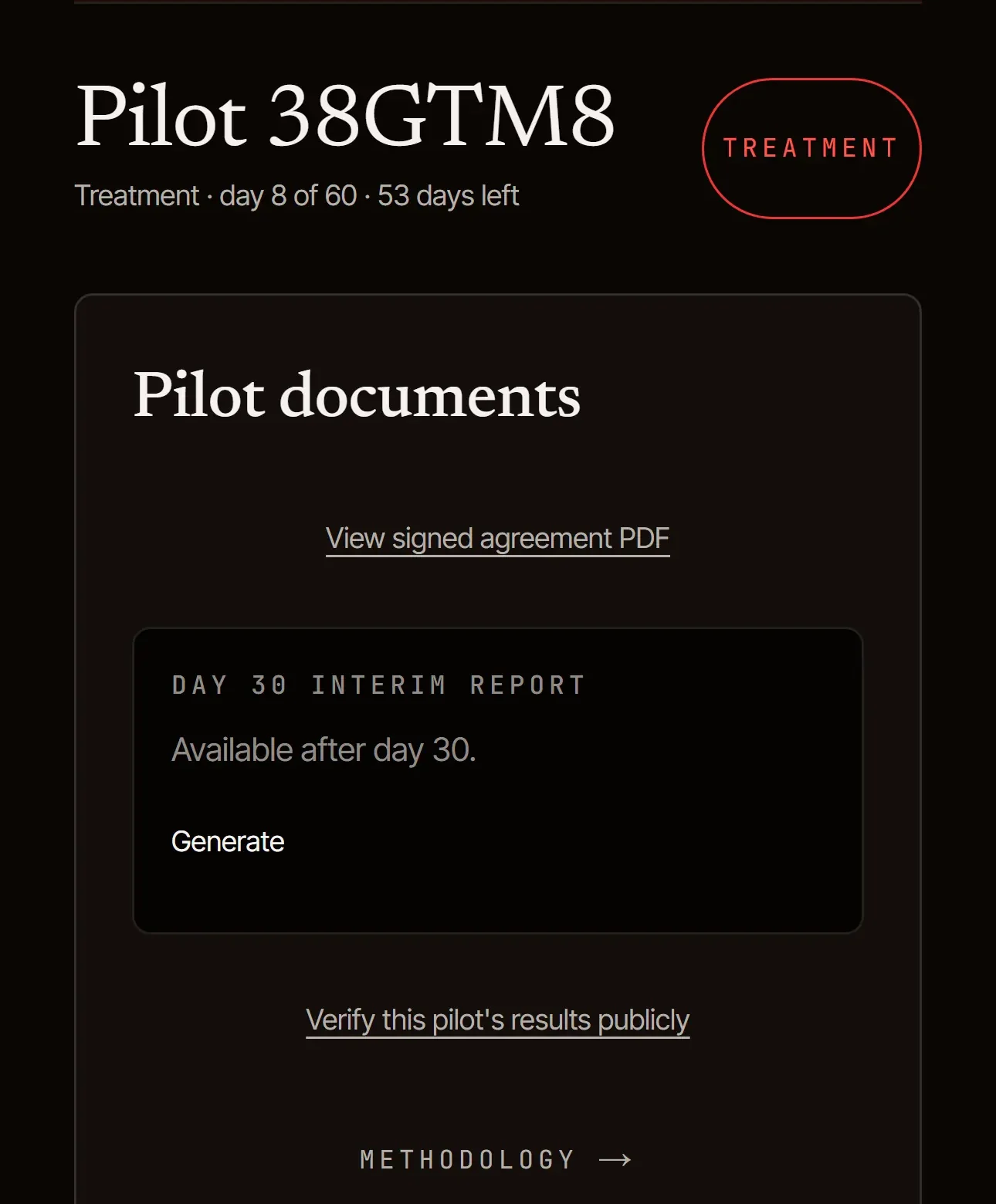
- day 30: a signed report so far
- day 60: the signed results of a 60-day trial, or a second signed report on a 90-day one
- day 90: the signed results of a 90-day trial
In the agreement it signs, the business sets a target for each way Recura keeps money, and it can walk away at the end if Recura misses them.
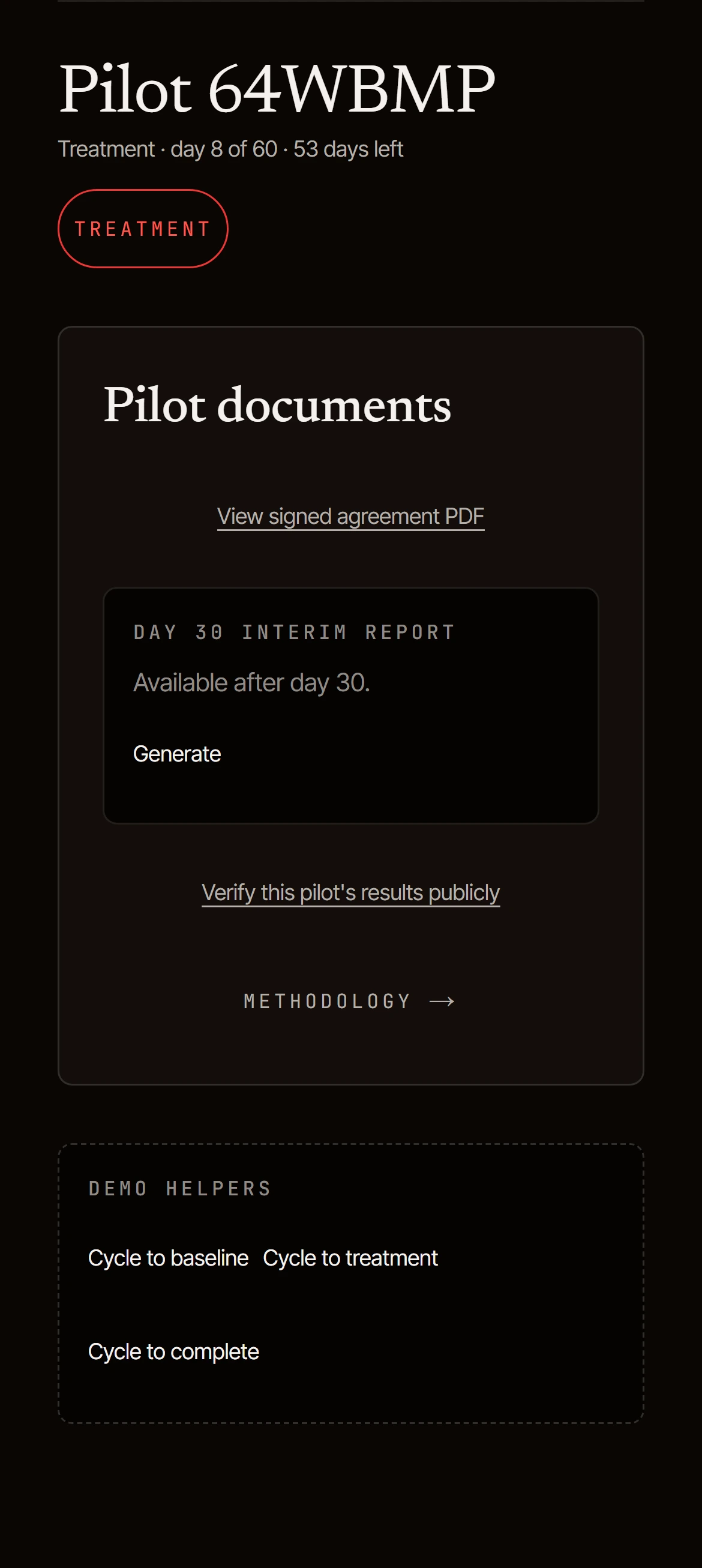
A business that would rather not spend a month only watching hands Recura its last 90 days of returns from its processor, so measuring starts on day 1.
While a trial runs, the business sees in its console how far it has got and, for each way Recura keeps money, whether any of its range is still below zero.
On a 60-day trial at FitGym, the customers Recura acted on do between 19% and 52% better than those left alone in each way, the time to get a file of proof ready is cut by more than half, and FitGym keeps €2,452, 5.95 times what it paid Recura.
8
Onboarding and setting it up
Recura is finished: a company can onboard, get set up on it and leave it again, and I built each of those into the product.
What a business can see before it onboards
Before it signs anything, a business can read what Recura does and costs, put its own figures through an estimate, and see the whole product in a private demo.
The estimate asks for the returns a business gets each month and what each is worth, then shows Recura’s estimated saving before its fee and under each of the three ways of paying. I had it count every way Recura keeps money at the bottom of its range.
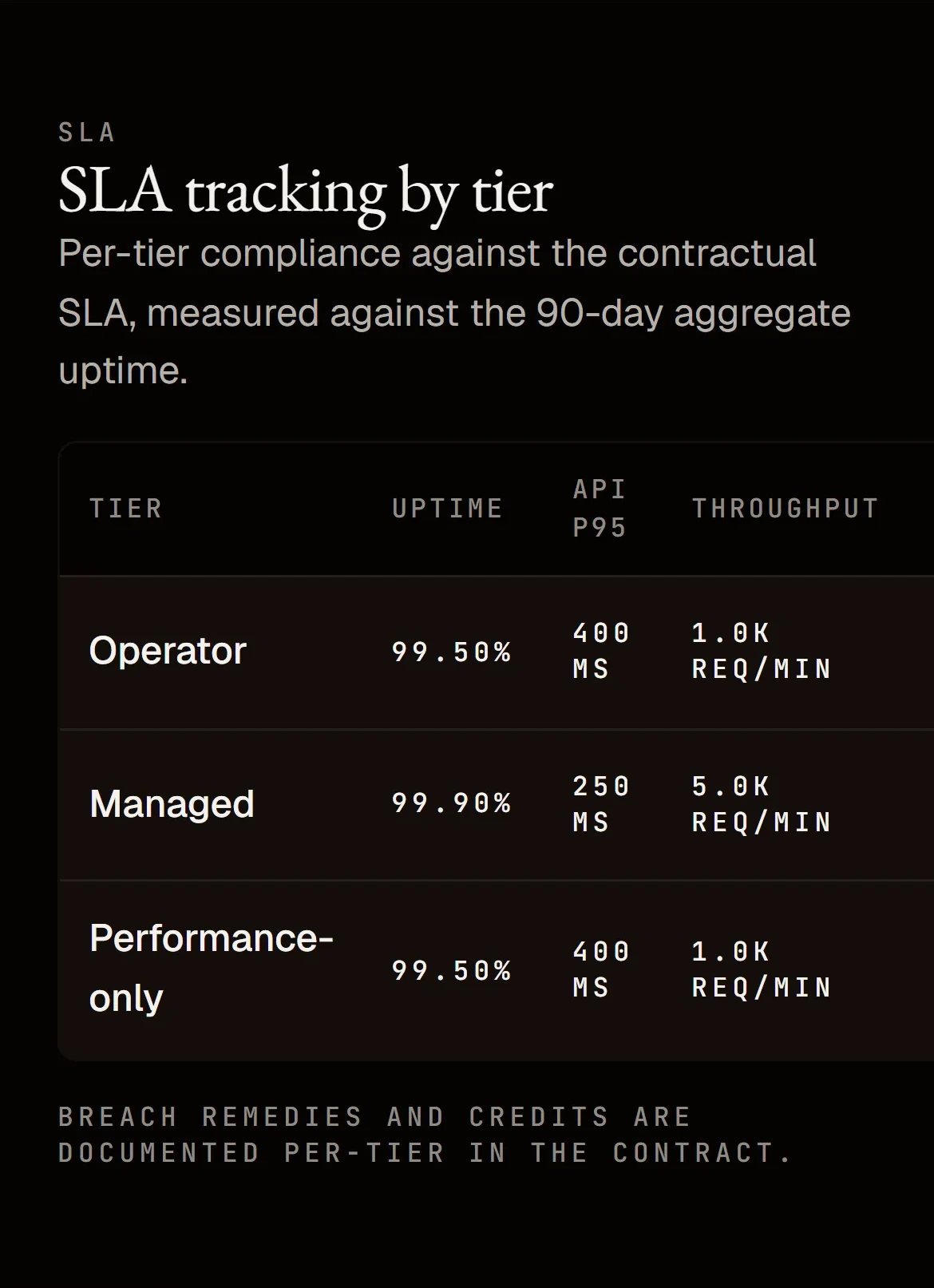
On the first two ways of paying the business signs service levels for uptime, 99.5% on the first and 99.9% on the second; a miss becomes a credit against that month’s fee, and a public status page is built to show anyone whether each is being kept.
What makes recognising a customer across businesses lawful
Recura comes with its legal ground, written out in four documents a business’s lawyers can check. A ground is needed because, under EU law, the fingerprint Recura makes of a customer’s bank account stays personal data for as long as Recura holds the secret key it is made with.
Consent would fail, since customers who take debits back on purpose would refuse it, so the ground is a legitimate interest: preventing repeated returns. I checked the ground against the Dutch financial sector’s own register of incidents, the Extern Verwijzingsregister, and set Recura’s window at ninety days where that register allows up to eight years.
Seven risks to customers
Being mistaken for somebody elseeach with what Recura does about itWho answers for what
Twelve uses of personal data
each with a legal ground and a time limitCustomers are told they are recognised across businesses, on their own page in all four languages, and can ask what Recura holds on them or have it erased without signing in. The third right on that page reads:
3 The network signal — and your right to object
Recura may combine signals about repeated SEPA returns from other merchants you have paid through Recura. It is never a final decision about you, and you can object to this cross-merchant processing at any time.
The documents a business’s lawyers, auditors and regulators ask for
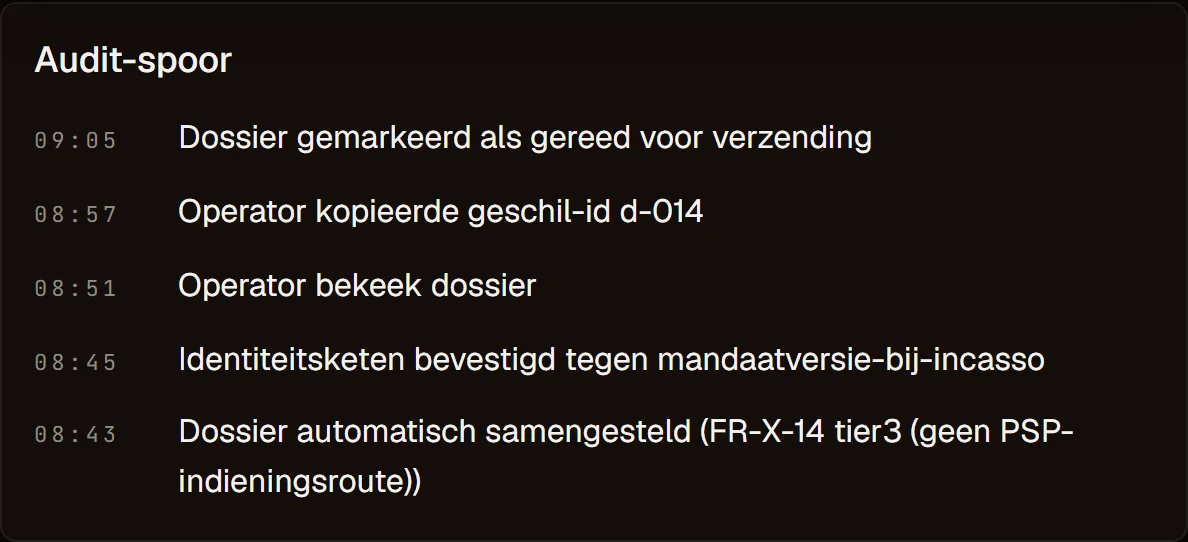
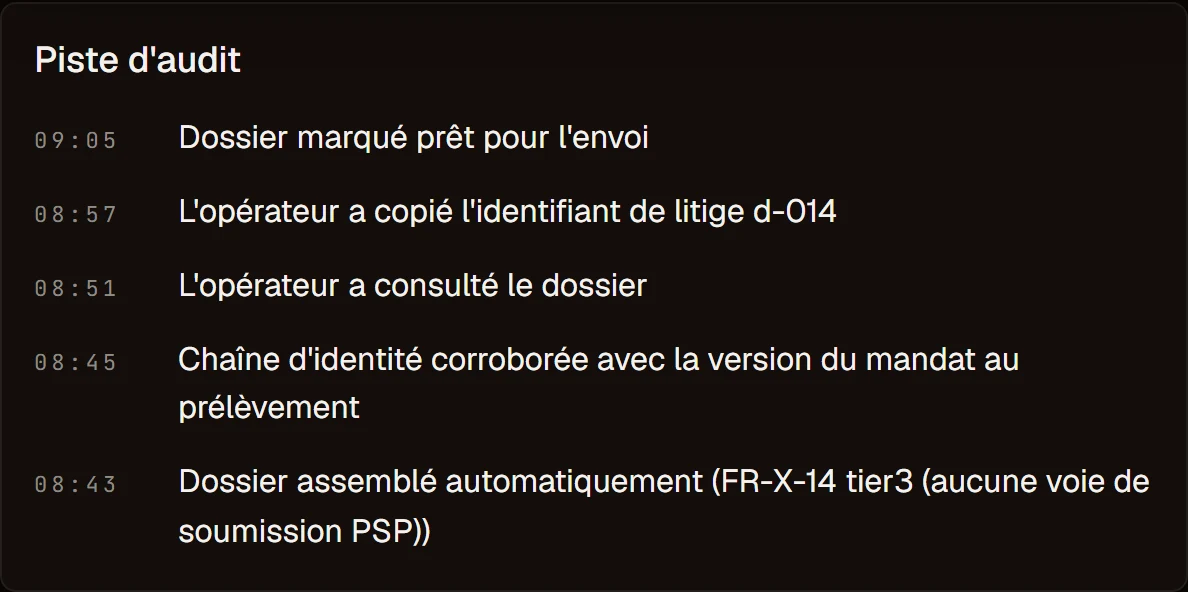
Before a business hands its customers’ bank details to any supplier, its lawyers and security people want the same standard documents, and writing them by hand takes two to four weeks. For a business on Recura they take about two minutes, produced from the business’s own details.
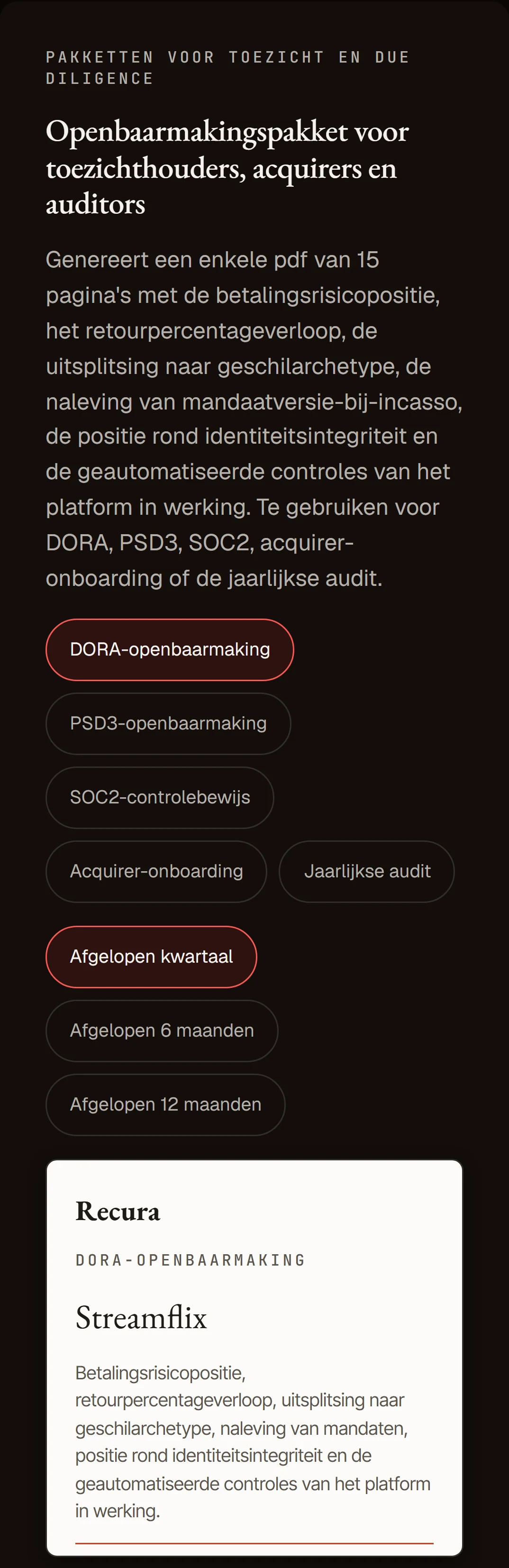
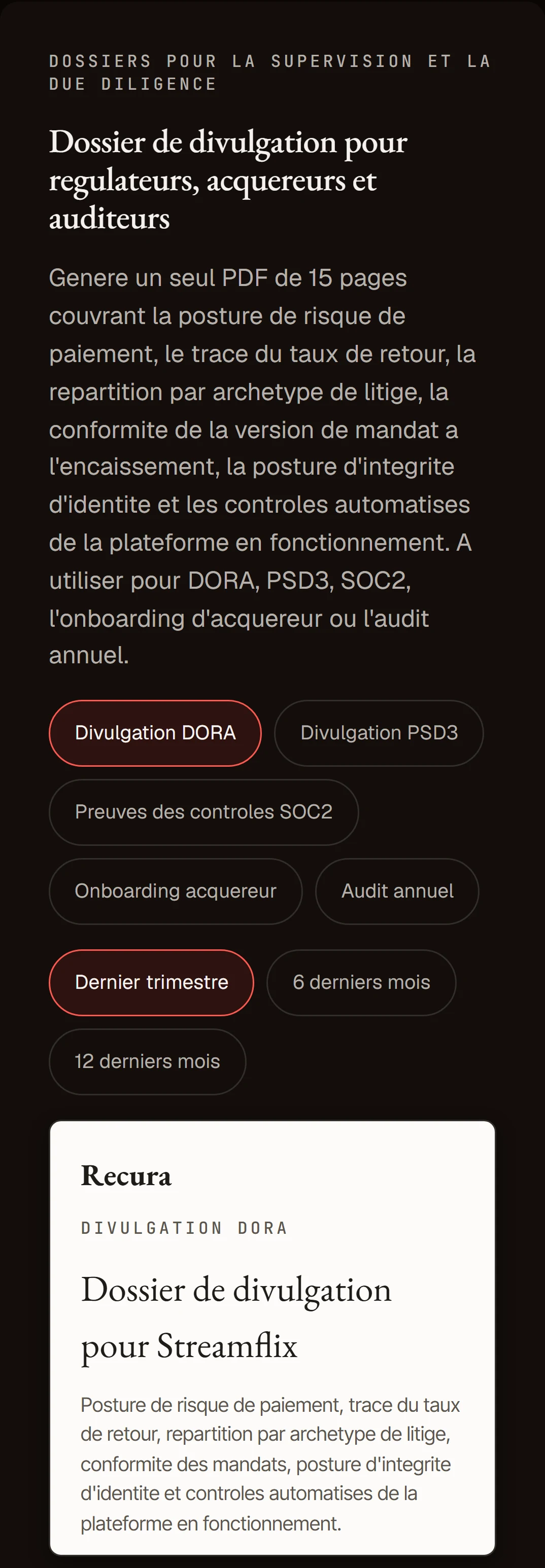
A regulator, an auditor or a new processor checking the business itself gets a 15-page disclosure pack, drawn from the same live records the payments team works from.
How a business is set up on Recura
The payments team finishes the setup in seven steps, and can walk through them on sample data before it connects anything.
Connect the processor it already has, and send a test message through the real connection.
Adyen GoCardless Mollie StripeThe business enters an address and a secret key from Recura in that processor’s settings, and from then on whatever the processor reports reaches Recura. Another processor that signs its reports can be added in a few days.
How Recura takes in a notice from Mollie MollieRecuraA notice with a payment’s number and no signatureRecura asks Mollie for the payment itselfThe payment itself, which Recura then believesChoose the tone of the customer’s own page, from helpful to as short as “Payment returned. Resolve now.”
Accept or change the first rule the overnight agent works to, which prepares a block on a customer’s debits.
See what the other businesses on Recura share with it, from its first day.
Pick one of the three ways of paying.
Start a trial on its own customers, or leave it for later.
Generate its data-processing agreement and security-questionnaire answers.


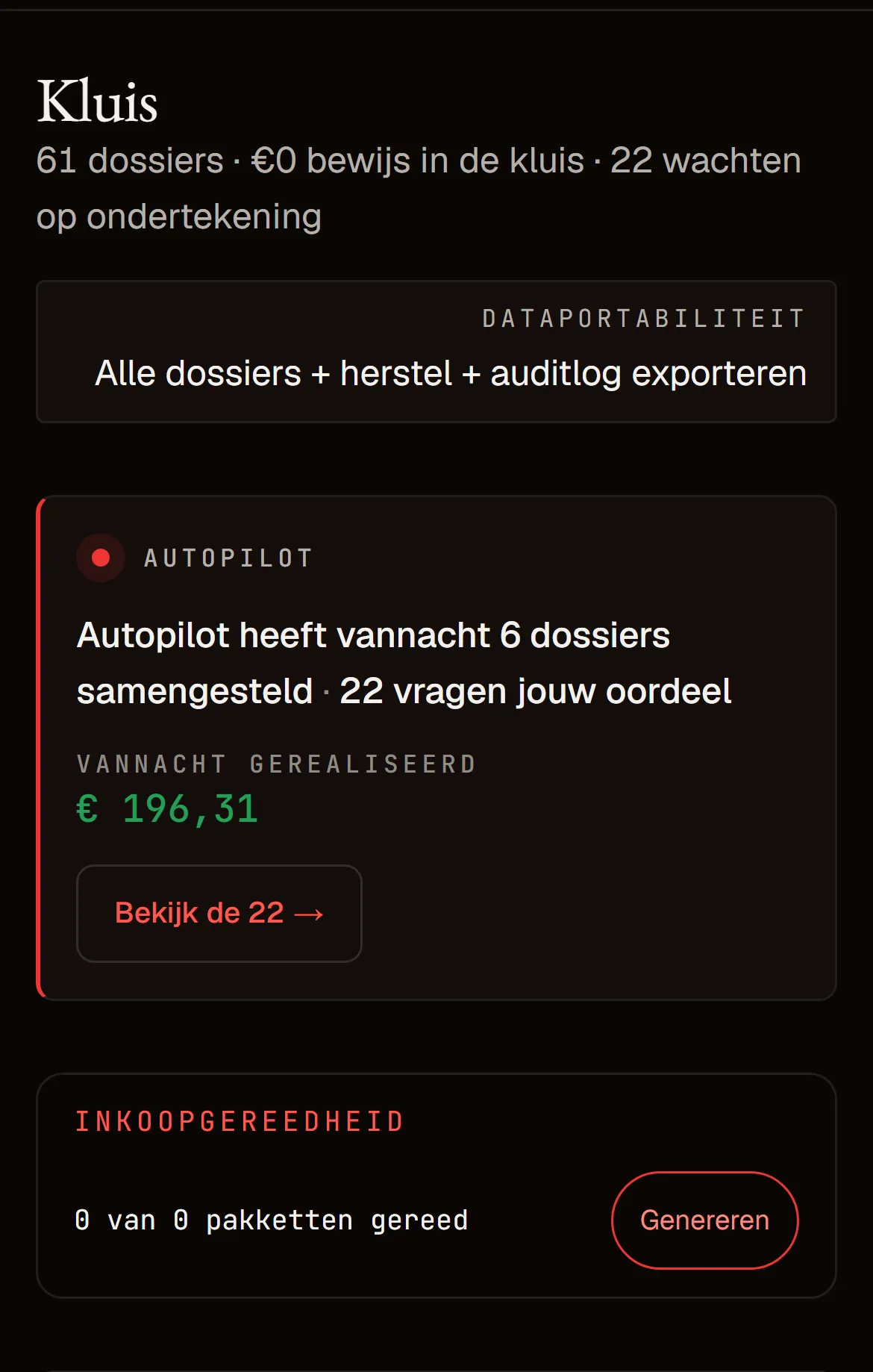
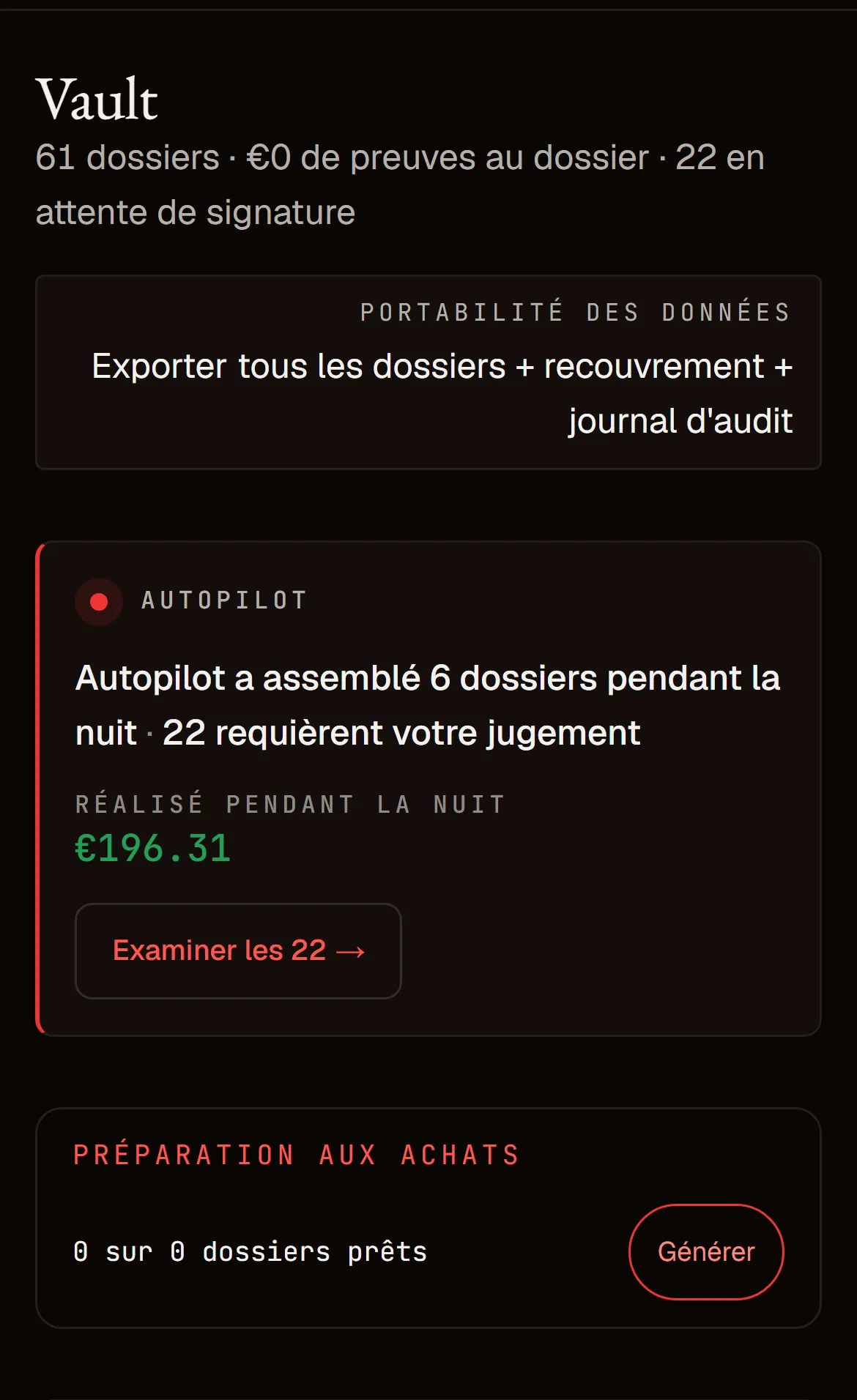
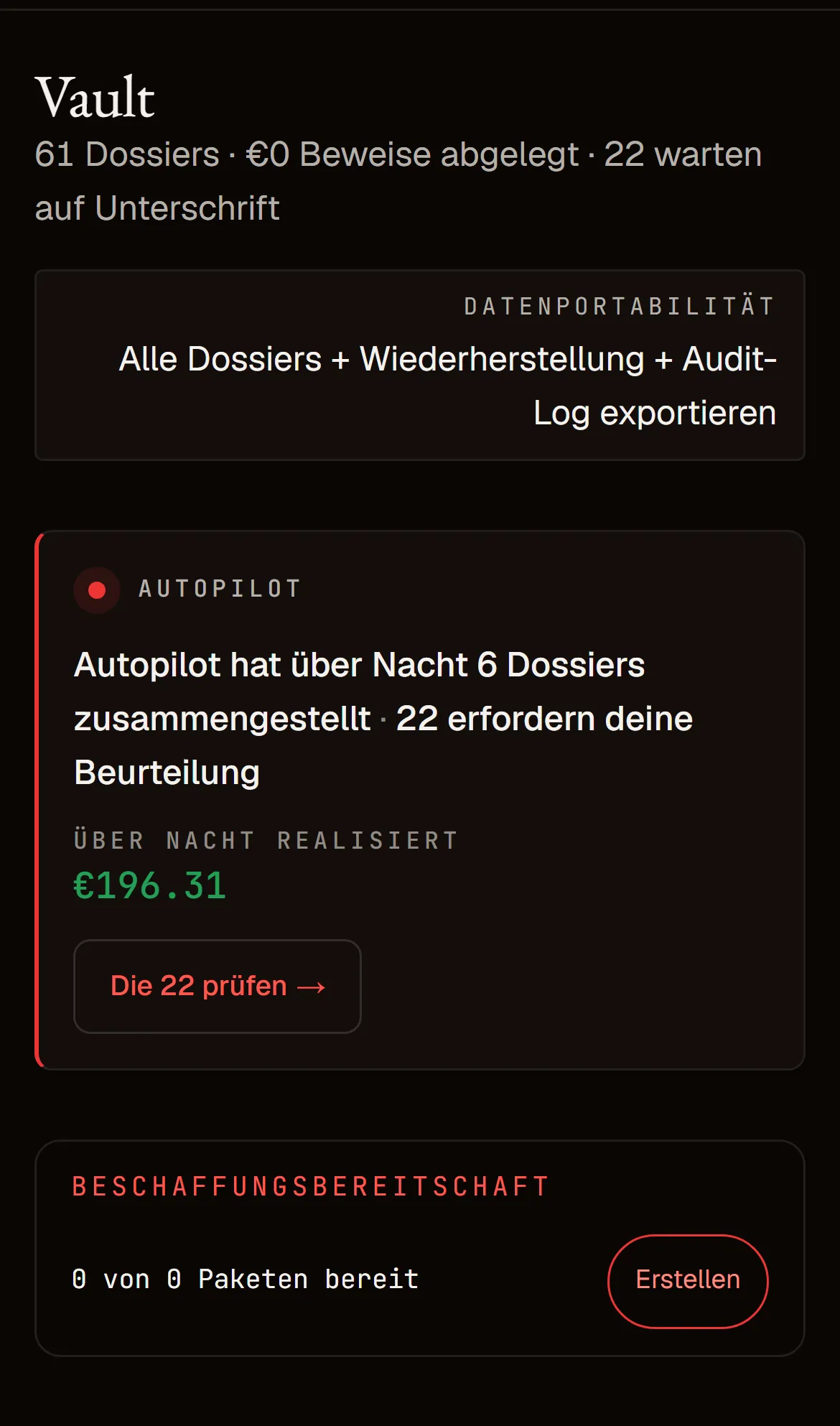
Taking every record out of Recura
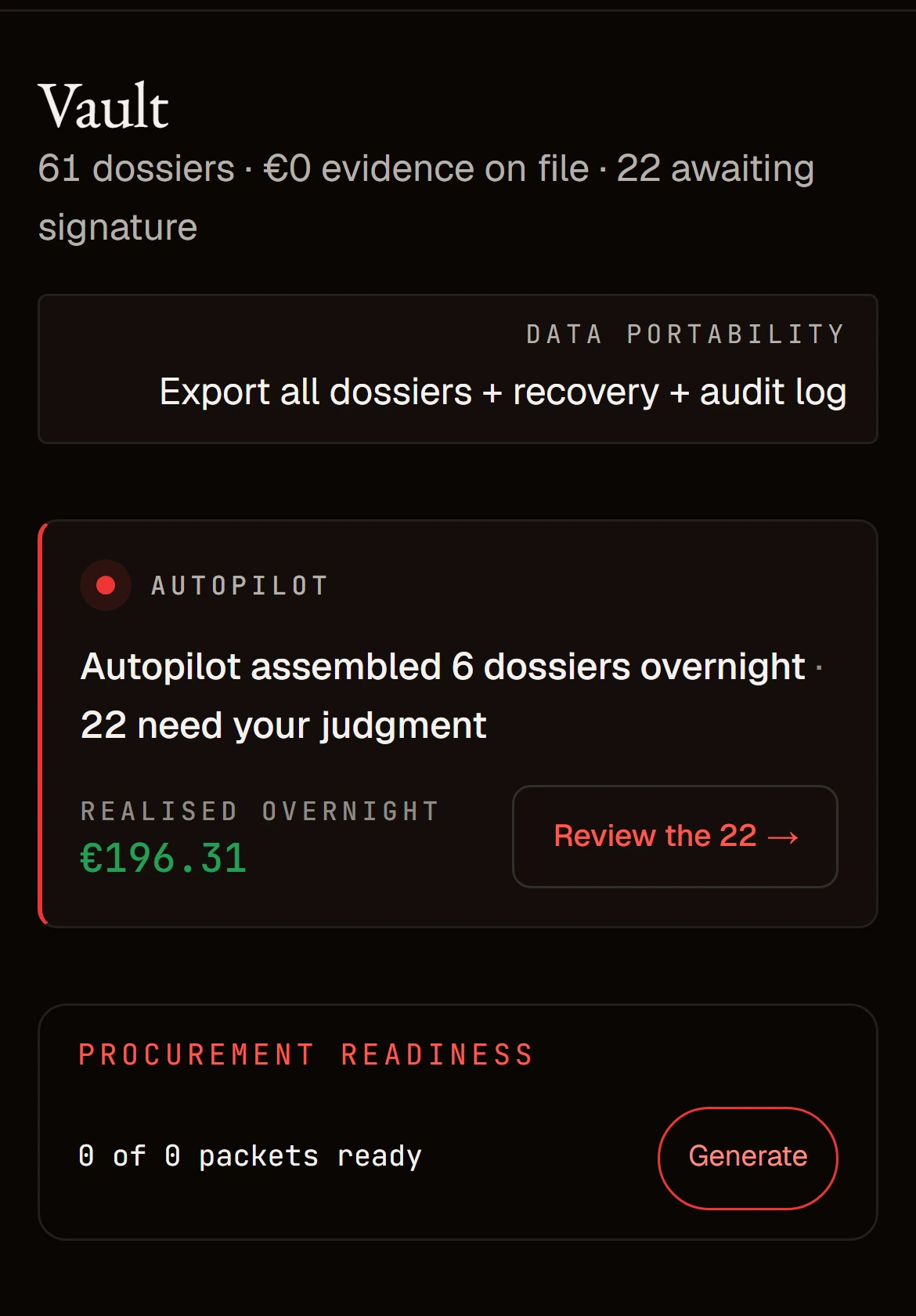
One file, free and ready in under a minute, holds everything Recura has for a business: the records, every file of proof and the log of who did what and when, plus a note on how its customers’ fingerprints were made, so they still mean something outside Recura.
For a move to another supplier, or into the business’s own data warehouse, Recura converts the lot too.
The manual
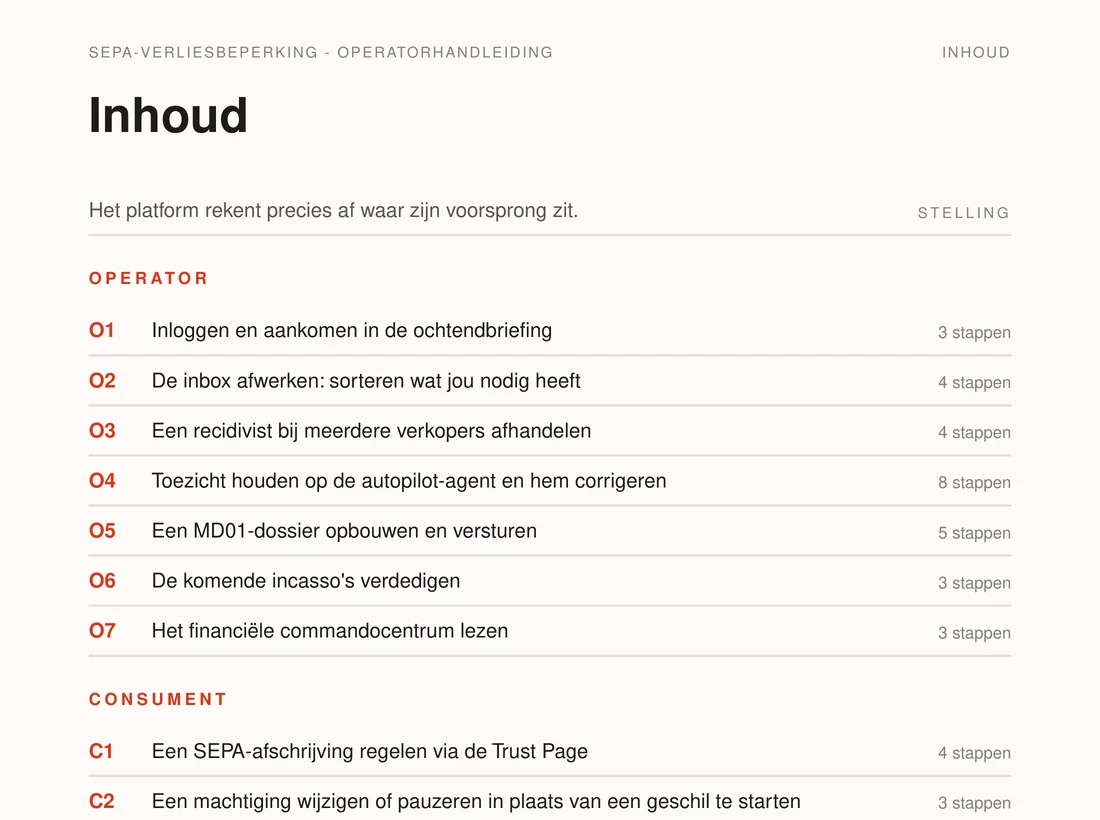
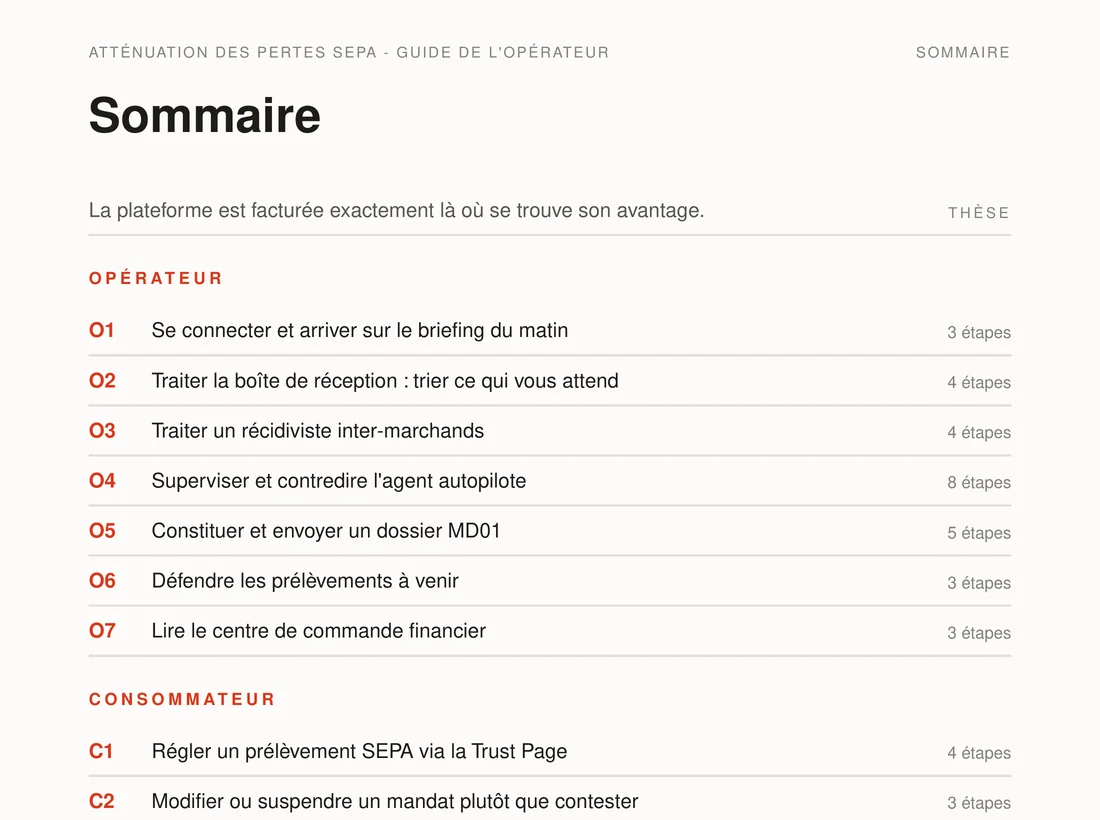
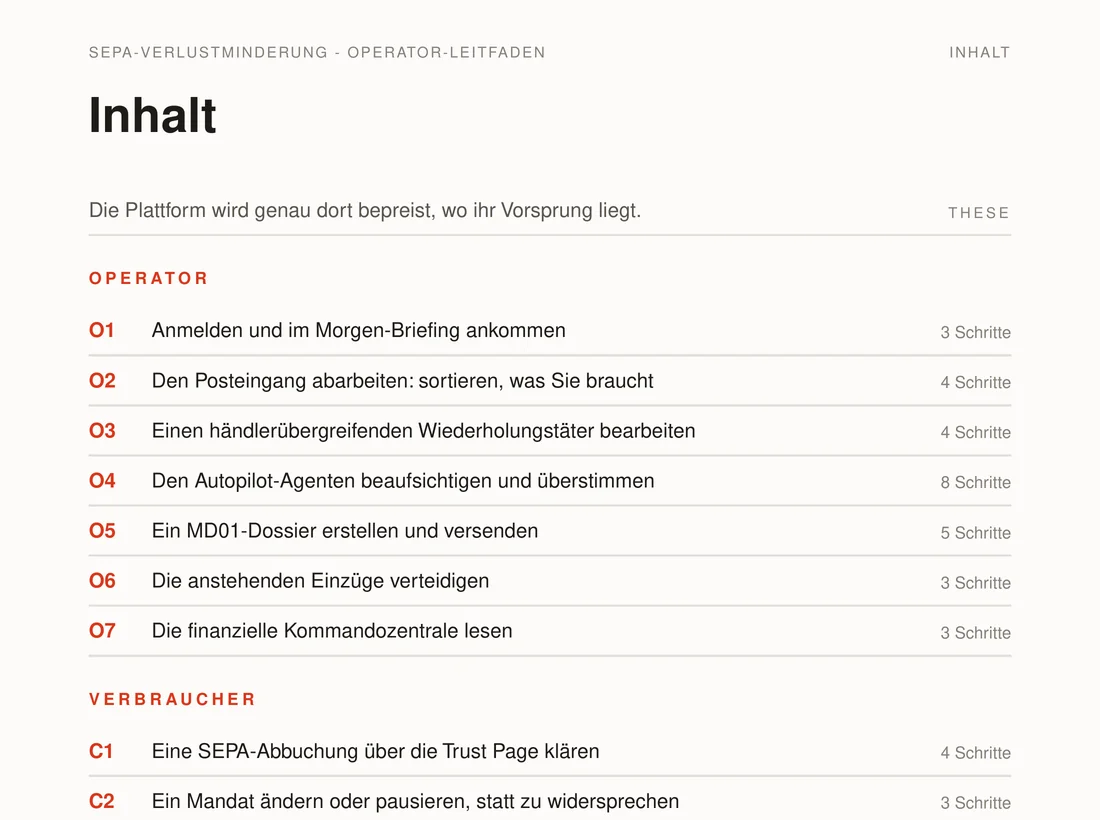
The 29-page guide teaches the payments team the job that remains once the overnight agent has worked the returns: checking what it did, making the calls it can’t make, and setting how far it goes on its own.
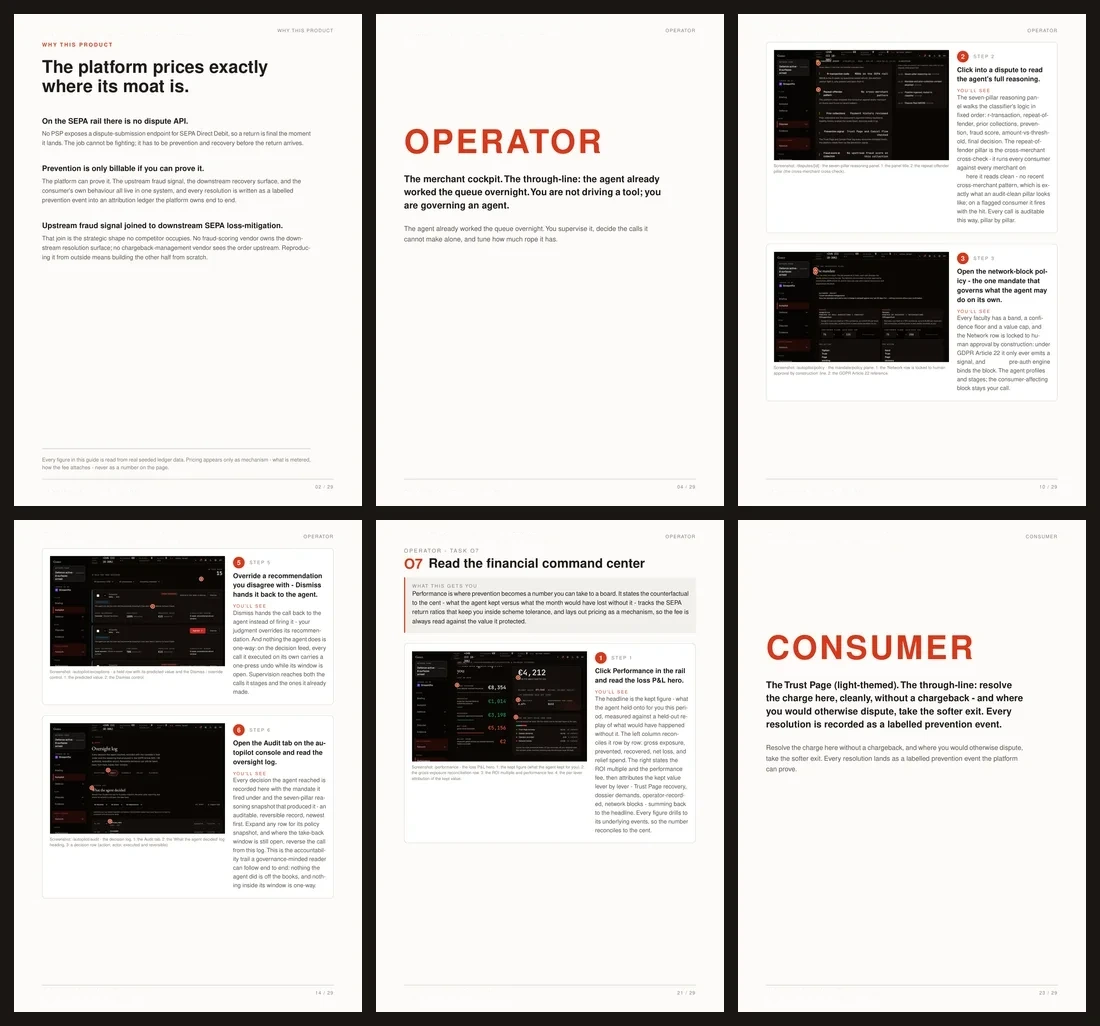
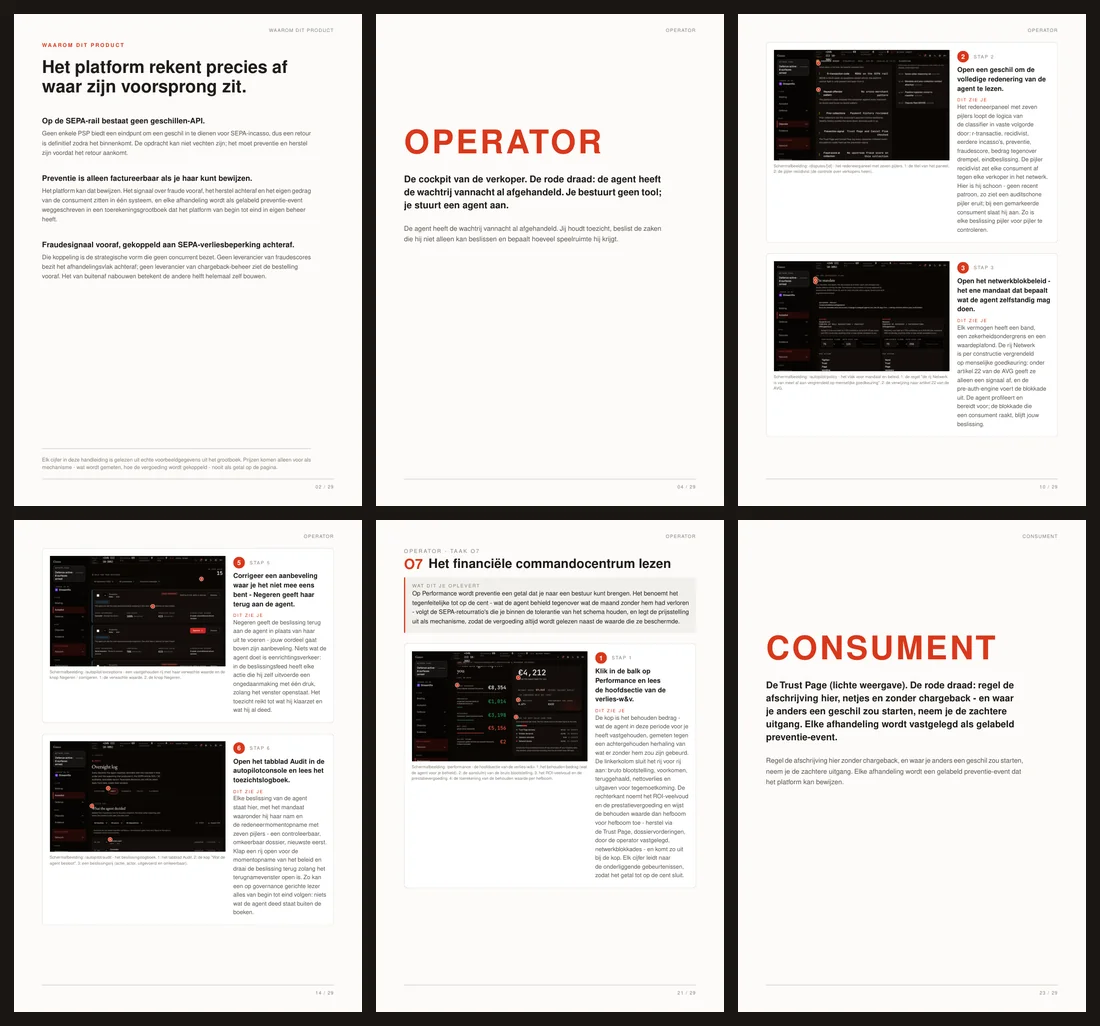
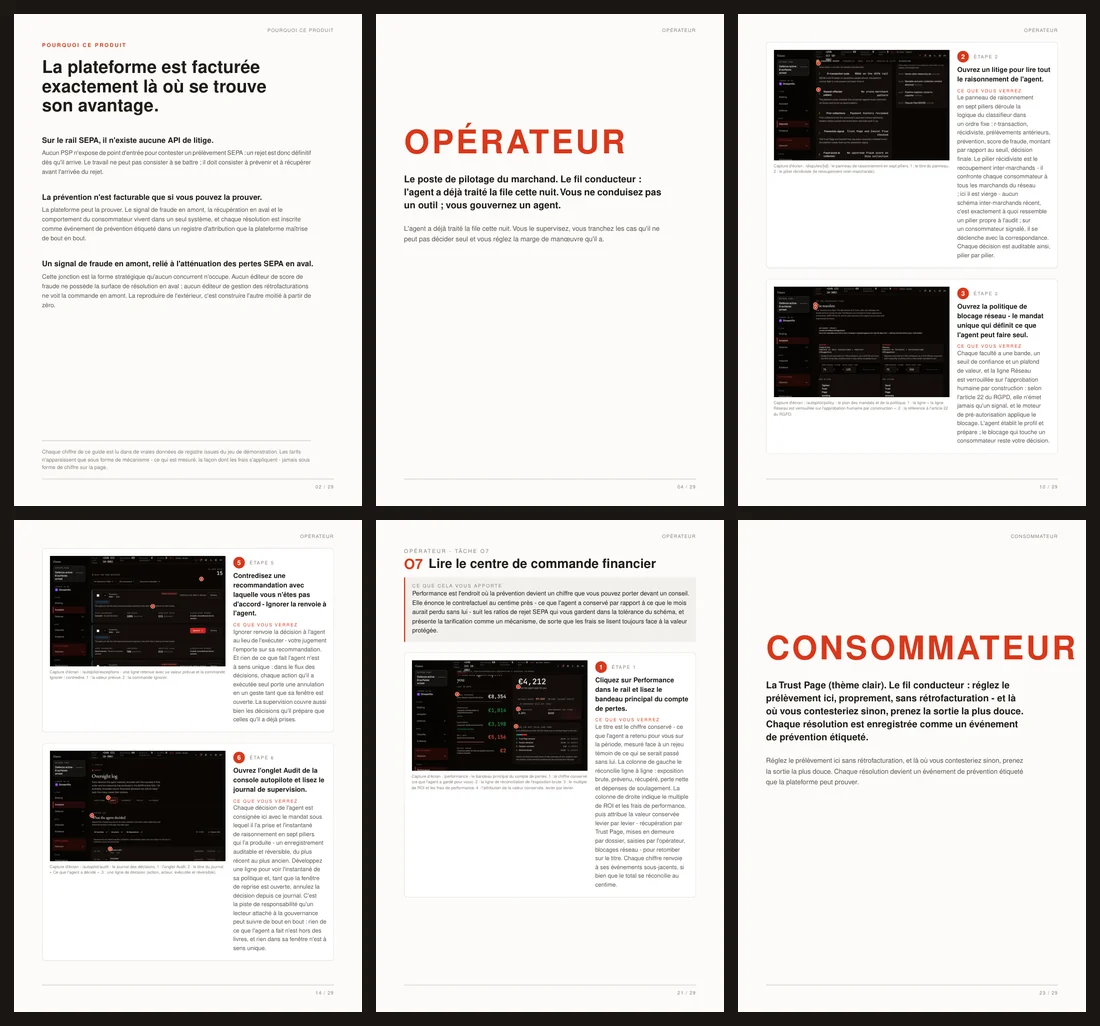
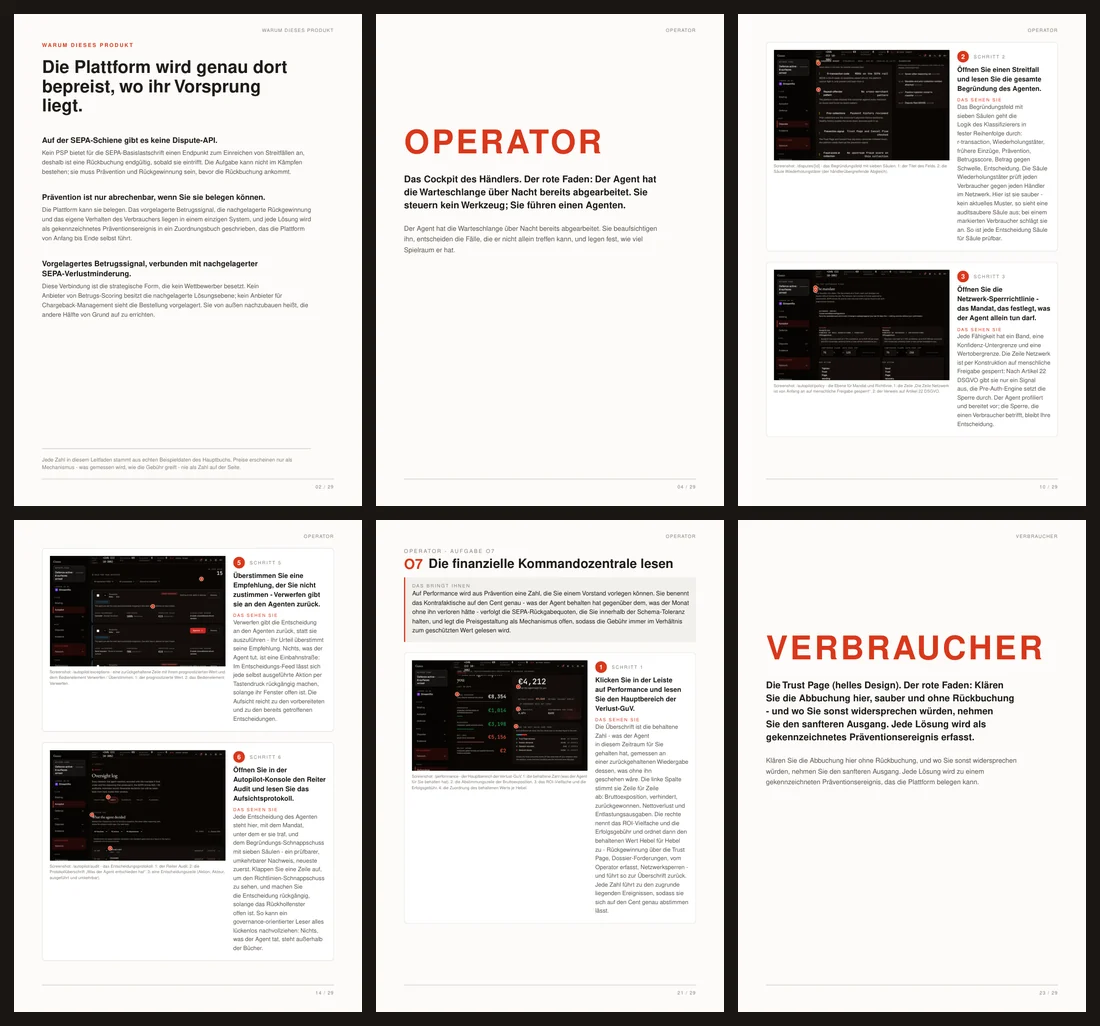
I handed Recura over on 21 June 2026 with this guide and its written procedures, the playbooks, so whoever runs it can run it without me.
The guide has nine tasks, seven for the payments team and two for customers. Every step is a screen of the working system, with what to press and what comes up.
A written procedure for every return and every exception




A team that meets a case it hasn’t seen opens its playbook and finds the same five parts every time: what happened, what Recura already did, what the team can do next, the usual edge cases, and the exact figure at which the case stops being routine.
I made the agent run on the playbooks the team reads. Before the team lets it do more alone, the playbooks show exactly what it will do.
Each playbook names the number at which to escalate, so a channel that has stopped working shows up as a figure, not as a month of losses.
- Links to customers’ own pages
- More than a fifth of a week’s links run out unused: the emails carrying them have stopped reaching customers.
What I made, and what the startup did next
I wrote the whole of Recura down first, as 204 functional and 86 non-functional requirements, and then built it myself. Every change to its payment code came with a test that fails on the old code and passes on the new one. It was in the startup’s hands on 21 June.
My three steps run from 9 May to the handover on 21 June. Since then hardly a month has passed without a partner, a milestone or a win for the startup, and each is public.
9 May
Platform in six layers, each valued in euros
Then
Platform recognises one customer across every business
21 June
Handover
24 June
MultiSafepay announces the partnership
2 July
Monta
25 August
Mollie
30 September
MultiSafepay makes it its preferred partner for disputes
8 October
Dutch semi-final of Mastercard For Fintechs won
24 June 2026
MultiSafepay, a Dutch payment provider, announced on its own blog that it was extending its chargeback handling through a partnership with the startup, for many payment methods and providers, Klarna among them.
2 July 2026
The startup partnered with Monta, whose fulfilment platform handles the warehousing and shipping of thousands of webshops: when a dispute comes in, the data Monta already holds is filed as the evidence.
25 August 2026
Mollie, which handles payments for more than 250,000 businesses, made the startup’s dispute handling available to all of them. Any of them can now choose to have its disputes handled automatically on cards, Klarna, Riverty and PayPal, with the evidence filed through Mollie’s own dispute portal. Emerce, The Paypers, MT Sprout and EU-Startups reported it the same day.
30 September 2026
MultiSafepay made the startup its preferred dispute and chargeback solution, for card and direct debit chargebacks as well as buy-now-pay-later disputes such as Klarna’s.
8 October 2026
At the Amsterdam Fintech Event, the startup won the Dutch semi-final of Mastercard For Fintechs 2026, picked by the jury over four other fintechs, for automating payment disputes and chargebacks for online retailers.
What I sell
I sell a Review, a Design and a Build, each on its own, on one payment flow you name, with a Change for one bounded change to a flow that already runs, at the fee its proposal states, and the pricing page sets all eight engagements side by side for whoever approves the purchase.
Working weeks, from the day each starts
- 0
- 2
- 4
- 6
- 8
- 10
- 12
Where I work on your payment flow
Review · €7,500
Ten working days, from complete inputs
No access to your systems
A written verdict, with the evidence behind it
Design · €30,000
Four to six working weeks, from complete inputs
Read-only access to what the proposal names
A written specification you hold
Build · From €75,000
Eight to twelve working weeks
Working access to the code, development and staging the proposal names
A working system, handed over
Whoever runs it
With its manual and a written procedure for each named failure
Review
The ten working days start once the inputs are complete and you have named the one person who acts on the verdict. I work from your documents, diagrams, past decisions and up to four people you name, an hour each, so a regulated company can buy it as an ordinary purchase. The verdict covers one payment flow and one decision, on a page that reads alone. The fee is set before I read anything and credited toward nothing else I sell, so a verdict that you need nothing more pays me the same as any other.
Design
The weeks start once the agreed inputs are available and you have named the one person who owns the decision, and the proposal names the delivery date. The specification is yours, in your repository if you have one, and an engineer who did not write it can build from it without asking me.
Build
The weeks start once the development and staging systems are ready; where you have none, I set them up first. The proposal names the scheduled acceptance date. A Build starts from a specification I have read and accepted; where there is none, I make it inside the Build. The proposal names who does each step, me included, and where you have engineers I set their part up with them. Whoever you choose makes the move into live systems, with me on the call.
With all three:
- Prices are in euros, excluding VAT, with nothing added: no expenses, travel, tools or licences.
- I do all of the work myself, and you are the only one who pays me: no processor, supplier or product pays me a commission, a referral fee or a success fee.
- Everything I make is kept in accounts in your own name from the first day.
- I sign your NDA before you share anything.
It started for the startup with one short paragraph and an open question. Bought today, what came of it, the money-moving part of a product built from that paragraph to a system with its manual, is a Platform: from €150,000, four to six months, the deciding done inside. Every flow of it is drawn and decided, and its tests signed, by a day the proposal names, at most six working weeks in, before any of it is coded, and its second payment is split equally among the flows, each share released when that flow’s first version runs in your staging. For the money a business sends out and what comes back to it, I have my own platform, Bilanx, and wherever it covers a flow, a Build or a Platform starts from it. Send me your own paragraph: one payment flow, and what is going wrong in it or what has to be decided, with nothing confidential.
Send me that paragraph, with nothing confidential in it.
By the end of the next Amsterdam business day, I reply with the first thing I’d check in your flow, which engagement it is, the next document, the date that document lands and its published price, or I tell you that none of the eight fits and where to go instead.
faruk@farukkurt.nlEmail
This opens in your own email app. You send it from there.
 Recura on one pageA one-page PDF of what Recura is, what it does for a business, and the project, 10 March to 26 June 2026, in which I built it.It’s written to be forwarded as it stands, to anybody you want to show it to. I send it by email when you ask, by the end of the next Amsterdam business day.open an email to me, asking for it